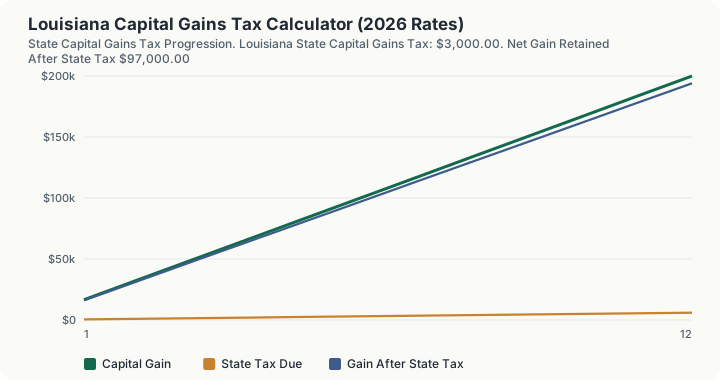
Quick Answer: On a $100,000 capital gain, Louisiana's flat 3.00% state tax adds $3,000.00 to your bill, leaving $97,000.00 after state tax.
After the Bracket Repeal
Louisiana taxes a realized capital gain at a flat 3.0%. On the default $100,000 gain the calculator returns $3,000.00 and $97,000.00 retained, and it reports 3.00% as both the effective and the marginal rate, because there is only one band for either to describe.
The graduated schedule Louisiana used before is repealed for taxable periods beginning on or after 1 January 2025, and the engine's table carries the Louisiana Department of Revenue page for that change as its source. This is why the other-income input on this page does nothing: the flat branch of calculateStateCapitalGains multiplies the gain by 0.03 and never looks at the second argument. Enter $75,000 of salary or none at all and a $100,000 gain still returns $3,000.00.
Two things are outside the figure and cannot be inferred from it. The engine's statutory relief routine is not switched on for this page, so any asset-specific Louisiana exclusion is unmodelled, and no federal layer is included: the $97,000.00 shown as retained is before federal capital gains tax and before the 3.8% net investment income surtax.
How This Is Calculated
Louisiana replaced its three-bracket schedule with a single 3.0% flat rate, and that rate applies to a capital gain exactly as it applies to salary. The change matters most to large gains, which previously reached the state top rate and now do not.
That makes the state computation a single multiplication, with the effective rate falling straight out of it.
The full sequence:
- Start with the net gain. Capital losses and loss carryforwards are netted first; what you enter is the net figure.
- No preferential rate. Louisiana has no separate capital gains rate and no long-term holding-period break, so the gain is taxed exactly as wages would be.
- Apply the rate. Multiply the net gain by 3.0%. Because the schedule is flat, your other income does not push the gain into a higher band, and the calculator does not need to stack the two.
- Effective rate. Total tax divided by realized gain, which on a flat schedule returns 3.0% at every gain size. Effective and marginal rates are the same number here.
- Net proceeds. Subtract the state tax from the gain to get what you keep before federal tax.
Worked Example
Consider an investor in Louisiana who realizes $100,000 in capital gains from a single asset sale during the year.
- Identify the gain. The full $100,000 capital gain is added to gross income, since Louisiana taxes capital gains at the same statutory rate as wages and other ordinary income, with no separate preferential rate for long-term holdings.
- Apply the flat rate. Louisiana's statutory individual income tax rate is a uniform 3.00%, applied to the entire gain regardless of the investor's total income or how long the asset was held.
- Compute the tax due. $100,000 × 3.00% = $3,000.00, the state tax liability on this sale.
- Net proceeds. Subtracting the $3,000.00 state tax from the $100,000 gain leaves the investor with $97,000.00 in state after-tax proceeds, before any federal capital gains tax is applied separately.
Because Louisiana applies one flat rate to every dollar of gain, the effective state tax rate here equals the statutory rate itself: 3.00%.
What Changes as the Gain Grows
The sweep below the calculator moves the gain from $16,666.67 to $200,000.00 in twelve steps and leaves other income where you put it. Tax runs from $500.00 on the first row to $6,000.00 on the last, with $3,000.00 at the $100,000 midpoint. Divide any row by its gain and you get 3.00%.
No boundary exists in this range, or in any range. Since the repeal there is no bracket edge in Louisiana's individual schedule, so the sweep contains no step, no cliff and no phase-out. A taxpayer who used to spread a disposal across years specifically to keep the top slice out of the old top bracket is now spreading it for no Louisiana benefit whatsoever. That is a real change in the planning answer, and it is visible in the table as a straight line where a graduated state shows a kink.
Marginal cost of the next unit. Each additional $1,000 of gain costs $30.00. Each additional $10,000 costs $300.00. Moving the input from $100,000 to $101,000 moves the headline from $3,000.00 to $3,030.00.
Working backwards. A $5,000 Louisiana tax bill corresponds to a gain of $166,666.67; a $10,000 bill to $333,333.34. Both return those tax figures exactly. A $450,000 gain, at the upper end of what a single property disposal typically produces, returns $13,500.00.
Where the number gets built wrong. The most expensive mistake is entering gross proceeds rather than the net gain. Sell for $450,000 an asset that cost $375,000 and the gain is $75,000, which returns $2,250.00. Enter the $450,000 sale price instead and the calculator returns $13,500.00, overstating Louisiana tax by $11,250.00 on one transaction. The input field takes any number and cannot tell which one you meant.
A second and quieter error is assuming the flat rate implies a flat total. Louisiana's combined state and average local sales tax is among the highest in the country, and Louisiana's local governments raise revenue in ways this income-tax page does not touch. Nothing on this page speaks to that; it computes one line of one return.
What This Does Not Account For
While this calculator provides penny-exact state statutory modeling, additional federal and transactional complexities warrant supplementary review: - Federal Capital Gains Taxes: Federal long-term brackets (0%, 15%, 20%) and short-term ordinary rates up to 37% under IRC § 1. - Net Investment Income Tax (NIIT): The 3.8% surtax on net investment income under IRC § 1411 for single filers over $200,000 (married joint over $250,000). - Alternative Minimum Tax (AMT): Federal AMT calculations under IRC § 55 impacting incentive stock option (ISO) exercise spread. - Section 1031 Like-Kind Exchanges: Tax deferral mechanisms for real property held for productive use in trade, business, or investment. - Qualified Small Business Stock (QSBS): Federal Section 1202 gain exclusions where state conformity varies significantly.
Common Pitfalls
- Assuming Federal Rate Parity: Most states do not offer preferential long-term capital gains rates; gains are taxed at standard ordinary income rates.
- Failing to Track Holding Periods: Short-term gains (assets held ≤1 year) generate higher federal tax liabilities even if state rates treat both holding periods identically.
- Underestimating Multi-State Apportionment: Selling real estate or business assets located in other jurisdictions triggers multi-state non-resident return filing obligations.
- Neglecting Underpayment Penalties: Substantial one-time liquidity events require prompt estimated tax payments within the quarter of sale to avoid statutory penalties.
- Mismatched Cost Basis Records: Failure to document reinvested dividends, stock splits, or structural return-of-capital distributions leads to inflated taxable gain calculations.
Frequently Asked Questions
Does Louisiana have a state capital gains tax?
How are short-term and long-term capital gains taxed in Louisiana?
Are retirement account distributions subject to capital gains tax in Louisiana?
Can capital losses offset capital gains in Louisiana?
When are estimated state tax payments required on capital gains?
Sources
- Louisiana Department of Revenue: 2026 Statutory Individual Income Tax Rate Schedules. revenue.louisiana.gov
- Internal Revenue Service (IRS): Publication 544 (Sales and Other Dispositions of Assets) and Publication 550 (Investment Income and Expenses). irs.gov/publications/p544