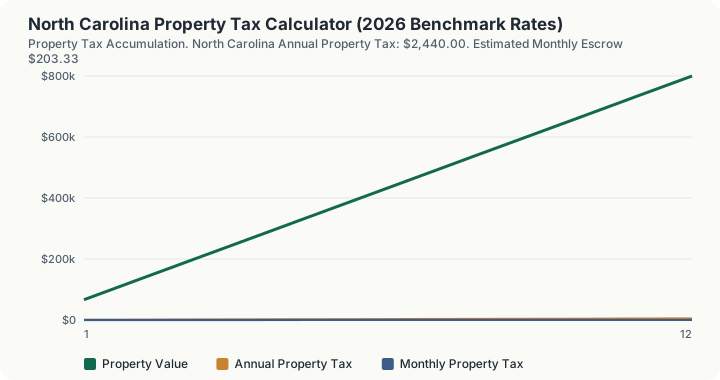
Quick Answer: A $400,000 home in North Carolina carries an estimated $2,440.00 in annual property tax at the state's 0.61% effective rate, or about $203.33 a month.
A Low Rate On A Rising Base
North Carolina homeowners pay an average effective property tax rate of 0.61%, which places the state at #36 of 50, below the national median. Measured against the roughly 1.0% average effective rate nationwide, North Carolina's number comes in noticeably below the national average of roughly 1.0%. Within the South, where the average effective rate runs near 0.79%, North Carolina sits meaningfully below the regional norm.
For buyers and investors evaluating North Carolina real estate, that rate is not just a sticker number: it funds the local school district, county services, and municipal budget that shape a property's long-run carrying cost and its resale economics.
County assessors in North Carolina carry out the periodic valuations that feed into the millage calculation, and the exemption and appeal process outlined further down this page is the practical way an individual owner can influence the final number on next year's bill rather than simply accepting the county's first estimate.
How This Is Calculated
North Carolina levies no state property tax at all, and requires counties to reappraise at 100% of market value at least once every eight years. That long cycle means a county's assessments can drift years behind the market, then reset in one move that redistributes the burden across every owner.
None of that detail is asked for here. This calculator works one level up, applying North Carolina's average effective property tax rate of 0.61% to the value you enter. That rate is the ratio of property taxes actually paid to home value across the state, so the assessment ratios, caps, and exemptions described above are already baked into it.
Working through it in order:
- Start from the county's appraised value. It holds fixed between reappraisals regardless of what the market does.
- Take off exclusions. The elderly and disabled homestead exclusion, the circuit breaker deferment, and the disabled veteran exclusion each reduce taxable value.
- Multiply by the effective rate. At 0.61%, a $400,000 home in North Carolina comes to $2,440 a year before any exemption you enter above.
- Divide by twelve for escrow. That same home works out to $203.33 a month set aside in a mortgage escrow account.
- Compare it against your own bill. In the year after a reappraisal counties must publish a revenue-neutral rate for comparison, which makes the shift visible. Your county's number is the one that governs; this figure tells you whether it is roughly where a North Carolina home of that value ought to land.
Worked Example
Using this calculator's baseline inputs: a $400,000 home in North Carolina, taxed at the state's 0.61% average effective rate (rank #36 of 50 states).
- Start with the assessed value. The home is assessed at its full $400,000.00 market value, with no homestead exemption applied in this baseline scenario.
- Apply the effective rate. $400,000.00 × 0.61% = $2,440.00 in annual property tax, North Carolina's statewide average effective rate.
- Convert to a monthly escrow. Lenders typically collect property tax in twelve equal installments alongside principal and interest: $2,440.00 ÷ 12 = $203.33 per month.
- Project a five-year hold. At a flat rate, five years of ownership totals $2,440.00 × 5 = $12,200.00, before any reassessment, exemption change, or millage increase.
At 0.61%, North Carolina lands below the middle nationally, ranking #36 of 50 states. That is a modest but still material carrying cost for homeowners.
Sweeping The North Carolina Valuation, And What The Table Will Not Show
North Carolina's 0.61% is the fourteenth lowest effective rate in the country, and because the engine applies it as one statewide figure the value sweep contains no bend at all.
What the next $10,000 of value adds. Raising the assessed value from $400,000 to $410,000 moves the annual tax from $2,440.00 to $2,501.00. Every additional $10,000 of North Carolina valuation costs exactly $61.00 a year, at every value the calculator accepts. Doubling the value to $800,000 doubles the tax to $4,880.00 to the cent.
Twelve rows, one slope. The table steps the value in increments of $66,666.67, from $66,666.67 in row one to $800,000 in row twelve, and the tax column rises by exactly $406.67 on every row without a single break. Row six carries the $2,440.00 baseline; row twelve carries $4,880.00, which is precisely double it.
The bill, read backwards into a value. Divide by 0.0061. A $10,000 annual bill corresponds to $1,639,344.26 of assessed value, and the $400,000 baseline is the value that produces the $203.33 monthly escrow line. Because the relationship is exactly linear with no cap, no cliff and no minimum, there is no valuation at which the arithmetic bends.
Where the exemption field reaches, and where it stops. Entering a $25,000 exemption reduces the taxable assessed value to $375,000 and the annual tax to $2,287.50, a saving of $152.50 a year against the $2,440.00 the page returns with the field at zero. That reduction reaches the headline, the monthly escrow figure and the twelve-row schedule alike. With $25,000 entered, row six prices $400,000 of value at $2,287.50, the same figure as the headline, and row one falls from $406.67 to $254.17. Because every row nets the same exemption off before applying the 0.61% rate, the table can be read straight across against the result above it rather than being treated as a separate gross-value answer.
Why a servicer's escrow line will not match. The escrow figure is where the common error lives. The monthly line the engine reports is $203.33, being $2,440.00 divided by twelve. Lenders frequently collect a cushion of up to two months on top, so a servicer's actual monthly draw on this property can run above $203.33 without any of the tax figures on this page being wrong. Comparing a servicer's escrow line directly against $203.33 and concluding the assessment is wrong is the mistake this page most often provokes.
What the rate is standing in for. North Carolina's 0.61% is a statewide average built from county and municipal rates that are set independently and stack where a property sits inside a municipality. The engine holds no county table, so the $2,440.00 is a benchmark. North Carolina also revalues on a county-by-county cycle of up to eight years, so a single reassessment can move a real bill by more than any figure on this page varies.
What This Does Not Account For
- Specific hyper-local county and municipal millage district variations within North Carolina.
- Special assessment or improvement district charges. Some North Carolina municipalities levy additional assessments on benefiting parcels for street, drainage, or sewer improvements on top of the base county and municipal millage; the specific list of districts varies by municipality.
- Commercial vs residential assessment classification differentials.
- Property tax appeal reductions or localized board of equalization adjustments.
Common Pitfalls
- Confusing Market Fair Value with Assessed Basis: Some jurisdictions assess property at fractional ratios rather than 100% of market value.
- Failing to File Homestead Paperwork: Homestead exemptions are rarely automatic; homeowners must file timely paperwork with the county appraisal district.
- Underestimating Post-Sale Supplemental Assessments: Purchasing a newly constructed or reassessed property often triggers catch-up supplemental tax bills.
- Ignoring Property Tax Appeal Windows: Missing the annual 30-to-60 day statutory protest window forfeits the right to challenge over-assessed property values for that tax year.
Frequently Asked Questions
How high are property taxes in North Carolina?
When are property taxes due in North Carolina?
How can I lower my property taxes in North Carolina?
Does purchasing a home trigger a property tax reassessment?
Sources
- U.S. Census Bureau: American Community Survey (ACS) Real Estate Assessment Benchmark Data. census.gov/programs-surveys/acs
- North Carolina Department of Revenue, Property Tax Division: Assessment Ratio Manuals. ncdor.gov