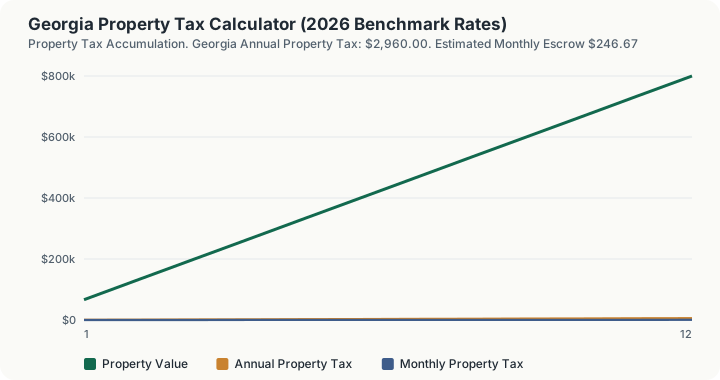
Quick Answer: A $400,000 home in Georgia carries an estimated $2,960.00 in annual property tax at the state's 0.74% effective rate, or about $246.67 a month.
Georgia's Rate Against Its Neighbors
At an average effective rate of 0.74%, Georgia ranks #28 among the 50 states (tied with Indiana), putting it below the national median. Nationally, the average effective rate runs close to 1.0%, well above Georgia's rate. That's also below the South regional average of about 0.79%.
As in most of the South, property tax revenue in Georgia funds local school districts, county services, and municipal budgets rather than flowing through a state-level general fund, so the rate is effectively set locally even though the average is reported statewide.
Because assessment and appeal procedures in Georgia are administered locally rather than by a single statewide office, the exact timeline for a reassessment or an appeal can vary by county. The sections below outline the exemptions and appeal windows generally available to owners who want to contest a valuation.
How This Is Calculated
Georgia assesses property at 40% of fair market value, a ratio applied uniformly across all 159 counties, and grants a statewide homestead exemption of $2,000 off that assessed figure. Counties and school districts then stack their own, often much larger, local homestead exemptions on top, so two counties with the same millage can produce very different bills.
None of that detail is asked for here. This calculator works one level up, applying Georgia's average effective property tax rate of 0.74% to the value you enter. That rate is the ratio of property taxes actually paid to home value across the state, so the assessment ratios, caps, and exemptions described above are already baked into it.
Working through it in order:
- Start from fair market value. The county board of tax assessors sets it, and 40% of that becomes the assessed value.
- Take off exemptions. The $2,000 statewide homestead exemption applies first, then whatever local exemption your county and school district have adopted.
- Multiply by the effective rate. At 0.74%, a $400,000 home in Georgia comes to $2,960 a year before any exemption you enter above.
- Divide by twelve for escrow. That same home works out to $246.67 a month set aside in a mortgage escrow account.
- Compare it against your own bill. The statewide exemption is small enough that the local ones do most of the work on a Georgia bill. Your county's number is the one that governs; this figure tells you whether it is roughly where a Georgia home of that value ought to land.
Worked Example
Using this calculator's baseline inputs: a $400,000 home in Georgia, taxed at the state's 0.74% average effective rate (rank #28 of 50 states, tied with Indiana).
- Start with the assessed value. The home is assessed at its full $400,000.00 market value, with no homestead exemption applied in this baseline scenario.
- Apply the effective rate. $400,000.00 × 0.74% = $2,960.00 in annual property tax, Georgia's statewide average effective rate.
- Convert to a monthly escrow. Lenders typically collect property tax in twelve equal installments alongside principal and interest: $2,960.00 ÷ 12 = $246.67 per month.
- Project a five-year hold. At a flat rate, five years of ownership totals $2,960.00 × 5 = $14,800.00, before any reassessment, exemption change, or millage increase.
At 0.74%, Georgia lands roughly in the middle nationally, ranking #28 of 50 states (tied with Indiana). That is a moderate but still material carrying cost for homeowners.
The Forty Percent Assessment Trap, Priced
Georgia's 0.74% effective rate ranks 28th nationally, and the twelve rows above are one rate applied twelve times. The engine does not read a county millage, an assessment ratio or a homestead schedule; it multiplies market value less your exemption entry by 0.0074 and divides by twelve for escrow.
The trap. Georgia assesses residential property at 40% of fair market value, and county mill rates are quoted against that 40% figure. The 0.74% here is an effective rate that already contains the 40%, so it goes on the full market value. Entering the assessed value instead is the single most common error on a Georgia property tax page: $160,000, which is 40% of the $400,000 baseline, returns $1,184.00 against the correct $2,960.00. The mistake understates the bill by $1,776.00 a year, or 60% of it, and it does so at every value on the sweep.
Two rungs of the sweep. Row 5 sets the value at $333,333.33 and returns $2,466.67 a year, $205.56 a month. Row 6 is the $400,000 baseline at $2,960.00 and $246.67. The $66,666.67 between the rungs is worth $493.33 a year, the same amount row 1 charges on an entire $66,666.67 parcel.
The marginal figure. Each additional $10,000 of Georgia market value costs $74.00 a year, $6.17 a month. The engine returns $3,034.00 at $410,000 against $2,960.00 at $400,000.
The reverse question. A $5,000 annual property tax budget supports $675,675.68 of Georgia market value; the engine returns exactly $5,000.00 and $416.67 a month there. That is a useful number for anyone moving up the market, because it prices the ceiling directly rather than making you iterate on the purchase price.
Georgia's homestead exemption, converted. The state standard homestead exemption is $2,000 of assessed value, which at the 40% ratio is $5,000 of market value. Entered as $5,000, the engine returns $2,923.00, a $37.00 annual saving. Entered naively as $2,000 it returns $2,945.20, and the $22.20 gap between the two is the whole of the conversion error. The engine subtracts the exemption from market value, never from assessed value, so every Georgia exemption quoted in assessed dollars must be divided by 0.40 before it goes in that field. Local floating homestead exemptions and the statewide assessed-value cap adopted under HB 581 are not modelled at all.
What This Does Not Account For
- Specific hyper-local county and municipal millage district variations within Georgia.
- Community Improvement District (CID) assessments. Georgia law lets commercial property owners in a defined area, common in metro Atlanta corridors like Cumberland and Perimeter, self-impose additional millage (up to 2.5% of assessed value) to fund shared infrastructure; the equivalent for single-family residential parcels is uncommon in Georgia.
- Commercial vs residential assessment classification differentials.
- Property tax appeal reductions or localized board of equalization adjustments.
Common Pitfalls
- Confusing Market Fair Value with Assessed Basis: Some jurisdictions assess property at fractional ratios rather than 100% of market value.
- Failing to File Homestead Paperwork: Homestead exemptions are rarely automatic; homeowners must file timely paperwork with the county appraisal district.
- Underestimating Post-Sale Supplemental Assessments: Purchasing a newly constructed or reassessed property often triggers catch-up supplemental tax bills.
- Ignoring Property Tax Appeal Windows: Missing the annual 30-to-60 day statutory protest window forfeits the right to challenge over-assessed property values for that tax year.
Frequently Asked Questions
How high are property taxes in Georgia?
When are property taxes due in Georgia?
How can I lower my property taxes in Georgia?
Does purchasing a home trigger a property tax reassessment?
Sources
- U.S. Census Bureau: American Community Survey (ACS) Real Estate Assessment Benchmark Data. census.gov/programs-surveys/acs
- Georgia Department of Revenue, Local Government Services Division: Assessment Ratio Manuals. dor.georgia.gov