Quick Answer: Utah has no state-level estate tax, so a $5,000,000 estate owes $0 in Utah estate tax. Federal exemption rules apply separately.
Utah's Estate Tax Position in One Line
Utah charges no estate tax and no inheritance tax, and every state it borders is in the same position.
Utah is one of 38 states that impose no separate estate tax, relying instead entirely on the federal system, which exempts more than $15,000,000 per individual for 2026 before any tax applies.
Executors administering an Utah estate can skip the state exemption calculation entirely and focus on the federal Form 706 threshold: the only filing that determines whether any death tax is owed at all.
Federal portability rules still apply in Utah exactly as they would anywhere else, letting a surviving spouse claim a deceased spouse's unused federal exemption on top of their own: a benefit entirely independent of Utah's lack of a state tax.
Utah is a Mountain West state with one of the youngest, fastest-growing populations, which shapes plenty about who lives here but not the tax math: because there's no state exemption to model, an Utah estate's tax bill is entirely a function of the federal calculation, deductions and all.
How This Is Calculated
There is no Utah estate tax statute, so there is no exemption to clear and no rate schedule to walk. The calculator confirms that rather than computing against a threshold, and the state tax line is $0 at every estate size.
- Value the gross estate. Fair market value at the date of death of all real property, business interests, securities, cash, and life insurance proceeds the decedent owned.
- Subtract allowable deductions. Debts, administrative expenses, qualifying charitable bequests, and the unlimited marital deduction come off the gross figure. This is bookkeeping here rather than tax math, since no state rate is applied to the result.
- Look Utah up in the state table. It is not among the twelve states that impose an estate tax, so no exemption threshold or bracket schedule is loaded.
- Return $0. The net estate passes to beneficiaries with no Utah reduction, whether it is $500,000 or $50,000,000.
The federal estate tax is a separate return with its own exemption, above $15,000,000 per individual for 2026, and this calculator does not compute it. It also does not carry over a deceased spouse's unused federal exemption, add back lifetime taxable gifts, or apply the generation-skipping transfer tax.
Worked Example
- Start with the gross estate. This example uses a $5,000,000 gross estate: the fair market value of all real property, business interests, equities, cash, and life insurance the decedent owned at death, before deductions.
- Check Utah's estate tax status. Utah is one of the 38 states with no separate state-level estate tax, so there is no state exemption threshold or bracket schedule to apply.
- Compute the state estate tax due. Because Utah taxes no estates at any size, the calculator returns $0.00 in state tax. A $5,000,000 estate and a $50,000,000 estate both owe Utah nothing.
- Distribute the net estate. With no state tax subtracted, the full $5,000,000.00 gross estate passes to beneficiaries as the net estate distributed.
- What this excludes. This is Utah's state-level result only; federal estate tax is computed separately against the $15,000,000+ federal exemption per individual for 2026 on IRS Form 706.
Zero to a Billion: The Sweep That Never Leaves the Axis
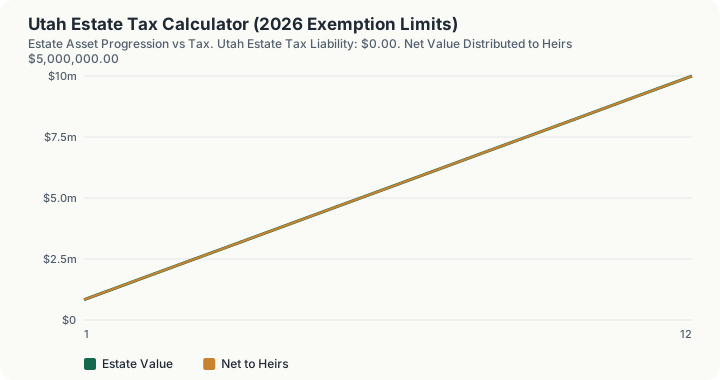
The interesting thing about a Utah estate calculation is how far you can push the inputs before anything moves. Sweeping grossEstateValue in million-dollar steps from $0 to $5,000,000 gives $0.00 at every stop, with a step delta of $0.00. The twelve-row schedule at the $5,000,000 default runs from $833,333.33 up to $10,000,000.00 of estate value and reports $0.00 of tax on all twelve rows, so the Net to Heirs column matches the Estate Value column exactly at every tier. At the input's ceiling, $1,000,000,000, the Utah estate tax is still $0.00 and the full $1,000,000,000.00 is reported as distributed.
The marginal number
Each additional $1,000,000 of estate costs $0.00 in Utah estate tax. The effective rate output holds at 0.00% from the first dollar to the billionth. There is no bottom band and no top band, which is why nothing on this page quotes a rate range the way the Rhode Island or Oregon pages do.
The reverse question has no answer, and that is the answer
How large can a Utah estate grow before the state takes a share? Within the domain the calculator accepts, up to $1,000,000,000 of gross estate and up to $100,000,000 of deductions, it never does. That is worth stating as a computed result rather than as a claim, because it is the one question this page is asked most and the sweep answers it at every point rather than at one.
A $0.00 that is easy to misread
exemptionThreshold reports $0.00 here. The engine reaches that value by checking the state table's hasEstateTax flag, finding it false for Utah, and returning zeros for the exemption, the taxable estate above the exemption and the tax due without reading the row's rate or bracket fields at all. The output cannot distinguish "no exemption exists" from "the exemption is zero dollars", and only the first is true of Utah. Treat the $0.00 exemption line as a status flag rather than as a number to compute against.
Priced against the neighbour that does tax estates
Utah borders a state with one of the lowest estate tax exemptions in the country, and running the same estate through both is the sharpest way to size the error. A $5,000,000 estate returns $0.00 on this page. The identical $5,000,000 through the Oregon calculator on this engine returns $425,000.00, an 8.50% effective rate against a $1,000,000 exemption, leaving $4,575,000.00 to heirs rather than the full $5,000,000.00. An executor who accrued on the Oregon pattern would withhold $425,000 from a Utah estate that owes nothing.
The same comparison shows why residency and asset situs matter more here than any input on this page: the calculator takes one state, one gross value and one deduction figure. It does not apportion an estate between Utah and a taxing state, and it does not model the federal estate tax in any form, so the $0.00 headline is a single-state answer with no federal component in it.
What This Does Not Account For
- Federal generation-skipping transfer (GST) tax under IRC Chapter 13.
- Ancillary probate requirements for real property situated in other jurisdictions.
- Complex liquidity discounts for minority non-voting family business entities.
- State-specific inheritance taxes levied directly on beneficiaries (e.g. PA, NJ, MD, KY, NE).
Common Pitfalls
- Assuming State Exemption Matches Federal: Forgetting that states like Oregon ($1.0M) and Massachusetts ($2.0M) tax estates far below the federal threshold.
- The "Cliff" Effect in Specific States: Failing to recognize that states like New York eliminate the exemption entirely if the estate exceeds 105% of the threshold.
- Out-of-State Real Property Exposure: Holding real estate in states with active estate taxes exposes non-resident estates to proportional state estate taxes.
- Failing to Fund Revocable Living Trusts: Assets held outside trust structures are subjected to public probate proceedings and statutory executor fees.
Frequently Asked Questions
Does Utah have a state estate tax?
Does Utah have an inheritance tax?
When is state estate tax due?
What assets are included in the taxable estate?
Sources
- Utah State Tax Commission: General state tax administration; Utah levies no state-level estate tax, so only the federal estate tax applies. tax.utah.gov