Quick Answer: A $400,000 home in Utah carries an estimated $1,960.00 in annual property tax at the state's 0.49% effective rate, or about $163.33 a month.
Overview
With a statewide average effective property tax rate of 0.49%, Utah sits at #41 nationally, tied with Colorado, among the ten lowest effective property tax rates in the country. That is noticeably below the national average of roughly 1.0%, based on the average effective rate across all 50 states. Compared with the rest of the West, which averages roughly 0.71%, Utah lands below its neighbors.
That revenue underwrites the basics (public schools, county government, emergency services), the same way it does across most of the West, though the specific mix of school, county, and municipal millage varies by jurisdiction within Utah.
Assessments are handled at the county level in Utah, where local appraisers periodically revalue residential and commercial parcels and apply the applicable millage rates; homestead exemptions and formal appeals remain the main levers available to individual owners looking to manage the bill, alongside any local bond measures voters approve along the way.
How This Is Calculated
Utah exempts 45% of the fair market value of a primary residence, so a home is taxed on 55% of what it is worth while a second home is taxed on all of it. A certified tax rate then adjusts each year to keep revenue from a given levy roughly flat as values rise.
None of that detail is asked for here. This calculator works one level up, applying Utah's average effective property tax rate of 0.49% to the value you enter. That rate is the ratio of property taxes actually paid to home value across the state, so the assessment ratios, caps, and exemptions described above are already baked into it.
Two of the five steps below are what the engine performs. Steps 3 and 4 are the calculation; steps 1, 2 and 5 describe the county process the effective rate is an average of, and no input on this page collects any of it:
- Start from fair market value. County assessors value annually, and the 45% residential exemption produces taxable value.
- Confirm primary residence status. The exemption applies only to a primary residence, and rental property qualifies only under specific conditions.
- Multiply by the effective rate. At 0.49%, a $400,000 home in Utah comes to $1,960 a year before any exemption you enter above.
- Divide by twelve for escrow. That same home works out to $163.33 a month set aside in a mortgage escrow account.
- Compare it against your own bill. Because the certified rate is revenue neutral, an Utah owner whose value rose less than the county average can see a bill fall. Your county's number is the one that governs; this figure tells you whether it is roughly where an Utah home of that value ought to land.
Worked Example
Using this calculator's baseline inputs: a $400,000 home in Utah, taxed at the state's 0.49% average effective rate (rank #41 of 50 states, tied with Colorado).
- Start with the assessed value. The home is assessed at its full $400,000.00 market value, with no homestead exemption applied in this baseline scenario.
- Apply the effective rate. $400,000.00 × 0.49% = $1,960.00 in annual property tax, Utah's statewide average effective rate.
- Convert to a monthly escrow. Lenders typically collect property tax in twelve equal installments alongside principal and interest: $1,960.00 ÷ 12 = $163.33 per month.
- Project a five-year hold. At a flat rate, five years of ownership totals $1,960.00 × 5 = $9,800.00, before any reassessment, exemption change, or millage increase.
At 0.49%, Utah carries one of the lightest property tax burdens nationally, ranking #41 of 50 states, tied with Colorado, though actual bills still vary by county and municipality.
What Each $10,000 Of Assessed Value Adds
The marginal cost of the next $10,000 of value. Moving the entered value from $400,000 to $410,000 moves the annual bill from $1,960.00 to $2,009.00. Every additional $10,000 of Utah value costs $49.00 a year, or $4.08 a month in escrow, and it costs exactly that at every point in the sweep because the engine applies one rate to the whole value with no bands, no floor and no cap.
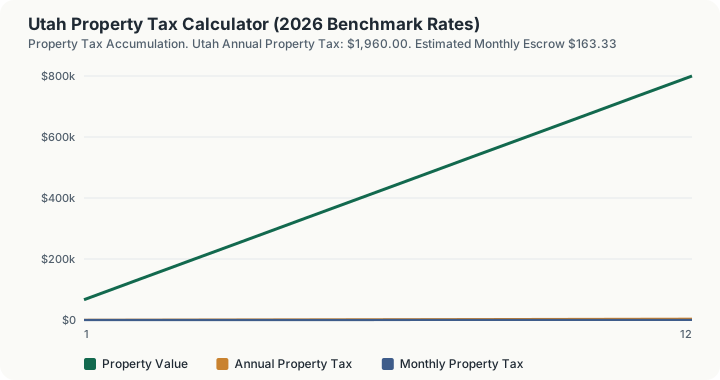
The sweep, end to end. The twelve-row table walks the entered value in sixths, from one sixth to twice it. At the first row, $66,666.67 of value, the bill is $326.67. At row six, the $400,000 default, it is $1,960.00. At row twelve, $800,000, it is $3,920.00, or $326.67 a month. Doubling the value doubles the tax to the cent, which is the clearest possible statement of what this calculator is: an effective-rate multiplication, not a millage computation.
The reverse question. A buyer with a fixed monthly escrow budget can read the sweep backwards. $163.33 a month supports a $400,000 assessment at 0.49%; $326.67 a month supports $800,000. To pay no more than $2,450.00 a year, the value has to stay at or under $500,000, which the engine confirms directly: $500,000 returns $2,450.00.
Right method against wrong method, priced. Enter a $25,000 homestead exemption and the headline falls from $1,960.00 to $1,837.50, a saving of $122.50. Now read the schedule underneath it: row six still shows $1,960.00. That is not a display bug, it is what the code does. The exemption is subtracted from the value before the headline is computed, but the twelve-row sweep is built from the entered value with the exemption never applied, so every row of the table is the no-exemption figure. Sizing a purchase off the table while quoting the headline double-counts nothing and single-counts wrongly: at a $50,000 exemption the headline is $1,715.00 and the gap to the table widens to $245.00.
What the effective rate is a ratio of, and what it is not. The 0.49% figure is total Utah property tax actually paid divided by market value, taken across the state. It is not a millage rate and it is not a rate to apply to a locally assessed figure. Utah taxes 55% of the fair market value of a primary residence, and entering $220,000 rather than $400,000 to reflect that returns $1,078.00 instead of $1,960.00, understating the bill by $882.00. The 45% residential exemption is already inside the 0.49% figure.
The one number on this page that carries no arithmetic. The national rank of 41st is read straight out of the same table as the rate and is not computed from the value entered. It does not move anywhere in the sweep, and it will read the same at $66,666.67 of value as at $800,000.
What This Does Not Account For
- The homestead exemption is applied to the headline only. The twelve-row schedule is built from the entered value with no exemption subtracted, so at a $25,000 exemption the table reads $1,960.00 at the default row while the headline reads $1,837.50.
- There is no threshold anywhere in this calculation. No band, no cliff, no cap and no phase-out exists in the code path, so no value in the sweep produces a step change in the rate.
- Specific hyper-local county and municipal millage district variations within Utah.
- Public Infrastructure District (PID) and Special Improvement District assessments. Newer Utah subdivisions can sit inside one of the roughly 70 PIDs statewide, which levy an additional property tax (capped at 0.005 of taxable value) or assessment to repay bonds for roads, water, and utility infrastructure, layered on top of the base county and school millage.
- Commercial vs residential assessment classification differentials.
- Property tax appeal reductions or localized board of equalization adjustments.
Common Pitfalls
- Confusing Market Fair Value with Assessed Basis: Some jurisdictions assess property at fractional ratios rather than 100% of market value.
- Failing to File Homestead Paperwork: Homestead exemptions are rarely automatic; homeowners must file timely paperwork with the county appraisal district.
- Underestimating Post-Sale Supplemental Assessments: Purchasing a newly constructed or reassessed property often triggers catch-up supplemental tax bills.
- Ignoring Property Tax Appeal Windows: Missing the annual 30-to-60 day statutory protest window forfeits the right to challenge over-assessed property values for that tax year.
Frequently Asked Questions
How high are property taxes in Utah?
When are property taxes due in Utah?
How can I lower my property taxes in Utah?
Does purchasing a home trigger a property tax reassessment?
Sources
- U.S. Census Bureau: American Community Survey (ACS) Real Estate Assessment Benchmark Data. census.gov/programs-surveys/acs
- Utah State Tax Commission: Property Tax Assessment Guidance. tax.utah.gov