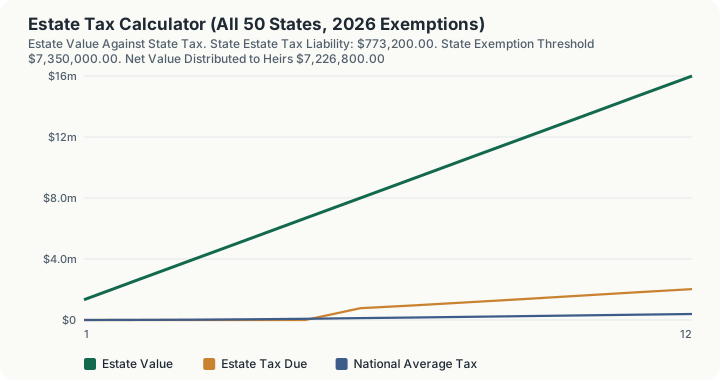
Quick Answer: An $8,000,000 estate domiciled in New York owes $773,200.00 in state estate tax for 2026, an effective rate of 9.67%, leaving $7,226,800.00 before federal tax. That is $647,328.12 above the $125,871.88 the same estate averages across the 50 states, and ranks New York 2nd of 50.
Overview
Twelve states levy an estate tax of their own, and thirty-eight do not. Where a state does levy one, its exemption is usually far below the federal exemption, so an estate that owes nothing federally can still owe a state several hundred thousand dollars. Domicile is what decides which of the twelve, if any, applies.
This page takes an estate value, applies the selected state's exemption and rate schedule, and then computes the same estate in the other 49 states so the domicile question has a number attached to it. On an $8,000,000 estate, thirty-nine states take nothing, Oregon takes the most at $802,500.00, and New York takes $773,200.00.
The gap between neighbouring states is often larger than any planning technique available inside one of them. That is the whole reason a national view is worth having before you look at any single state's rules.
How This Is Calculated
- Subtract deductions from the gross estate. Marital, charitable and administrative deductions all enter as one figure you supply. The result floors at zero.
- Look up the state. If the state levies no estate tax, the answer is $0.00 and the exemption shows as $0.00. That is thirty-eight states.
- Compare the net estate to the exemption. At or below it, no tax. New York's 2026 exemption is $7,350,000.
- Apply that state's rate schedule. Most of the taxing states run graduated brackets defined on the whole estate value, not on the excess over the exemption, so the tax jumps once the exemption is passed rather than starting at zero and rising smoothly. Massachusetts and Rhode Island instead compute a credit-table amount on the whole estate and subtract a flat credit. Illinois uses its own circular calculation. Each of these is implemented separately in the engine.
- New York's cliff. New York phases its exclusion down linearly between the exemption and 105% of it, then removes it entirely. Below $7,350,000 there is no tax. At $7,700,000, inside the phase-out, the tax is $721,690.00. At $8,000,000, past the 105% cliff of $7,717,500, the exclusion is gone and the full table applies to the whole estate: $773,200.00. An extra $300,000 of estate value carries $51,510 of extra tax there, and an extra $350,000 above the exemption carries the first $721,690.
The national comparison then repeats steps 2 through 5 for all 50 states on the same net estate.
- Average and rank. The mean across the 50 states on an $8,000,000 estate is $125,871.88, which counts each of the thirty-nine states owing nothing as zero. New York is $647,328.12 above that mean and ranks 2nd, behind Oregon. Rank 1 is the largest tax, and tied states share a rank, so every state owing nothing on this estate sits together.
The effective rate reported is the state tax divided by the net estate: $773,200.00 / $8,000,000 = 9.67%.
Worked Example
An $8,000,000 estate with no deductions, comparing four domiciles.
- New York. Exemption $7,350,000, so the estate clears it by $650,000 and lands past the 105% cliff at $7,717,500. The full bracket table applies to the whole $8,000,000: $773,200.00, or 9.67%. Heirs receive $7,226,800.00 before federal tax.
- Oregon. Exemption $1,000,000, the lowest in the country, and the estate clears it by $7,000,000. Tax $802,500.00, or 10.03%, the highest of the 50 states on this estate.
- Washington. Exemption $3,000,000. Tax $730,000.00, or 9.13%.
- Florida. No state estate tax. Tax $0.00, and all $8,000,000 passes before federal tax.
- The comparison. Moving this estate from Oregon to Florida is worth $802,500.00. Moving it from New York to Florida is worth $773,200.00. The 50-state average is $125,871.88, which tells you that most states are Florida.
Two variations on New York show how sharp the cliff is. At $7,000,000, below the exemption, the tax is $0.00. At $7,700,000, inside the phase-out band, it is $721,690.00. A $700,000 increase in estate value moves the state tax from nothing to over $700,000, which is the single most consequential fact on this page for a New York estate near the threshold.
What This Does Not Account For
- Federal estate tax. Only state estate tax is computed. The federal exemption is much higher than every state exemption here, but for estates that exceed it the federal liability is the larger number, and the state tax is deductible against the federal estate tax base.
- State inheritance tax. Five states levy a beneficiary-paid inheritance tax rather than, or in addition to, an estate tax: Pennsylvania, Nebraska, Maryland, Kentucky and New Jersey. Rates there depend on the beneficiary's relationship to the decedent, and none of that is modelled here. Maryland is the one state that levies both.
- Portability and the deceased spouse's unused exclusion. The federal exemption is portable between spouses. Most state exemptions are not, which is why credit shelter trusts remain common in the twelve taxing states.
- The specifics of your deductions. Marital, charitable, debt, mortgage and administrative deductions all enter as one number you supply. Their eligibility rules are not tested.
- Property in more than one state. Real property is generally taxed by the state where it sits, regardless of domicile, so an estate can face two states at once.
- Trust structures, business valuation discounts and lifetime gifting. Every one of these changes the taxable estate before this calculation begins.
- Rate schedules changing. These are 2026 figures. Several states index their exemptions annually, and legislatures revisit both exemptions and rates often.
Common Pitfalls
- Assuming no federal liability means no tax. A $5,000,000 estate is far under the federal exemption and still owes Oregon, Massachusetts, Rhode Island, Washington, Minnesota and Illinois.
- Reading a state's tax as applying only to the excess. In most of these states the graduated schedule runs on the whole estate value, so the first dollar above the exemption drags a large tax with it. New York is the extreme version: past the cliff the exclusion vanishes entirely.
- Confusing estate tax with inheritance tax. An estate tax is paid by the estate before distribution. An inheritance tax is paid by each beneficiary on what they receive, at a rate that depends on how closely related they were. Maryland levies both.
- Assuming a move settles it. Domicile is a factual question about where you actually live, and states with an estate tax audit claimed changes of domicile carefully. Real property left behind stays taxable where it sits.
- Overlooking the marital deduction in the entry. Assets passing outright to a surviving spouse are generally deductible. Running the gross estate without entering that deduction can produce a tax figure that will never be owed.
Frequently Asked Questions
Which states have an estate tax?
Which state has the lowest exemption?
What is the New York estate tax cliff?
Does the estate tax apply where I live or where my property is?
What happens if my estate is below the exemption?
Sources
- Internal Revenue Service, the official authority for the tax rules this calculator relates to. irs.gov
Also consulted: New York Form ET-706 and its instructions: the estate tax rate table and the worksheet that phases down the applicable credit between the exemption and the 105% cliff; State statutory codes and department of revenue publications: exemption amounts and bracket schedules for the twelve taxing states, including Hawaii Form M-6 instructions and Washington's RCW 83.100.040 rate schedule.