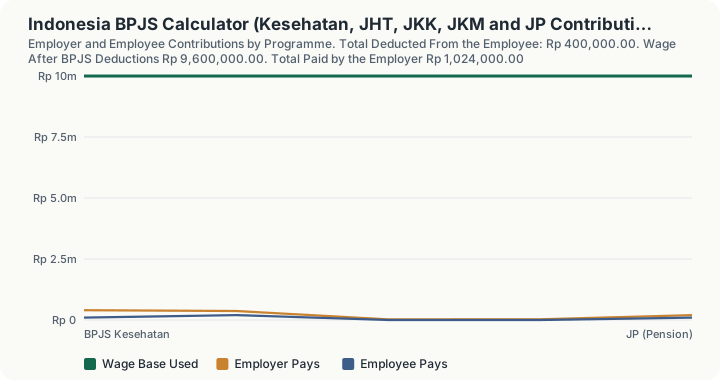
Quick Answer: On a Rp 10,000,000 monthly wage, Rp 400,000 is deducted from the employee across the five BPJS programmes, leaving Rp 9,600,000. The employer pays a further Rp 1,024,000, so the total cost of employing that person is Rp 11,024,000 a month. The employee bears 4% of wage and the employer 10.24%.
What does this calculator do?
Indonesian social insurance is not one scheme but five, split across two institutions. BPJS Kesehatan runs health cover. BPJS Ketenagakerjaan runs four employment programmes: JHT old age savings, JKK work accident cover, JKM death benefit, and JP pension. Each has its own rate, its own employer and employee split, and, crucially, its own treatment of high wages.
That last point is where most calculations go wrong. There is no single BPJS wage ceiling. There are three different situations:
BPJS Kesehatan has a ceiling of Rp 12,000,000 a month. It has been fixed at that figure since 2020 and is not indexed to anything, so it quietly erodes in real terms every year.
JHT, JKK and JKM have no ceiling at all. They are charged on the whole wage however high it goes, which means a senior executive's employer keeps paying 4.24% or more on the full salary indefinitely.
JP pension has a ceiling that is reindexed every single year, by a factor of one plus the previous year's GDP growth. A figure that was right last March is wrong this March.
A model that applies one ceiling to everything gets high earners wrong in two directions simultaneously: it under-charges the uncapped programmes and over- or under-charges the two capped ones. This calculator runs each programme on its own base and shows all five separately.
How is this calculated?
Each programme is charged on its own base. First the bases:
Kesehatan Base = min(max(Wage, Local Minimum Wage), Rp 12,000,000)
JP Base = min(Wage, JP Ceiling)
JHT, JKK, JKM Base = Wage, uncapped
Then the rates are applied. BPJS Kesehatan is 5% of the base, split 4% employer and 1% employee. JHT is 5.7%, split 3.7% employer and 2% employee. JP is 3%, split 2% employer and 1% employee. JKK is charged wholly to the employer at one of five rates set by industry risk class: 0.24%, 0.54%, 0.89%, 1.27% or 1.74%. JKM is 0.30%, also wholly employer-borne.
Contribution = Programme Base × Programme Rate
The employee's take-home is the wage less the employee-side amounts, and the employer's total cost is the wage plus the employer-side amounts.
One further distinction matters for income tax. Only the JHT and JP employee contributions are deductible against PPh 21 gross income. The BPJS Kesehatan employee contribution is not, so the calculator reports the deductible figure separately rather than lumping all three together.
Worked Example
An office employee in a very low risk industry earns Rp 10,000,000 a month, which is below every ceiling.
Step 1: Health contribution at 5% of the wage.
Rp 10,000,000 × 4% = Rp 400,000 employer
Rp 10,000,000 × 1% = Rp 100,000 employee
BPJS Kesehatan = Rp 500,000 total
Step 2: JHT at 5.7%, with no ceiling.
Rp 10,000,000 × 3.7% = Rp 370,000 employer
Rp 10,000,000 × 2% = Rp 200,000 employee
JHT = Rp 570,000 total
Step 3: JKK at the very low risk rate, employer only.
Rp 10,000,000 × 0.24% = Rp 24,000
JKK = Rp 24,000
Step 4: JKM at 0.30%, employer only.
Rp 10,000,000 × 0.30% = Rp 30,000
JKM = Rp 30,000
Step 5: JP pension at 3%, below its ceiling here.
Rp 10,000,000 × 2% = Rp 200,000 employer
Rp 10,000,000 × 1% = Rp 100,000 employee
JP = Rp 300,000 total
Step 6: Total the employee side.
Rp 100,000 + Rp 200,000 + Rp 100,000 = Rp 400,000
Employee deduction = Rp 400,000, leaving take-home of Rp 9,600,000.
Step 7: Total the employer side.
Rp 400,000 + Rp 370,000 + Rp 24,000 + Rp 30,000 + Rp 200,000 = Rp 1,024,000
Employer contribution = Rp 1,024,000, for a total employment cost of Rp 11,024,000.
Now double the wage to Rp 20,000,000 and watch the three ceilings diverge. The health base stops at Rp 12,000,000, so the employee health contribution rises only from Rp 100,000 to Rp 120,000. The JP base stops at Rp 11,086,300, so the employee pension contribution rises to Rp 110,863 and no further. But JHT is uncapped, so the employee JHT contribution doubles cleanly to Rp 400,000. The employee total is Rp 630,863, not the Rp 800,000 a naive doubling would suggest.
What does this calculator not account for?
- The regional minimum wage. The BPJS Kesehatan floor is the regency or city minimum wage, which differs across every kabupaten in Indonesia. Nothing is assumed: you must enter your own UMK or UMP if you need the floor modelled.
- The JKK risk class assignment. Your class is set by BPJS Ketenagakerjaan from your registered business activity. The calculator applies whichever class you select and cannot verify it.
- Family members on BPJS Kesehatan. The 5% contribution covers the worker, spouse and up to three children. Additional family members carry a separate per-person contribution that is not modelled.
- Non-wage participants and informal workers, who pay flat per-class amounts rather than a percentage of wage.
- JKP, the job loss guarantee programme, which is funded partly by government and partly by a recomposition of existing contributions rather than a new employer charge.
- Benefit calculations. This computes contributions only. It does not project a JHT balance or a JP pension entitlement.
- Late payment penalties for employers who remit after the deadline.
- PPh 21 itself. The calculator identifies which employee contributions are deductible, but does not compute the income tax.
- Whether the JP ceiling shown is current. See below.
The JP ceiling default of Rp 11,086,300 deserves an explicit caveat. It is the figure BPJS Ketenagakerjaan circulated as applying from March 2026, derived as the previous Rp 10,547,400 uprated by 5.11% GDP growth. That circular was not retrieved from bpjsketenagakerjaan.go.id itself, so its provenance is weaker than every other figure on this page. Because the ceiling is reindexed annually in any case, it is exposed as an editable input. Confirm the current figure before relying on it.
What mistakes do people make with this?
- Applying the Rp 12,000,000 ceiling to everything. It is the health ceiling only. JHT, JKK and JKM have no ceiling, and JP has a different one.
- Assuming the health ceiling is indexed. It is not. It has stood at Rp 12,000,000 since 2020, so its real value falls every year.
- Using a stale JP ceiling. It moves every year by design. A model carrying last year's figure understates the pension contribution for everyone above it.
- Deducting the health contribution against PPh 21. Only JHT and JP employee contributions are deductible. The BPJS Kesehatan employee share is not.
- Ignoring the risk class. The JKK rate spans more than sevenfold, from 0.24% to 1.74%. On a Rp 10,000,000 wage that is the difference between Rp 24,000 and Rp 174,000 a month of employer cost.
- Forgetting the wage floor for low earners. Where a wage is below the local minimum, health contributions are charged on the minimum wage, not on what was actually paid.
- Quoting "BPJS is about 10%" as a single number. The employer rate depends on the risk class and on where the wage sits against three different ceilings, so it varies considerably.
Frequently Asked Questions
How much is deducted from my salary for BPJS?
What does BPJS cost the employer?
Which BPJS contributions reduce my income tax?
Is there a maximum salary for BPJS contributions?
Why does the JP ceiling change every year?
What determines my JKK rate?
Sources
- Peraturan Presiden Nomor 64 Tahun 2020, amending Perpres 82/2018. peraturan.bpk.go.id/Download/127554/Perpres%20Nomor%2064%20Tahun%202020.pdf (read 31 August 2026). Pasal 30(1) for the 5% health contribution split 4% employer and 1% employee; Pasal 32(1) for the Rp 12,000,000 ceiling; Pasal 32(2) and (3) for the regional minimum wage floor.
- Peraturan Pemerintah Nomor 46 Tahun 2015, Pasal 16. bpjsketenagakerjaan.go.id/assets/uploads/peraturan/15122015_104556_PP%2046%20Tahun%202015.pdf (read 31 August 2026). Source for JHT at 5.7%, split 3.7% employer and 2% employee.
- Peraturan Pemerintah Nomor 44 Tahun 2015, Pasal 16(1) and 18(1). bpjsketenagakerjaan.go.id/assets/uploads/peraturan/15122015_104557_PP%2044%20Tahun%202015.pdf (read 31 August 2026). Source for the five JKK risk-class rates and for JKM at 0.30%, both employer-borne.
- Peraturan Pemerintah Nomor 45 Tahun 2015, Pasal 28 and 29(3). bpjsketenagakerjaan.go.id/assets/uploads/peraturan/15122015_104556_PP%2045%20Tahun%202015.pdf (read 31 August 2026). Source for JP at 3%, split 2% employer and 1% employee, and for the annual GDP-linked reindexation of the JP wage ceiling.