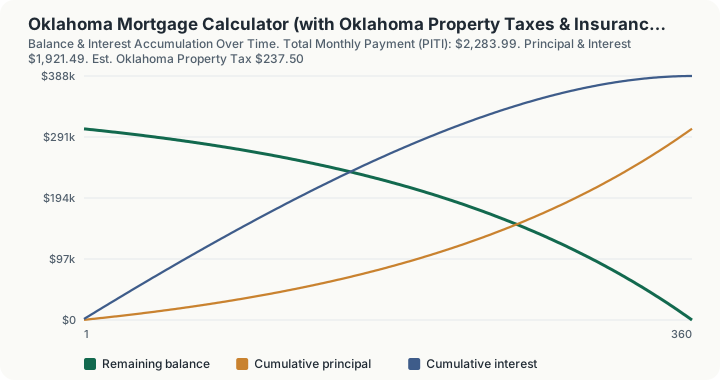
Quick Answer: A $380,000 Oklahoma home purchased with 20% down at a 6.5% rate costs about $2,283.99 a month once Oklahoma's roughly 0.75% average property tax rate and a flat insurance estimate are folded into the payment.
Overview
Oklahoma carries one of the lowest average effective property tax burdens in the country, generally landing under 1% of market value once county assessors apply the state's fractional assessment system. Homes are assessed at 11% to 13.5% of fair cash value depending on the county, then a local millage rate is applied to that smaller assessed figure rather than the sale price. The net effect is a property tax bill that looks light compared to states like Pennsylvania or Rhode Island, even though the headline home prices in cities such as Tulsa, Oklahoma City, and Norman are also comparatively affordable.
This calculator exists because a mortgage quote that only shows principal and interest hides most of what actually lands in an Oklahoma homeowner's escrow account. Lenders collect for property tax and hazard insurance alongside the loan payment, and a buyer comparing a $380,000 purchase against a rental or against a home in a neighboring state needs the full PITI (principal, interest, taxes, insurance) number, not just the loan math. The tool applies a 0.75% effective county millage estimate to the purchase price, adds a flat monthly insurance placeholder, and runs the loan itself through a full 360-month amortization engine so the principal and interest split is exact to the cent.
Oklahoma also has no state-level real estate transfer tax on the buyer's side; the documentary stamp tax on the deed (roughly $0.75 per $500 of consideration) is customarily paid by the seller, so it does not appear in a buyer's monthly payment and is intentionally excluded here.
How This Is Calculated
The engine splits the purchase into three streams and reconciles them to a single monthly figure.
- Loan principal. Down payment percentage is multiplied against the home price and subtracted from the price to get the financed balance. At the default inputs, $380,000 minus 20% down ($76,000) leaves a $304,000 loan.
- Principal and interest. The $304,000 balance is amortized over 360 monthly periods at the entered annual rate using the standard fixed-payment formula, where the monthly rate
i = APR / 12and the paymentM = P × i × (1 + i)^n / ((1 + i)^n − 1). Every one of the 360 periods is generated individually, so rounding never accumulates across the schedule the way it can in a simplified spreadsheet formula. - Escrow stack. Monthly property tax is the home price times 0.75% divided by 12, and a flat $125 monthly hazard insurance estimate is added on top. All three pieces are summed into the headline PITI figure.
Worked Example
Using the platform defaults, a $380,000 Oklahoma home with 20% down and a 6.5% APR produces the following engine output:
- Loan principal: $304,000.00
- Monthly principal & interest: $1,921.49
- Monthly Oklahoma property tax (0.75% of price, over 12 months): $237.50
- Monthly insurance estimate: $125.00
- Total monthly PITI: $2,283.99
- Total interest paid over 30 years: $387,735.24
Walking through the math: the monthly rate is 6.5% ÷ 12 = 0.5416667%. Raising 1.00541667 to the 360th power and running it through the fixed-payment formula against a $304,000 balance yields the $1,921.49 principal and interest figure. Add $237.50 for the tax escrow line ($380,000 × 0.0075 ÷ 12) and $125.00 for insurance, and the total lands at $2,283.99. Over the full 30-year term, the borrower repays $304,000 of principal plus $387,735.24 of interest, for total loan payments of $691,735.24.
What This Does Not Account For
- County-specific millage rates. Oklahoma's 77 counties and their overlapping school, city, and county tax districts each set their own millage, so actual tax bills can sit meaningfully above or below the 0.75% statewide estimate used here.
- Homestead and senior valuation freeze exemptions. Owner-occupants can reduce assessed value with a homestead exemption, and residents 65 and older or disabled homeowners with limited income can freeze their assessed value entirely, both of which lower the real tax bill below what this calculator shows.
- Seller-side documentary stamp tax. Oklahoma's deed transfer tax is a seller cost, not a buyer monthly payment item, so it is excluded rather than blended into PITI.
- PMI for low down payment loans. Below roughly 20% equity, most conventional loans require private mortgage insurance, which is not modeled in the flat $125 insurance line.
- HOA dues, flood zone premiums, and rate locks. None of these are reflected, and actual homeowner's insurance premiums vary by roof age, wildfire and tornado risk zone, and carrier.
Common Pitfalls
- Reading only the principal and interest quote. A lender's advertised rate often excludes escrow, so the $1,921.49 P&I figure alone understates the true monthly obligation by roughly 19%.
- Assuming assessed value equals market value. Oklahoma's fractional assessment system means the taxable base is far smaller than the purchase price, which is why the effective rate looks low even though millage rates themselves can be 80 to 130 mills in some districts.
- Forgetting the homestead exemption paperwork. Buyers who do not file for the homestead exemption after closing leave a real, recurring tax reduction on the table.
- Comparing Oklahoma taxes directly against a neighboring state's nominal millage. Because assessment ratios differ by state, comparing raw millage numbers across state lines is misleading; the effective rate (tax bill divided by market value) is the only fair comparison.
- Ignoring PMI when putting down less than 20%. Buyers modeling a 5% or 10% down scenario should budget an additional 0.3% to 1.5% of the loan annually until they reach 20% equity.
Frequently Asked Questions
How accurate is the 0.75% Oklahoma property tax estimate?
Does Oklahoma require private mortgage insurance below 20% down?
Why is the loan principal exactly $304,000 at the default inputs?
Can I model a shorter loan term or extra principal payments?
Is the total interest figure exact or rounded?
Sources
- Oklahoma Tax Commission, Ad Valorem Division: county assessment ratio and homestead exemption guidance. oklahoma.gov/tax.html
- Consumer Financial Protection Bureau: Regulation Z disclosure requirements for fixed-rate mortgage APR and finance charges. ecfr.gov/current/title-12/chapter-X/part-1026
Also consulted: Oklahoma Statutes Title 68, Article 32: documentary stamp tax on deeds; Freddie Mac Primary Mortgage Market Survey: benchmark 30-year fixed conventional rate ranges used to sanity-check default rate assumptions.