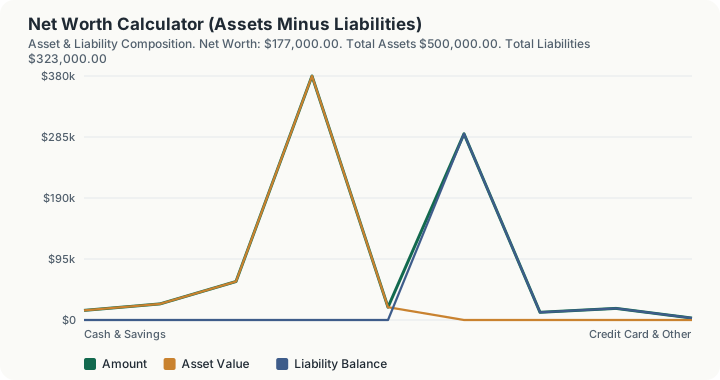
Quick Answer: With $500,000.00 in total assets ($15,000 cash, $25,000 in investments, $60,000 in retirement accounts, $380,000 in real estate, $20,000 in vehicles and other property) against $323,000.00 in total liabilities ($290,000 mortgage, $12,000 auto loan, $18,000 student loan, $3,000 credit card debt), net worth comes to $177,000.00.
Overview
Net worth is the single number that summarizes a household's financial position at a point in time: everything owned, minus everything owed. It is not income, and a high income does not guarantee a high net worth. A household earning $250,000 a year with no savings and a leveraged lifestyle can have a lower net worth than a household earning $70,000 a year that has saved consistently for two decades.
This calculator sums five asset categories and four liability categories into a single net worth figure, and breaks out two supporting metrics: liquid assets (cash and investments you can access without selling a home or cashing out retirement accounts early) and the debt-to-asset ratio, a leverage measure lenders and financial planners use to gauge how much of what you own is actually financed.
Tracking net worth over time, not just as a single snapshot, is what makes the number useful. A single calculation tells you where you stand; a series of calculations, updated quarterly or annually, tells you whether your financial decisions are moving the number in the right direction.
How This Is Calculated
- Total assets. The sum of five categories: cash and savings, taxable investment accounts, retirement accounts, real estate market value, and vehicles plus other significant property.
- Total liabilities. The sum of four categories: mortgage balance, auto loan balance, student loan balance, and credit card or other debt.
- Net worth. Total assets minus total liabilities.
- Debt-to-asset ratio. Total liabilities expressed as a percentage of total assets, a standard leverage measure.
Worked Example
Using the calculator's default inputs:
Assets: - Cash & Savings: $15,000.00 - Investment Accounts: $25,000.00 - Retirement Accounts: $60,000.00 - Real Estate (Market Value): $380,000.00 - Vehicles & Other Assets: $20,000.00 - Total Assets: $500,000.00
Liabilities: - Mortgage Balance: $290,000.00 - Auto Loan Balance: $12,000.00 - Student Loan Balance: $18,000.00 - Credit Card & Other Debt: $3,000.00 - Total Liabilities: $323,000.00
Net Worth: $500,000.00 − $323,000.00 = $177,000.00
Liquid Assets: Cash ($15,000) + Investments ($25,000) = $40,000.00, the portion of net worth actually accessible without selling a home or triggering early-withdrawal penalties on retirement accounts.
Debt-to-Asset Ratio: $323,000.00 ÷ $500,000.00 × 100 = 64.6%, meaning roughly two-thirds of this household's assets are financed rather than owned outright.
Reading the Debt-to-Asset Ratio
A ratio above 100% means liabilities exceed assets, a negative net worth position, common for recent graduates carrying student debt or early-career homeowners who bought with a small down payment. A ratio in the 40-70% range is typical for a household still paying down a mortgage. A ratio under 20% typically signals either a paid-off home, minimal debt, or both. The ratio by itself doesn't say whether leverage is "good" or "bad"; a mortgage financing an appreciating asset is a very different kind of leverage than credit card debt financing consumption.
What This Does Not Account For
- Illiquidity timing. Real estate and retirement accounts are counted at full value, but converting them to cash takes time, transaction costs (in the case of real estate), or early-withdrawal penalties and taxes (in the case of pre-59½ retirement withdrawals).
- Taxes owed on unrealized gains. Investment and retirement account balances are shown gross; selling investments or taking retirement distributions triggers capital gains or ordinary income tax that would reduce the amount actually realized.
- Depreciation timing on vehicles. Vehicle values decline steadily; the figure you enter should reflect current resale value, not the original purchase price, and should be updated periodically.
- Business ownership and other complex assets. Private business equity, collectibles, and other hard-to-value assets are not broken out as their own category here; include a reasonable estimate under "other assets" if applicable.
- Joint versus individual net worth. This calculator produces a single combined figure; couples who want to track individual net worth separately (for example, before marriage or in a state with separate property considerations) should run the calculator once per person.
Common Pitfalls
- Using original purchase price instead of current market value for real estate. A home bought years ago is very likely worth more (or, in some markets, less) than its purchase price; use a current estimate from a recent appraisal or comparable sales, not the mortgage's original principal amount.
- Forgetting to update retirement and investment balances. These balances move with the market, sometimes substantially; a net worth snapshot using six-month-old balances can be materially wrong in either direction.
- Excluding small debts. Store credit cards, buy-now-pay-later balances, and small personal loans are easy to forget but add up; the "credit card and other debt" category is meant to catch all of them.
- Treating net worth as a complete financial health picture on its own. Net worth says nothing about cash flow, emergency fund adequacy, or income stability; a household can have a strong net worth and still be one job loss away from financial distress if liquid assets are thin.
- Comparing your net worth to national averages without adjusting for age. Net worth benchmarks (like Federal Reserve Survey of Consumer Finances data) vary enormously by age cohort; a 30-year-old and a 55-year-old at the same income level are not expected to have comparable net worth.
Frequently Asked Questions
What's a "good" net worth for my age?
Should I include my home's full market value or just my equity?
How often should I recalculate my net worth?
Does net worth include retirement accounts I can't touch until 59½?
What if my liabilities exceed my assets?
Sources
- Federal Reserve: Survey of Consumer Finances, for net worth benchmarks by age and income bracket. federalreserve.gov
- Consumer Financial Protection Bureau: guidance on net worth statements and household balance sheet basics. consumerfinance.gov
- Internal Revenue Service: rules on early-withdrawal penalties and taxation of retirement account distributions (IRC § 72(t)). law.cornell.edu/uscode/text/26/72
- Board of Governors of the Federal Reserve System, Survey of Consumer Finances. federalreserve.gov/econres/scfindex.htm