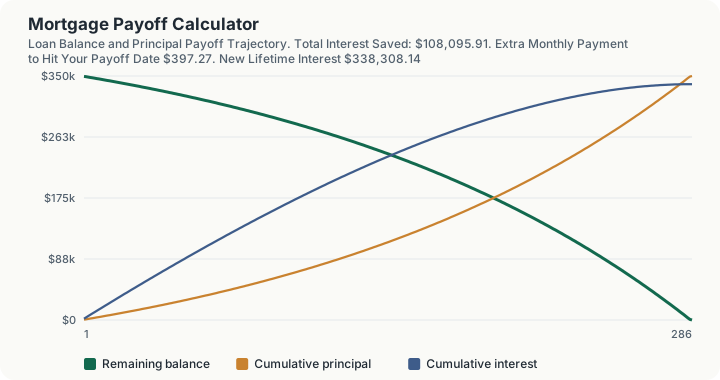
Quick Answer: Adding $200 extra per month to a $350,000 mortgage at 6.5% APR pays off the loan 74 months (about 6.2 years) early and saves roughly $108,096 in total interest.
Overview
Every dollar applied directly to mortgage principal, above and beyond your required monthly payment, does two things simultaneously: it shortens the remaining life of the loan, and it eliminates every future interest charge that would have accrued on that dollar for the rest of the amortization schedule. Because mortgage interest is calculated on the outstanding balance each period, an extra payment made early in the loan term has a larger cumulative effect than the same extra payment made in year 25, since it removes more compounding periods from the calculation.
This calculator models exactly that mechanic. It takes your current loan balance, interest rate, and remaining term, applies a fixed extra payment to every future month, and regenerates the full amortization schedule to show precisely how many months you cut off the loan and exactly how many dollars of interest you avoid paying. It does not use a rule-of-thumb approximation; it recomputes the actual month-by-month schedule with the extra principal applied and stops the schedule the moment the balance reaches zero.
How This Is Calculated
The engine follows this sequence for every month of the loan:
- Compute interest for the period. Interest due for the month equals the current outstanding balance multiplied by the monthly interest rate (annual rate divided by 12).
- Apply the base payment. The required monthly principal and interest payment, calculated once at the start using the standard amortization formula, is split between interest due and principal reduction.
- Apply the extra payment. Your specified extra monthly amount is applied entirely to principal, on top of the base payment's principal portion.
- Update the balance and repeat. The new, lower balance carries into the next month's interest calculation, and the process repeats until the balance reaches zero.
- Compare schedules. The engine also computes the baseline schedule with zero extra payment, so it can report the exact difference in total months and total interest between the two scenarios.
The standard monthly payment formula used to establish the base payment is:
where $P$ is the starting balance, $r$ is the monthly interest rate, and $n$ is the original number of months in the term.
- Working back from a payoff date. To answer how much extra you need to be debt-free by a chosen year, the calculator finds the level payment that clears the same balance over that shorter period, using the formula above with $n$ set to the target number of months, and subtracts the scheduled payment. For a $350,000 balance at 6.5%, paying it off in 20 years instead of 30 takes about $397.27 extra a month.
Worked Example
Scenario A: No extra payment (baseline). A $350,000 balance at 6.5% APR over a 360-month remaining term requires a base monthly payment of $2,212.24. Paid on schedule with no extra principal, the loan runs the full 360 months and accrues $446,404.05 in total interest over that time.
Scenario B: $200 extra per month. Using the identical $350,000 balance, 6.5% APR, and 360-month term, but adding $200 to every monthly payment (a total monthly payment of $2,412.24), the loan is fully paid off in 286 months instead of 360, a reduction of 74 months, or about 6.2 years. Total interest paid drops to $446,404.05 minus $108,095.91 in interest saved, meaning the borrower pays roughly $338,308 in interest instead of $446,406, a direct 24% reduction in lifetime interest cost for a monthly outlay increase of less than 10%.
Scenario C: Larger loan, larger extra payment. A $500,000 balance at 7.0% APR over 360 months, with $500 extra applied monthly, cuts the term to 247 months (113 months saved) and reduces total interest by more than $240,000, illustrating how the effect scales with both loan size and extra payment amount.
What This Does Not Account For
- Prepayment penalties. Some mortgage products, particularly certain non-conforming or investment property loans, carry prepayment penalty clauses. This calculator assumes extra payments are applied penalty-free, which is standard for most conventional and government-backed residential mortgages but not universal.
- Lender-required extra payment handling. Some servicers apply extra payments to the next month's payment rather than directly to principal unless you specifically instruct them otherwise in writing or through your servicer's online portal. This calculator assumes correct principal-only application.
- Opportunity cost of the extra cash. Paying down a 6.5% mortgage early is mathematically equivalent to earning a guaranteed 6.5% after-tax return on that money. If you could reasonably expect a higher return elsewhere (a retirement account, for example), the interest savings shown here should be weighed against that alternative.
- Tax deductibility of mortgage interest. For borrowers who itemize and deduct mortgage interest, the effective after-tax cost of that interest is lower than the stated rate, which slightly reduces the real-world value of prepayment compared to the raw dollar figures shown.
- Variable-rate loans. This model assumes a fixed interest rate for the remaining term. Adjustable-rate mortgages introduce rate uncertainty that this calculator does not project.
Common Pitfalls
- Assuming extra payments automatically go to principal. Many servicers require you to explicitly designate an extra payment as "principal only" on the check memo, mobile app, or online payment portal, or it may simply be applied as a future payment credit instead.
- Confusing interest saved with the extra cash outlay. The $108,096 saved in the worked example is not free; it required paying $200 extra every month for 286 months. The real benefit is the difference between the extra cash spent and the interest avoided.
- Ignoring the diminishing marginal benefit of extra payments made late in the loan term. An extra payment applied in year 28 of a 30-year loan has a far smaller effect than the identical payment applied in year 2, because there are fewer future interest periods left to eliminate.
- Not comparing against refinancing. In some rate environments, refinancing to a lower rate or shorter term can outperform simply adding extra payments to an existing higher-rate loan.
- Overlooking liquidity risk. Extra principal paid into a mortgage is generally illiquid until you sell or refinance; unlike an emergency fund or brokerage account, you cannot easily access that equity in an emergency.
Frequently Asked Questions
How much does $200 extra per month really save on a $350,000 mortgage?
Does making one large extra payment work the same as smaller recurring extra payments?
Will my lender automatically shorten my loan term if I pay extra?
Is paying off a mortgage early always the best use of extra money?
Why does a zero-interest-rate scenario still show a payoff time reduction?
Sources
- Consumer Financial Protection Bureau: Regulation Z (Truth in Lending Act), mortgage servicing rules, and guidance on principal-only payments. ecfr.gov/current/title-12/chapter-X/part-1026
- Federal Reserve Bulletin: Historical mortgage interest rate benchmarks and amortization conventions. federalreserve.gov
- Internal Revenue Service: Publication 936, Home Mortgage Interest Deduction. irs.gov/publications/p936
Also consulted: Fannie Mae and Freddie Mac: Standard conforming mortgage prepayment terms and servicing guidelines.