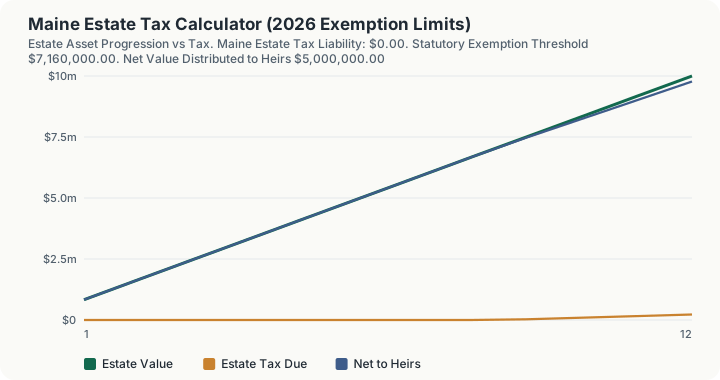
Quick Answer: Maine's state estate tax exemption is $7,160,000, so a $5,000,000 estate falls entirely below the threshold and owes $0 in Maine estate tax; only value above $7,160,000 would be taxed, up to 12.0%.
Overview
Maine's estate tax exemption is $7,160,000, and estates above that line move through three brackets that top out at 12%, a rate that ties Connecticut for the lowest top marginal rate among the twelve states that still tax estates separately from the federal government.
That comparatively gentle rate schedule, combined with an exemption higher than several neighboring states', means Maine's estate tax reaches fewer households, and taxes them more lightly once it applies, than most of the other eleven states with their own estate tax.
Maine borders only one other state, New Hampshire, which charges no estate tax at all, a reminder that a family's state-level exposure can turn entirely on which side of a state line a decedent was domiciled.
There's no separate inheritance tax layered on top, either, so once the estate-level number is set, no additional state charge applies to individual beneficiaries. As in the other eleven states, Maine's exemption and bracket schedule are set independently of the federal exemption, which is currently more than triple Maine's own threshold.
How This Is Calculated
The calculator starts from two numbers you enter: the gross estate at fair market value, and the marital, charitable, and administrative deductions the estate can claim. It subtracts the second from the first to get the net estate, then applies Maine's own schedule to that figure. Nothing else feeds the result.
Below the exemption the tax is zero. Above it, Maine does not apply one rate to the whole excess. Each dollar is taxed at the rate for the bracket that dollar falls into, so the schedule below is read slice by slice.
| Net Estate Falls In | Rate On That Slice |
|---|---|
| $7,160,000 to $10,160,000 | 8% |
| $10,160,000 to $13,160,000 | 10% |
| Over $13,160,000 | 12% |
- Value the gross estate. Fair market value at the date of death of all real property, business interests, securities, cash, and life insurance proceeds the decedent owned.
- Subtract allowable deductions. Debts, administrative expenses, qualifying charitable bequests, and the unlimited marital deduction come off the gross figure. What remains is the net estate.
- Test it against the $7,160,000 exemption. If the net estate is at or below that line, the answer is $0 and the calculation stops.
- Walk the brackets. Each slice of the net estate above $7,160,000 is multiplied by its own rate and the products are added together. Quoting the top rate against the whole excess overstates the bill on any estate that does not reach the final bracket.
- Subtract the tax. What is left of the net estate is what beneficiaries actually receive.
The three brackets come from 36 M.R.S. section 4103. Maine's 8% opening rate is the gentlest entry point of any state with an estate tax.
That is the entire computation. The calculator does not carry over a deceased spouse's unused exemption, add back lifetime taxable gifts, apply the generation-skipping transfer tax, discount closely held interests, or figure the separate federal return. Those sit under "What This Does Not Account For" below, not in the math above.
Worked Example
- Start with the gross estate. This example uses a $5,000,000 gross estate: the fair market value of all property, business interests, equities, cash, and life insurance the decedent owned at death, before deductions.
- Compare against Maine's exemption. Maine taxes estates only above $7,160,000; the $5,000,000 estate sits at or below that threshold, so none of it is taxable.
- Taxable estate above exemption. $5,000,000 minus the $7,160,000 exemption leaves nothing above the line, so the taxable estate above the exemption is $0.
- Compute the tax due. With nothing above the exemption, the calculator returns $0.00 in Maine estate tax, even though Maine's top bracket reaches 12.0% above the threshold.
- Distribute the net estate. The full $5,000,000.00 gross estate passes to beneficiaries undiminished.
- What this leaves out. This is Maine's state-level result only; federal estate tax is assessed separately under IRC § 2010.
Walking the $7,160,000 Line, and the Two Above It
The default $5,000,000 estate sits below the exemption, so the headline is $0.00 and the sweep shows nothing interesting until row nine. Here is what the calculator returns on either side of each of Maine's three boundaries.
At a $7,159,900 net estate. Below the exemption by a hundred dollars. Tax $0.00, taxable estate above exemption $0.00.
At $7,160,100, two hundred dollars later. Taxable estate above exemption $100.00, and the calculator returns $8.00 of Maine estate tax.
So the exemption is not a cliff. Crossing it costs eight dollars, not $572,800. Maine taxes only the excess at 8%, and at exactly $7,160,000 the tax is $0.00. This is the single most misunderstood feature of a state estate tax, and the eight-dollar figure is the cheapest possible demonstration of it: an estate one dollar over the line does not suddenly owe tax on the whole $7.16 million.
The second boundary, at $10,160,000. The calculator returns $240,000.00, which is 8% of the full first $3,000,000 slice, at an effective rate of 2.36% on the whole estate. Above this point the marginal rate moves from 8% to 10%, so each additional $100,000 of estate costs $10,000 rather than $8,000.
The third, at $13,160,000. The calculator returns $540,000.00, an effective rate of 4.10%, and the marginal rate steps to 12%. A $20,000,000 estate returns $1,360,800.00, an effective rate of 6.80% against that 12% top marginal rate. Even at three times the exemption the effective rate is barely over half the headline rate, which is what quoting "12%" against a whole estate gets wrong.
Marginal cost of the next unit, by band. Each additional $100,000 of net estate costs $8,000 between $7.16m and $10.16m, $10,000 between $10.16m and $13.16m, and $12,000 above $13.16m.
The reverse question, which is the one an estate plan is built around. How much can pass with no Maine tax at all? $7,160,000 of net estate, after deductions. Every dollar of allowable deduction therefore raises that ceiling dollar for dollar until the estate is under the line, and above the line it is worth the marginal rate. Concretely: a $10,000,000 estate returns $227,200.00 of tax; add $1,000,000 of debts, administration expenses and charitable bequests and the same estate returns $147,200.00. That $1,000,000 deduction is worth exactly $80,000.00, which is 8% of it, because the whole deduction came out of the first bracket.
Reading the twelve-row sweep. The table scales the net estate from $833,333.33 to $10,000,000.00. Rows one through eight all read $0.00, because they sit below the exemption. Only the top rows carry tax, and row twelve, a $10,000,000 estate, reads $227,200.00. Eight zero rows followed by four rising ones is what an exemption looks like in a table, and it is why the chart appears flat for two thirds of its width.
What This Does Not Account For
- Portability of a deceased spouse's unused exemption. Most states with an estate tax, including this one, do not allow it at the state level, and the calculator does not apply it in either direction.
- Lifetime taxable gifts added back into the taxable estate, and any QTIP election, credit shelter trust, or state QTIP decoupling that would change what the taxable estate actually is.
- Valuation discounts for minority or non-marketable interests in closely held entities. Enter the discounted value yourself if the appraisal supports one.
- Federal generation-skipping transfer (GST) tax under IRC Chapter 13.
- Ancillary probate requirements for real property situated in other jurisdictions.
- Complex liquidity discounts for minority non-voting family business entities.
- State-specific inheritance taxes levied directly on beneficiaries (e.g. PA, NJ, MD, KY, NE).
Common Pitfalls
- Assuming State Exemption Matches Federal: Forgetting that states like Oregon ($1.0M) and Massachusetts ($2.0M) tax estates far below the federal threshold.
- The "Cliff" Effect in Specific States: Failing to recognize that states like New York eliminate the exemption entirely if the estate exceeds 105% of the threshold.
- Out-of-State Real Property Exposure: Holding real estate in states with active estate taxes exposes non-resident estates to proportional state estate taxes.
- Failing to Fund Revocable Living Trusts: Assets held outside trust structures are subjected to public probate proceedings and statutory executor fees.
Frequently Asked Questions
Does Maine have a state estate tax?
Does Maine have an inheritance tax?
When is state estate tax due?
What assets are included in the taxable estate?
Sources
- Maine Revenue Services: Estate Tax Guidance (2026). maine.gov/revenue