Quick Answer: A charitable remainder unitrust pays you (or another beneficiary) a percentage of its revalued assets every year for a set term, then gives what remains to charity, and the present value of that future gift earns you an income tax deduction the year you fund the trust.
Overview
A charitable remainder trust is an irrevocable trust that lets a donor contribute appreciated assets, sell them inside the trust without immediate capital gains tax, receive an income stream for a period of years or for life, and leave the remainder to one or more qualified charities. There are two statutory flavors under IRC § 664. A charitable remainder annuity trust (CRAT) pays a fixed dollar amount every year, set once at funding. A charitable remainder unitrust (CRUT) pays a fixed percentage of the trust's value, revalued each year, so the payout rises and falls with the trust's investment performance. This calculator models the CRUT structure, since it is the more commonly used version for donors who want their income stream to keep pace with inflation and market growth, and because it lets the donor keep contributing additional assets to the trust after it is established, which a CRAT does not allow.
The core appeal of a CRUT is timing. A donor with a large position in low-basis stock or real estate faces a painful choice: sell and pay capital gains tax immediately, or hold and stay concentrated in a single asset. Funding a CRUT sidesteps that choice. The trust itself is tax-exempt, so it can sell the contributed asset and reinvest the full proceeds without paying capital gains tax at the trust level. The donor receives a partial income tax deduction in the year of the gift, spreads out the income stream (and the associated tax on distributions) over many years, and ultimately supports a cause of their choosing with whatever principal remains.
Because a CRUT is irrevocable, the decision to fund one should not be made casually. Once assets go into the trust, the donor cannot get the full principal back. The trade is deliberate: give up outright ownership and estate-planning flexibility in exchange for a partial current deduction, tax-deferred diversification, and a defined income stream.
How This Is Calculated
The calculator projects two separate things, and it is important to keep them distinct.
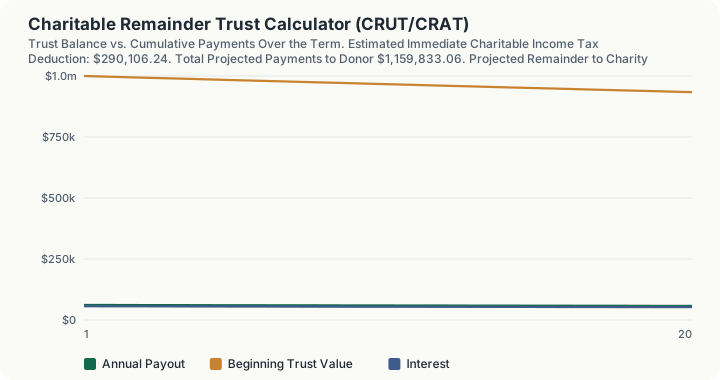
The illustrative payout stream uses the annual growth rate you enter for the trust's investments. Each year, the trust pays out the stated percentage of its value at the start of the year, and the remaining balance grows (or shrinks) by your assumed return for the rest of the year. This produces a year-by-year schedule so you can see how quickly the balance changes and how much cash the beneficiary receives in total.
The charitable deduction estimate is a different calculation, because the IRS does not let the donor use their own optimistic growth assumption to value the deduction. Instead, the tax code requires the trust to be valued as if its assets earn exactly the IRC § 7520 rate, a discount rate published monthly by the IRS. Because a unitrust's payout is a percentage of revalued corpus rather than a fixed dollar amount, the math works out cleanly: if you assume the trust earns exactly the 7520 rate every year, the present value of the remainder interest passing to charity simplifies to
`
Deduction ≈ Funding Amount × (1 − payout rate)^term in years
`
The 7520 rate cancels out of this first-order annual formula entirely. That is a real and well-documented feature of unitrust valuation. It is also the biggest structural difference between a CRUT and a CRAT: a CRAT's deduction is quite sensitive to the 7520 rate, while a CRUT's is not, at least in the simplified annual model used here. The official IRS actuarial tables (Publication 1458) apply a small "adjusted payout rate" correction for trusts that pay quarterly or monthly instead of annually in arrears; that correction is typically well under one percent of the deduction and is not reproduced here.
The calculator also checks the 10% remainder test required by IRC § 664(d)(2)(D): the present value of the charitable remainder must be at least 10% of the initial funding amount, or the arrangement does not qualify as a CRUT at all, no matter how the trust document is drafted. A very high payout rate combined with a long term will fail this test.
Estimated first-year tax savings is simply the deduction estimate multiplied by the donor's marginal federal tax rate. This ignores the percentage-of-AGI ceilings that apply to charitable deductions (30% of AGI for appreciated long-term capital gain property contributed to certain trusts, with a five-year carryforward for any excess), which a donor's own tax advisor needs to check against their specific return.
Worked Example
A donor holding $1,000,000 of low-basis stock wants income for a fixed period and a gift to their university at the end. They fund a 20-year term-of-years CRUT at a 6% unitrust payout, in a month when the IRS section 7520 rate is 5.2%, and assume the trust portfolio earns 6% a year.
Step 1 -- The remainder factor. (1 - 0.06)^20 = 0.94^20 = 0.29010624
Step 2 -- The charitable deduction. $1,000,000 x 0.29010624 = $290,106.24
Step 3 -- The 10% remainder test. 0.29010624 x 100 = 29.01% of funding, clear of the 10% statutory floor
Step 4 -- First-year tax savings. $290,106.24 x 37% = $107,339.31
The Payout Stream, Year One
Step 5 -- Year one payout. 6% x $1,000,000 beginning value = $60,000
Step 6 -- Corpus remaining after the payout. $1,000,000 - $60,000 = $940,000
Step 7 -- Growth on the post-payout corpus. 6% x $940,000 = $56,400
Step 8 -- Ending trust value, year one. $940,000 + $56,400 = $996,400
Year Two, and the Running Total
Step 9 -- Year two payout. 6% x $996,400 beginning value = $59,784
The payout falls, and it falls every year here. A unitrust pays a percentage of a revalued corpus, so when the payout rate exceeds the return rate the base shrinks and the cheque shrinks with it.
Step 10 -- Corpus remaining after the year two payout. $996,400 - $59,784 = $936,616
Step 11 -- Growth on the year two post-payout corpus. 6% x $936,616 = $56,196.96
Step 12 -- Ending trust value, year two. $936,616 + $56,196.96 = $992,812.96
Step 13 -- Cumulative payouts after two years. $60,000 + $59,784 = $119,784
Across the Full Term
Step 14 -- Total projected payouts over 20 years. = $1,159,833.06
Step 15 -- Projected remainder passing to charity. = $930,410.02
Two figures on this page rest on different assumptions on purpose, and confusing them is the classic error. The $290,106.24 deduction in step 2 is a statutory valuation, fixed at funding, computed as though the trust earns exactly the 7520 rate. The $930,410.02 in step 15 is a market projection at the assumed 6% return. The donor deducts the first number and the charity, if the assumption holds, receives the second -- more than three times as much.
What This Does Not Account For
- Life-based and multi-life CRUTs. This calculator only models a term-of-years payout (capped at 20 years by statute). Trusts that pay for one or more donors' lifetimes require IRS Table 2000CM mortality factors, which produce a different, age-dependent deduction figure.
- The AGI percentage limits on charitable deductions, and the five-year carryforward for any deduction that exceeds those limits in the year of the gift.
- Net investment income tax (3.8% NIIT) on trust distributions that carry out investment income character to the beneficiary under the CRUT's tiered accounting rules (ordinary income, then capital gain, then tax-exempt income, then return of principal).
- State-level tax treatment, which varies and is not uniform with federal rules.
- Trustee fees, investment management fees, and trust administration costs, which reduce the actual payout below the model's projections.
- The exact IRS adjusted-payout-rate actuarial factor for quarterly or monthly distributions; this calculator uses the simplified annual approximation described above.
- Unrelated business taxable income (UBTI). If a CRUT ever earns UBTI in a given year, historically the entire trust lost its tax-exempt status for that year (a rule Congress has revisited); this calculator assumes a clean trust with no UBTI exposure.
Common Pitfalls
- Confusing a CRUT with a CRAT. A CRAT pays a fixed dollar amount set once at funding and cannot accept additional contributions. A CRUT's payout moves with the trust's value every year and can accept more assets later. Mixing up the two structures changes both the cash flow projections and the deduction math.
- Assuming the deduction uses the trust's expected investment return. It does not. The deduction is fixed by statute using the § 7520 rate for the month of funding (or, at the donor's election, either of the two preceding months), regardless of how the trust actually performs afterward.
- Picking a payout rate near the statutory ceiling without checking the 10% remainder test. A high payout rate over a long term can push the projected remainder below 10% of funding, which disqualifies the arrangement as a CRUT entirely, not just as an inefficient one.
- Forgetting the trust is irrevocable. Once funded, the donor cannot unwind the trust to reclaim full principal, even if their financial circumstances change.
- Ignoring the tiered income character rules. Distributions to the beneficiary carry out the trust's income in a specific order (ordinary income first, then capital gains, then tax-exempt income, then principal), so the tax character of what the beneficiary actually reports can differ substantially from a simple pro-rata assumption.
Frequently Asked Questions
What is the minimum and maximum payout rate for a CRUT?
Why does the deduction estimate not change much when I adjust the § 7520 rate?
Can I change the charity that receives the remainder after the trust is set up?
How is the charitable deduction actually calculated by the IRS, if not by this simplified formula?
Is a CRUT worth it compared to simply selling the asset and donating the after-tax proceeds?
Sources
- Internal Revenue Code § 664(d)(2), Charitable Remainder Unitrust (26 U.S.C. § 664). law.cornell.edu/uscode/text/26/664
- Internal Revenue Service, "Section 7520 Interest Rates," irs.gov/businesses/small-businesses-self-employed/section-7520-interest-rates (August 2026 rate: 5.20%, Rev. Rul. 2026-13).
- Internal Revenue Service, Publication 1458, Actuarial Values, Book Aleph. irs.gov
Also consulted: Treasury Regulation § 1.664-4, Calculation of the fair market value of the remainder interest in a charitable remainder unitrust; Internal Revenue Code § 664(d)(2)(D), the 10% minimum remainder interest requirement; Internal Revenue Code § 664(c) and § 512, unrelated business taxable income and trust tax-exempt status.