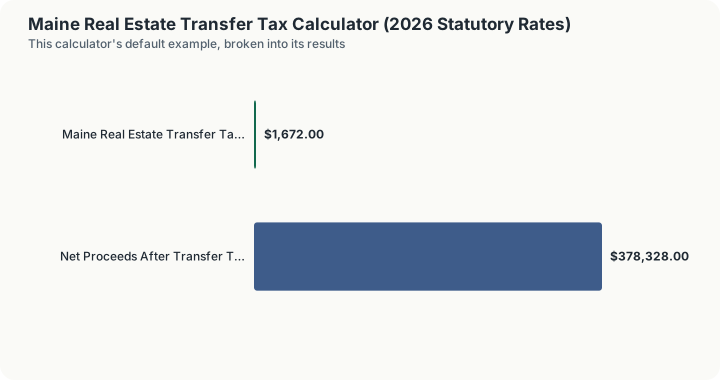
Quick Answer: A $380,000 home sale in Maine at the statutory combined rate of $4.40 per $1,000 of value (0.44%) generates $1,672 in Real Property Transfer Tax due.
Overview
Maine's Real Property Transfer Tax under 36 M.R.S. Section 4641 is unusual in how explicitly it addresses payment: the statute itself splits the $2.20 per $500 rate equally between buyer and seller, for a combined $4.40 per $1,000, or 0.44%, of the sale price, with each party statutorily responsible for half. That is a firmer rule than most states, where payer allocation is left entirely to the purchase contract.
In practice this means a $380,000 Maine sale generates $1,672 in total tax, split into two $836 halves rather than one combined bill assigned to a single party. Maine's flat 0.44% rate sits above flat-rate states like Alabama or Georgia at 0.1% but below bracketed high-end states like Connecticut or New Jersey once their upper tiers are reached, placing Maine in the middle of the national range.
Unlike New Hampshire's similarly split 1.5% combined rate just across the border, Maine's statutory split produces a materially smaller total bill, so a buyer relocating between the two states should not assume the "split tax" structure implies a similar dollar amount.
How This Is Calculated
Maine splits its transfer tax down the middle by statute. The buyer owes $1.10 per $500 and the seller owes $1.10 per $500, summing to the statutory $2.20 per $500, and 36 M.R.S. 4641 sets it up that way rather than leaving it to local custom.
The engine applies the combined $4.40 per $1,000 rate to the full sale price in exact decimal arithmetic, so the result matches the Registry of Deeds stamp. The figure shown is the total on the transaction. For one party's share, halve it: each side owes exactly 0.22%. There is no bracket schedule and no high-value surcharge, so the effective rate reads 0.440% at every price.
Worked Example
Maine's transfer tax is the rare one that statute itself splits down the middle. The calculator reports the combined figure, and the split is worth showing alongside it.
Step 1 -- The consideration. Contract sale price = $380,000
Step 2 -- The combined statutory rate. 36 M.R.S. 4641, $2.20 per $500 of value, which is $4.40 per $1,000 combined = 0.44%
Step 3 -- Apply the combined rate. $380,000 x 0.0044 = $1,672.00
Step 4 -- Net proceeds after the full combined tax. $380,000.00 - $1,672.00 = $378,328.00
Step 5 -- The effective rate. $1,672.00 / $380,000 = 0.440%
Now the calculator's $1,500,000 scenario.
Step 6 -- The luxury sale at the combined rate. $1,500,000 x 0.0044 = $6,600.00
Step 7 -- The effective rate, unchanged. $6,600.00 / $1,500,000 = 0.440%
One caution about reading Step 4. The engine computes the combined buyer-plus-seller tax and subtracts all of it from the sale price, so the net proceeds figure is the transaction's net of the whole tax rather than the seller's personal net. Under the statutory 50/50 split the seller's own liability on the baseline sale is half of Step 3, and the buyer separately owes the other half at the registry of deeds; the calculator does not perform that division, which is why it does not appear as a numbered step above. Sellers who want their true net should add half of the Step 3 figure back to Step 4.
Walking the Price Sweep: What Each Extra $1,000 Costs
The calculator's price sweep is the part of this page worth reading closely, because Maine's schedule has no bracket edge anywhere in it. That absence is itself the finding: the same $4.40 per $1,000 applies to the first dollar of consideration and to the millionth, so the sweep is a straight line and the only question left is its slope.
The marginal cost of the next unit. Raise the baseline sale from $380,000 to $390,000 and the computed tax moves from $1,672.00 to $1,716.00. That is $44.00 per additional $10,000 of price, or $4.40 per $1,000, split into $2.20 of extra buyer liability and $2.20 of extra seller liability. Unlike Connecticut or New York, where the marginal figure jumps at a statutory cliff, Maine's stays at $4.40 per $1,000 across the entire sweep. At $250,000 the engine returns $1,100.00; at $500,000, $2,200.00; at $1,000,000, $4,400.00; at $1,500,000, $6,600.00. Every one of those divides back to exactly 0.440%.
The reverse question. A seller who wants the combined transfer tax capped at a round number can invert the rate rather than iterate. Holding the bill to $2,200.00 means a price at or below $500,000, which the engine confirms exactly. Holding it under $1,672.00, the baseline figure, means staying under $380,000. Each $1,000 of headroom in the target bill buys about $227,273 of additional price, which is a wide enough step that transfer tax almost never binds a Maine pricing decision the way it does above a New Jersey or New York cliff.
Right method against wrong method, priced. The common arithmetic error in Maine is doubling. Because the statute reads "$2.20 per $500, split equally," it is easy to apply $2.20 per $500 to the buyer and again to the seller. Done that way the baseline sale produces $3,344.00 against the engine's $1,672.00, an overstatement of exactly $1,672.00, because the $2.20 per $500 figure is already the combined rate. The correct per-party figure is $1.10 per $500. On the $1,500,000 scenario the same mistake overstates the bill by $6,600.00.
What the sweep cannot show. The engine holds hasTransferTax true and applies 0.44% to whatever price is entered, with no exemption switch anywhere in the code path. A transfer between spouses, a transfer to a revocable trust, or a deed for nominal consideration would still return $1,672.00 at the baseline rather than the $0.00 the statute allows, so the sweep should be read as the fully taxable case only.
What This Does Not Account For
- Individual buyer/seller allocation: This calculator reports the total combined transfer tax; it does not separately break out each party's $1.10-per-$500 statutory half, though that figure is simply the total divided by two.
- Registry of Deeds recording fees: Separate from the transfer tax itself, Maine county Registries of Deeds charge their own flat recording fees to file the deed and any related mortgage discharge or assignment.
- Statutory exemptions: Maine law exempts certain transfers, including many transfers between spouses, transfers to a revocable trust for estate planning, and transfers for nominal consideration, from all or part of the transfer tax; these are not captured by a simple sale-price calculation.
- Controlling interest transfers: Maine's transfer tax framework can extend to transfers of a controlling interest in an entity that owns real property, a more complex scenario this calculator's simple sale-price model does not address.
- Maine Real Estate Withholding: Non-resident sellers may be subject to a separate Maine income tax withholding requirement on the sale, which is unrelated to the transfer tax computed here.
Common Pitfalls
- Assuming the whole tax falls on the seller. Unlike many states, Maine's transfer tax is split equally by statute between buyer and seller; assuming the seller owes the full combined amount overstates their individual liability by half.
- Confusing the combined rate with the per-party rate. The 0.44% figure this calculator reports is the sum of both parties' obligations; each party individually owes 0.22%, not 0.44%.
- Overlooking Maine Real Estate Withholding for non-resident sellers. This is a separate income tax mechanism, distinct from the transfer tax, and can catch out-of-state sellers off guard if not planned for ahead of closing.
- Forgetting Registry of Deeds recording fees. These are billed alongside the transfer tax at closing but are calculated under a completely separate, flat fee schedule.
- Applying a bracket mentality from another state. Maine's rate is flat and proportional across the entire sale price, unlike Hawaii's marginal bracket system, so there is no need to track different rates at different price tiers.
Frequently Asked Questions
What is Maine's real estate transfer tax rate?
Does the buyer or the seller pay Maine's transfer tax?
Why does this calculator show $1,672 in total tax for a $380,000 sale?
Is Maine's transfer tax bracketed like Hawaii's, or flat like Kentucky's?
Does Maine have a separate tax for non-resident sellers?
Sources
- Maine Revenue Services, Real Property Transfer Tax guidance and 36 M.R.S. 4641. maine.gov/revenue