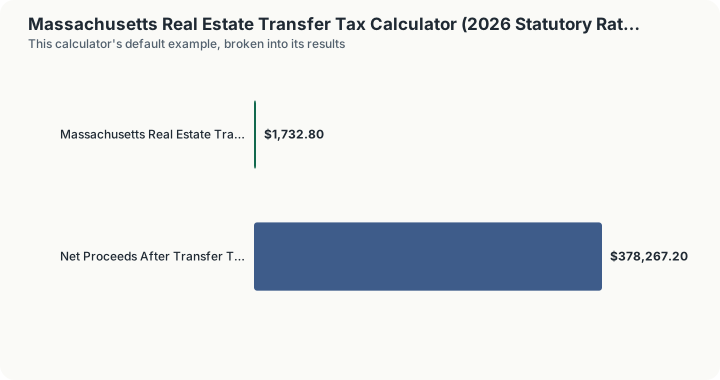
Quick Answer: Massachusetts charges a flat deeds excise tax of $4.56 per $1,000 of the sale price (0.456%), so a $380,000 home sale owes $1,732.80 in state transfer tax.
Overview
Massachusetts assesses its deeds excise tax at $4.56 per $1,000 of consideration, 0.456% of the sale price, under M.G.L. Chapter 64D, a single statewide rate with one notable regional exception. Barnstable County, which covers Cape Cod, layers on a separate 2% land bank fee dedicated to open-space preservation, a levy with a conservation purpose rather than a general-revenue one, and it is not modeled in this calculator's statewide baseline.
By long-standing custom, the seller pays the deeds excise tax at closing, since the tax attaches to recording the seller's deed, though the purchase and sale agreement can reallocate this cost and seller-paid remains the market norm statewide. At 0.456%, Massachusetts sits close to Maine's 0.44%, a fellow New England state one border away past New Hampshire, though the two states arrive at nearly identical rates through very differently structured statutes.
On the calculator's $380,000 baseline, the deeds excise tax comes to $1,732.80 outside Barnstable County; a Cape Cod transaction should budget for the additional 2% land bank fee stacked on top of that statewide figure.
How This Is Calculated
Massachusetts charges a deeds excise of $4.56 per $1,000, an unusual rate in that it is not a round number and does not divide evenly into a per-$500 figure.
The engine takes the full consideration stated on the deed, multiplies by 0.00456, and rounds to the cent in the same arbitrary-precision arithmetic used across this platform, so the result matches what a registry of deeds assesses. It then reports the sale price minus the tax as net proceeds, which is the figure a seller wants at closing.
There are no brackets and no mansion-tax cliff at state level, so the effective and marginal rates are identical at every price. Barnstable County, covering Cape Cod, adds a separate 2% land bank fee that is not modeled here.
Worked Example
The deeds excise on a $380,000 Worcester County sale, at a rate that resists mental arithmetic in a way most states' do not.
Step 1 -- The consideration. Contract sale price = $380,000
Step 2 -- The statutory rate. M.G.L. c.64D, $4.56 per $1,000 of consideration = 0.456%
Step 3 -- Apply the rate. $380,000 x 0.00456 = $1,732.80
Step 4 -- Cross-check by the per-$1,000 method. 380 x $4.56 = $1,732.80
Step 5 -- Net proceeds after the excise. $380,000.00 - $1,732.80 = $378,267.20
Step 6 -- The effective rate. $1,732.80 / $380,000 = 0.456%
The calculator's $1,500,000 scenario, for contrast with the bracketed New England states next door.
Step 7 -- The luxury sale at the same rate. $1,500,000 x 0.00456 = $6,840.00
Step 8 -- The effective rate, unchanged. $6,840.00 / $1,500,000 = 0.456%
Note the cents in Step 3. Massachusetts is one of the few states whose rate does not resolve to a round figure at residential prices, which is exactly why the engine carries the calculation in arbitrary-precision decimal rather than floating point: $1,732.80 is the registry's figure to the cent, not an approximation of it. The steadiness of Steps 6 and 8 is the real contrast worth drawing. Rhode Island next door adds a second tier above $824,000 and Vermont adds one above $200,000, so on the $1,500,000 sale their effective rates climb to roughly 1.09% and 1.34% while Massachusetts stays pinned at 0.456%. Barnstable County's separate 2% Cape Cod land bank fee is not included in any of the figures above.
The Excise Across the Price Range, and the Two Ways to Get It Wrong
Because M.G.L. c.64D sets one rate and no thresholds, the calculator's price sweep produces a perfectly straight line, and the useful questions are about its slope and about the errors that a non-round rate invites.
The marginal cost of the next unit. Moving the sale price from $380,000 to $390,000 takes the computed excise from $1,732.80 to $1,778.40, a step of $45.60 per $10,000, or $4.56 per $1,000. That figure is constant everywhere in the sweep. The engine returns $1,140.00 at $250,000, $2,280.00 at $500,000, $4,560.00 at $1,000,000 and $6,840.00 at $1,500,000, and each of those divided by its price gives 0.456% to three decimal places.
The reverse question. Working backwards from a target excise is a single division. A seller who wants to keep the deeds excise at or under $2,280.00 is asking for a price at or under $500,000; the engine returns exactly $2,280.00 there. Every additional $1,000 of excise the seller is willing to absorb corresponds to roughly $219,298 of price. That ratio is stable in Massachusetts in a way it is not in Rhode Island or Vermont, both of which add a second tier partway up the same range.
Right method against wrong method, priced. Two errors are common here. The first is rounding $4.56 to $4.50 per $1,000 for mental arithmetic: on the baseline sale that yields $1,710.00 against the engine's $1,732.80, understating the excise by $22.80, and on the $1,500,000 scenario it understates by $90.00. The second is treating the excise as a per-$500 figure by halving to $2.28 and then applying it per $500, which happens to reproduce the right answer, and treating it as $4.56 per $500, which does not: that doubles the baseline bill to $3,465.60, an overstatement of $1,732.80. The safe form is the one in the worked example, price divided by 1,000 then multiplied by 4.56.
What the sweep does not carry. The engine reads a single stateRate of 0.00456 with avgLocalRate at zero, so the Barnstable County land bank fee has no representation anywhere in the computed figures. On the $380,000 baseline that omission is worth 2% of price, or $7,600, which is more than four times the entire state excise the calculator reports.
What This Does Not Account For
- The Cape Cod and Islands Land Bank fee. Barnstable County adds a separate 2% fee under different enabling legislation, which would roughly quadruple the total transfer-related cost on a Cape property.
- Recording fees and other closing costs. The Registry of Deeds charges a separate flat recording fee per document that is not part of the excise tax itself.
- Exemptions for certain transfers. Deeds between spouses, transfers to correct a title defect, and a handful of other statutory categories can be excise-exempt; this calculator assumes an ordinary arm's-length sale.
- Local option taxes some municipalities have proposed. Massachusetts has periodically debated allowing cities to add their own transfer fee on high-value sales, but no such local option is currently in effect statewide.
- Federal and state capital gains tax on the sale. The deeds excise tax is separate from any income tax owed on the seller's gain.
Common Pitfalls
- Assuming the buyer pays. Massachusetts custom puts this cost on the seller's side of the settlement statement, which surprises buyers who are used to states where the tax is split or buyer-paid.
- Forgetting the Cape Cod land bank fee. Anyone working with a Barnstable County property needs to budget for a materially larger combined transfer cost than this statewide baseline shows.
- Confusing the excise tax with the recording fee. These are two separate line items charged by the registry of deeds and are easy to conflate when reading a closing statement.
- Using stamp count instead of dollar value. Older references to the tax describe it in terms of "$2.28 per $500," which is mathematically identical to $4.56 per $1,000 but trips people up when they try to reconstruct the total manually.
Frequently Asked Questions
Who actually pays the Massachusetts deeds excise tax?
Is the Massachusetts transfer tax the same everywhere in the state?
Does Massachusetts have a mansion tax like New York or New Jersey?
How is the deeds excise tax collected?
Are any transfers exempt from the excise tax?
Sources
- Massachusetts Department of Revenue, Deeds Excise Tax (M.G.L. c.64D) mass.gov/orgs/massachusetts-department-of-revenue