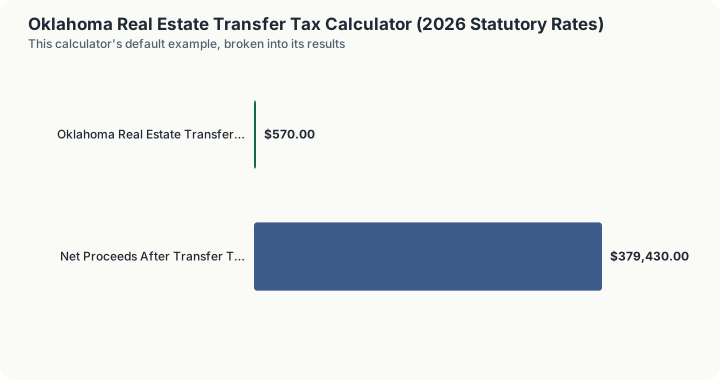
Quick Answer: Oklahoma charges a flat documentary stamp tax of $0.75 per $500 of consideration, which works out to 0.15% of the sale price, on real property conveyances statewide. On the calculator's $380,000 baseline sale, that comes to $570.00 in documentary stamp tax.
Overview
Oklahoma's documentary stamp tax under 68 O.S. Section 3201 runs $0.75 per $500 of consideration, 0.15% of the sale price, a single statewide flat rate with no county or municipal add-on anywhere in the state. That places Oklahoma just above the 0.1% flat rate shared by Alabama, Georgia, Kentucky, and South Dakota, and well below neighboring Arkansas at 0.33%, despite the two states sharing a border and a similar flat, no-bracket structure.
By common custom, the seller pays Oklahoma's documentary stamp tax at closing, though the purchase contract can specify a different arrangement and the closing statement should always be checked. Because the rate is flat, a $380,000 Oklahoma sale owes exactly $570, and the tax scales in exact proportion to price with no bracket threshold to track.
County clerks across all 77 Oklahoma counties apply that same 0.15% calculation, so a Tulsa County closing and a rural panhandle closing generate identical effective rates on identically priced properties, unlike the county-by-county variation found in a state like Nevada or Maryland.
How This Is Calculated
Oklahoma's documentary stamp tax is $0.75 per $500 of consideration, a flat 0.15% with no county option layered underneath it.
The engine reads the 0.0015 rate under 68 O.S. 3201 and multiplies the full sale price by it. There is no bracket walk and no local rate lookup, because Oklahoma authorizes neither, so the effective rate reads 0.150% at every price and net proceeds are the price less the stamp tax.
Worked Example
Oklahoma's documentary stamp tax on the calculator's default sale price.
Step 1 -- The consideration. Contract sale price = $380,000
Step 2 -- The statutory rate. 68 O.S. 3201, $0.75 per $500 of consideration = 0.15%
Step 3 -- Apply the rate. $380,000 x 0.0015 = $570.00
Step 4 -- Cross-check by the per-$500 method. 760 x $0.75 = $570.00
Step 5 -- Net proceeds after the stamp tax. $380,000.00 - $570.00 = $379,430.00
Step 6 -- The effective rate. $570.00 / $380,000 = 0.150%
Now the calculator's $1,500,000 scenario.
Step 7 -- The luxury sale. $1,500,000 x 0.0015 = $2,250.00
Step 8 -- The effective rate at $1.5M. $2,250.00 / $1,500,000 = 0.150%
Oklahoma's rate is low enough that the stamp tax rarely drives a negotiation, and the absence of any threshold means there is no price at which it suddenly does. That distinguishes it sharply from the cliff states: a New York seller at $999,999 and one at $1,000,000 face a $10,000 difference in tax on a one-dollar difference in price, whereas an Oklahoma seller moving between those same two prices sees the stamp tax change by fractions of a cent. Grantors pay the stamps at recording, and the county clerk affixes them to the deed, so Step 5 is the seller's operative figure.
Sweeping The Oklahoma Documentary Stamp Tax
Oklahoma's documentary stamp tax is $0.75 per $500 of consideration, a flat 0.15%, which is among the lowest transfer charges in the country and contains no bracket at all.
The marginal cost of the next unit. Raising the sale price from $380,000 to $390,000 moves the stamp tax from $570.00 to $585.00. Every additional $10,000 of consideration costs exactly $15.00, at every price the calculator accepts, and the effective rate output holds at 0.150% throughout. At $1,500,000 the tax is $2,250.00.
The reverse question: what price sits behind a given stamp? Multiply by 666.67. A $570.00 stamp corresponds to $380,000 of consideration and a $2,250.00 stamp to $1,500,000. Oklahoma computes in whole $500 increments of value, so the recorded figure lands on a clean multiple of $0.75 at any price divisible by $500.
Net proceeds. On the $380,000 baseline the engine reports $379,430.00 of net proceeds and on the $1,500,000 sale $1,497,750.00. At 0.15% the documentary stamp is the smallest line on an Oklahoma closing statement by a wide margin, and it is frequently smaller than the recording fee charged alongside it.
Right method against wrong method. The common error is importing a neighbouring state's rate. Oklahoma at 0.15% is one thirteenth of Pennsylvania's typical combined 2%, and a seller who budgets from a generic national transfer tax guide will overstate the Oklahoma charge by an order of magnitude. The engine's $570.00 on a $380,000 sale is the whole of the state documentary stamp tax, and Oklahoma authorises no county or municipal transfer tax on top of it.
A second error, priced by the sweep itself. Assuming the stamp scales with something other than consideration. It does not: the engine multiplies the price you enter by 0.0015 and nothing else. Entering an appraised value, an assessed value or a loan amount rather than the contract consideration produces a proportionally wrong figure, and at 0.15% a $50,000 error in the input moves the answer by $75.00.
What is not computed. Oklahoma exempts a list of conveyance types from the documentary stamp under 68 O.S. 3202, including transfers between spouses, transfers to or from a business entity by its own owners, and instruments given as security for debt. The engine tests for none of them. County clerk recording fees are separate flat charges not included here, and no title insurance, settlement or commission figure appears above.
What This Does Not Account For
- Exemptions. Oklahoma law exempts certain transfer types from the documentary stamp tax, including transfers securing a debt, transfers between an individual and a wholly-owned entity in some circumstances, and specific governmental conveyances.
- County recording fees. Oklahoma county clerks charge a separate, flat fee to record the deed itself, which is distinct from the value-based documentary stamp tax.
- Title insurance and closing or abstracting fees. Oklahoma real estate transactions commonly involve an abstract of title, and those costs are unrelated to the documentary stamp tax.
- Real estate commissions. Agent commissions are negotiated separately and are typically the largest single cost at closing.
- Mineral rights and severed interests. Oklahoma's oil and gas heritage means many transactions involve separate surface and mineral conveyances; this calculator models the standard surface real property transfer only.
Common Pitfalls
- Assuming the rate varies by county. Oklahoma applies a single statewide rate of 0.15% with no local option, so there is no need to look up a county-specific add-on the way you would in Ohio or North Carolina.
- Confusing the documentary stamp tax with mortgage recording costs. Oklahoma's tax applies to the deed conveying the property, not to the mortgage or deed of trust securing the buyer's loan.
- Overlooking exemptions for related-party or debt-securing transfers. Certain conveyances that do not represent a true arm's-length sale may be exempt from the documentary stamp tax entirely.
- Assuming the buyer pays the documentary stamp tax. By common Oklahoma custom, the seller pays this tax, though the purchase contract ultimately controls the allocation.
- Treating the stamp tax as the only closing cost tied to the deed. Recording fees, abstracting fees, and title work are separate costs layered on top of the documentary stamp tax.
Frequently Asked Questions
What is Oklahoma's real estate transfer tax rate?
Does the rate change based on the county where the property is located?
Who typically pays Oklahoma's documentary stamp tax, the buyer or the seller?
Are any Oklahoma real estate transfers exempt from the documentary stamp tax?
Does Oklahoma's transfer tax apply to mineral rights conveyances separately?
Sources
- Oklahoma Tax Commission, Documentary Stamp Tax (68 O.S. Section 3201 et seq.). oklahoma.gov/tax.html