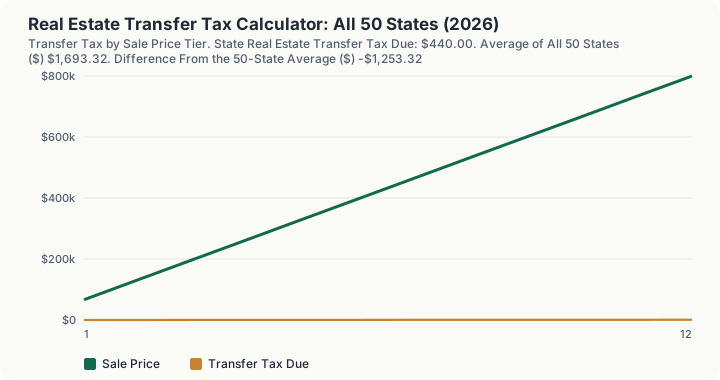
Quick Answer: On a $400,000 sale in California the statewide documentary transfer tax is $440.00, an effective rate of 0.110% and the 29th highest bill of the 50 states, against a 50-state average of $1,693.32.
What does this calculator do?
Transfer tax is the charge a state takes when a deed changes hands. It goes by several names depending on the statute: deed tax, conveyance tax, documentary stamp tax, realty transfer fee. What it costs varies by a factor of four hundred across the country. On a $400,000 sale, Colorado's documentary fee is $40 and Delaware's combined rate takes $16,000. Fifteen states take nothing at all.
Pick the state the property sits in, enter the contract price, and this calculator returns the statutory transfer tax, the effective rate, any mansion surcharge, and where that state ranks among all 50 at that price. The ranking and averages are computed by running the same calculation for every state at your price, which matters because the ordering genuinely changes with price: bracketed states and mansion cliffs overtake flat-rate states as the number climbs.
Transfer tax follows the property, not the seller's residence. A New York resident selling a Florida condo pays Florida's tax.
The 2026 spread on a $400,000 sale
- Highest: Delaware $16,000 (4.0% combined), Pennsylvania $8,000, New Hampshire $6,000, Washington $5,400, Connecticut and Maryland $4,000
- Lowest that still charges: Colorado $40, then Hawaii, Kentucky and South Dakota at $400
- No statewide transfer tax at all (15 states): Alaska, Arizona, Idaho, Indiana, Kansas, Louisiana, Mississippi, Missouri, Montana, New Mexico, North Dakota, Oregon, Texas, Utah, Wyoming
- 50-state average: $1,693.32. Median: $719.60
How is this calculated?
Three statutory structures exist in the table, and the code branches on which one the state uses.
Flat state : Base Tax = Sale Price × (State Rate + Average Local Rate)
Bracketed state : Base Tax = ∑_b (Price within bracket b) × Rate_b + Sale Price × Average Local Rate
Mansion cliff : Surcharge = Sale Price × Cliff Rate, if Price ≥ Threshold
Tax Due = Base Tax + Surcharge
- State lookup. The state's entry is read from the 2026 transfer tax table: whether it has a transfer tax, whether the rate is flat or bracketed, the state rate, any average local rate, and any mansion cliff.
- Flat states (28 of them). The state rate plus the average local rate is applied to the full sale price.
- Bracketed states (Connecticut, Hawaii, Maine, New Jersey, Rhode Island, Vermont, Washington). Each bracket rate applies only to the portion of the price inside that bracket, the same marginal treatment used elsewhere in this engine for graduated schedules. Any average local rate is then added on the full price.
- Mansion cliffs (New York and New Jersey). These are cliffs, not marginal charges. Once the price reaches the threshold, the matching cliff rate applies to the entire sale price, which is how both states actually administer them. That is why crossing the threshold by a dollar can cost tens of thousands.
- No-tax states. The fifteen states above return zero.
- National ranking. The same calculation runs for all 50 states at your sale price and the results are sorted, so rank 1 is the largest bill. The states owing nothing share a single rank. The average, median and highest-state figures come from that run.
Worked Example
A $4,000,000 sale in New York, which exercises both the flat base and the cliff.
- Base rate. New York's base transfer tax is $2.00 per $500 of consideration, 0.4%, under Tax Law section 1402. $4,000,000 times 0.004 is $16,000.00.
- Mansion threshold. The statewide mansion tax under Tax Law section 1402-a applies at $1,000,000 and above on residential one to three family homes. $4,000,000 clears it.
- Cliff applied to the whole price. The 1% rate applies to the full $4,000,000, not to the excess over $1,000,000: $40,000.00.
- Total. $16,000.00 plus $40,000.00 is $56,000.00, an effective rate of 1.400%.
- National position. At $4,000,000 New York ranks 8th, and New Jersey has become the most expensive state in the country at $185,875.00, having overtaken Delaware because New Jersey's bracket schedule and its own mansion cliff both escalate with price while Delaware's 4% stays flat.
Compare that to the default case: a $400,000 California sale pays $440.00 at the 0.11% county documentary rate, ranks 29th, and sits $1,253.32 below the national average.
What does this calculator not account for?
- City and county rates layered on top. This is the largest omission and it is deliberate. Where a state's rate varies materially by locality, the statewide or most common statutory rate is used as the baseline. San Francisco and Los Angeles both impose city transfer taxes far above California's county rate, Chicago and Cook County add to Illinois, Philadelphia adds to Pennsylvania, and Miami-Dade differs from the rest of Florida. New York City's supplemental progressive mansion tax, up to 3.9%, is a city charge and is not included in the New York figure above.
- Local transfer taxes in nominally cheap states. Colorado's $40 documentary fee is statewide, but Aspen, Vail, Breckenridge, Telluride and Crested Butte have grandfathered local transfer taxes of roughly 1% to 3%.
- Who pays. Custom varies by state and county, and contracts can reallocate it. The calculator computes the tax on the transaction, not the split between buyer and seller.
- Exemptions. Transfers between spouses, transfers into or out of trusts, transfers securing debt, foreclosure deeds, gifts and intra-family transfers are exempt or reduced in many states. An arm's length taxable sale is assumed.
- Recording fees, title insurance, commission and mortgage tax. All separate from transfer tax, and often much larger. The "sale price after transfer tax" output is not net proceeds.
- Mortgage recording taxes. New York and a few other states tax the mortgage separately from the deed. Not included.
- First-time buyer and owner-occupier reliefs, which several states apply against the transfer tax.
What mistakes do people make with this?
- Using the statewide rate in a big city. In California, Illinois, Pennsylvania and New York the city charge can dwarf the state one. The statewide figure is a floor in those states, not an estimate.
- Treating a mansion tax as marginal. It is a cliff in both states that levy one. A $999,999 New York sale pays no mansion tax; a $1,000,000 sale pays 1% of the whole million. Pricing just under a threshold is a real strategy for exactly this reason.
- Assuming no transfer tax means no closing costs. Texas has no transfer tax and plenty of closing costs. The two are unrelated.
- Paying on assessed value. Almost every statute taxes consideration, the contracted price. In a rising market the assessor's value can be far lower, and it is not the base.
- Confusing transfer tax with the property tax reassessment a sale triggers. Transfer tax is one time at closing. Reassessment is an ongoing annual cost and a different calculator.
- Forgetting that the ranking moves with price. Delaware is the most expensive state at $400,000 and New Jersey is the most expensive at $4,000,000. There is no fixed league table.
Frequently Asked Questions
Which state has the highest real estate transfer tax?
Which states have no real estate transfer tax?
Who pays the transfer tax, buyer or seller?
Is transfer tax deductible?
Does refinancing trigger transfer tax?
Why is my closing statement higher than this figure?
Sources
- New York State Department of Taxation and Finance, Real Estate Transfer Tax, tax.ny.gov/bus/transfer/rptidx.htm
Also consulted: New York Tax Law Sections 1402 and 1402-a; Delaware Code Title 30, Chapter 54, Realty Transfer Tax; Colorado Revised Statutes 39-13-102, Documentary Fee; California Revenue and Taxation Code Section 11911, Documentary Transfer Tax Act; National Association of Realtors, State and Local Issues: Real Estate Transfer Tax summary (an industry trade association summary, not a government source); State Departments of Revenue and county recorder fee schedules, verified 2026-08-21.