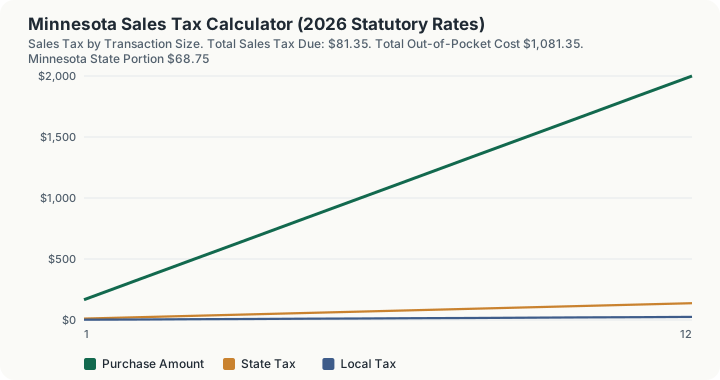
Quick Answer: A $1,000 taxable purchase in Minnesota costs $81.35 in combined state and local sales tax, for a total of $1,081.35 out the door.
State Rate Plus a Real Local Layer
How much sales tax gets added to a purchase in Minnesota depends on two separate decisions: what the state legislature set as the statutory rate (6.88%), and what the local city or county government layered on top of it. Local jurisdictions (cities, counties, and in some cases special taxing districts) are free to add their own surcharges on top of that, and the statewide average of those add-ons is 1.26%, which brings the typical combined rate to 8.14%.
That puts Minnesota a bit above the roughly 7.3% average combined rate seen across the states that levy a general sales tax. A single combined figure is useful for budgeting and for comparing Minnesota to other states, but it is still an average. The exact rate a shopper pays depends on the specific address where the sale takes place. Someone relocating to Minnesota, or opening a second business location within the state, should treat the 8.14% figure as a planning estimate rather than the number that will appear on every single invoice.
How This Is Calculated
Minnesota has one of the highest state rates in the country at 6.875%, and unlike most high-rate states it exempts clothing entirely rather than taxing it. Local taxes average 1.26%, which brings the typical combined rate to 8.135% and the tax on a $1,000 purchase to $81.35. The local layer in Minnesota is concentrated: the Twin Cities metro carries regional transit and housing sales taxes that many outstate jurisdictions do not, so the metro combined rate runs meaningfully above the statewide average.
State and local rates apply to the same taxable amount and can be summed before multiplying:
The calculator proceeds through:
- Take the entered amount as the base. No adjustments are made to the price before tax is computed.
- No item-level exemption filtering. The clothing exemption, the grocery exemption and the prescription drug exemption are not applied. Enter only amounts taxed at the general rate.
- Compute the state portion. The base is multiplied by the state statutory rate.
- Apply the local surcharge. The 1.26% average blends city and county option taxes with the metro regional levies.
- Sum and total. The state and local amounts are added to give total tax, and the total is added back to the price to give the out-of-pocket cost.
Worked Example
For a $1,000 taxable purchase in Minnesota:
- Starting purchase price. The buyer rings up a $1,000.00 taxable retail purchase in Minnesota, the baseline amount before any tax is applied.
- State portion. Minnesota's statutory state sales tax rate of 6.88% applies to the full purchase amount: $1,000.00 × 6.88% = $68.75 owed to the state.
- Local portion. Local municipal, county, and special-district surcharges add an average of 1.26% on top of that: $1,000.00 × 1.26% = $12.60 more.
- Combined tax due. Summing the two pieces, $68.75 in state tax plus $12.60 in local surcharge comes to $81.35 in total sales tax owed on the transaction.
- Total out-of-pocket cost. Adding that $81.35 in tax to the $1,000.00 purchase price brings the buyer's total out-of-pocket cost to $1,081.35.
This example uses Minnesota's statewide average local rate of 1.26%; actual combined rates vary by city and county, so a real receipt could show a combined rate above or below the 8.14% average used here.
Pricing the Local Layer, and a Five-Cent Rounding Artefact
Minnesota is one of the states on this platform where the local surcharge toggle does real work, so the sweep has two components worth separating before the slope is any use.
Pricing the toggle. On the baseline $1,000 purchase the engine returns $81.35 of total sales tax with the local surcharge included, split into $68.75 of state tax and $12.60 of local tax, for a total cost of $1,081.35. Switch the surcharge off and the same purchase returns $68.75, a difference of $12.60, and the reported combined rate falls from 8.14% to 6.88%. The average local layer is therefore worth $1.26 per $100 of spend, or about 15.5% on top of the state tax bill.
The marginal cost of the next unit. With local tax included, each additional $100 of purchase costs $8.14 and each additional $1,000 costs $81.35. The engine returns $40.68 at $500, $162.70 at $2,000, $406.75 at $5,000 and $2,033.75 at $25,000.
A rounding artefact worth naming. Those two marginal figures are not consistent with each other, and the engine is where the inconsistency lives. It rounds the state and local components to the cent separately before summing them. On a $100 purchase the state portion of $6.875 rounds up to $6.88 and the local portion is $1.26, totalling $8.14. Ten separate $100 purchases therefore compute to $81.40 while a single $1,000 purchase computes to $81.35, a $0.05 difference created entirely by componentwise rounding. The same gap appears between ten $500 rows at $40.68 each and one $5,000 row at $406.75. The displayed combined rate of 8.14% is likewise a rounded rendering of 8.135%, so multiplying the displayed rate by the price will not reproduce the engine's tax figure.
The reverse question. To hold total Minnesota sales tax at $100.00, the purchase must be $1,229.25, which the engine confirms exactly, splitting it into $84.51 state and $15.49 local. Each $10 of tax budget corresponds to about $122.93 of purchase, against $166.67 in Michigan, which is the practical measure of what the local layer costs a Minnesota buyer.
What the average conceals. The stored 1.26% is a statewide average local rate, not any actual jurisdiction's rate. Minnesota local option taxes vary widely by city and county, so a specific Minneapolis, Duluth or Rochester transaction will not match the local column above, and the engine has no field in which to enter a locality. The 6.875% state rate is exact; the local figure is an average and should be treated as an estimate.
What This Does Not Account For
- Statutory exemptions on unprepared groceries, prescription medications, or manufacturing equipment.
- Special industry excise taxes (lodging hotel taxes, vehicle rental fees, alcohol/tobacco excise).
- Use tax compliance on out-of-state untaxed online purchases.
- B2B resale certificate exemptions or direct pay permit programs.
Common Pitfalls
- Confusing State and Combined Rates: Quoting the state base rate without factoring in local city and county add-on taxes.
- Overlooking Consumer Use Tax: Failing to self-report and remit use tax on untaxed out-of-state purchases on your state income tax return.
- Missing Annual Sales Tax Holidays: Many states offer annual tax-free weekends for back-to-school items, severe weather supplies, or energy-efficient appliances.
- Failing to Collect Resale Certificates: Selling wholesale without collecting valid exemption certificates exposes sellers to full sales tax liability upon audit.
Frequently Asked Questions
What is the sales tax rate in Minnesota?
Are groceries taxed in Minnesota?
How does use tax differ from sales tax?
Are digital goods and SaaS taxable in Minnesota?
Sources
- Minnesota Department of Revenue: 2026 Sales and Use Tax Rate Schedules. revenue.state.mn.us
- Streamlined Sales Tax Governing Board (SSTGB): State Taxability Matrix. streamlinedsalestax.org/for-businesses/taxability-matrix