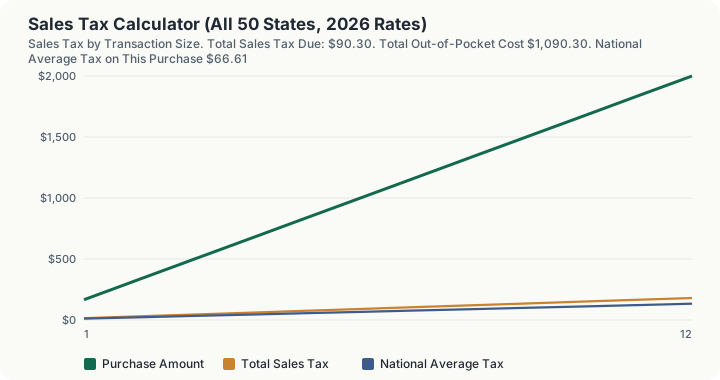
Quick Answer: A $1,000 taxable purchase in California carries $90.30 in sales tax at the state's 9.03% combined rate, bringing the total to $1,090.30. That is $23.69 above the $66.61 the same purchase averages across all 50 states, and ranks California 7th highest of 50.
What does this calculator do?
Sales tax in the United States is two taxes stacked. The state sets a statutory rate, then cities, counties and transit or improvement districts add their own. The number on your receipt is the sum, and it changes when you cross a county line, sometimes when you cross a street.
This page applies a state's statutory rate plus that state's average local rate, then prices the same purchase in the other 49 states so the comparison is on the table rather than in your head. Pick a state, enter what you are buying, and decide whether to include the local layer.
The local layer is not a rounding difference. Louisiana's state rate is 5.00%, lower than California's 7.25%, and Louisiana still finishes first in the country at 10.13% combined because its average local rate is 5.13%. Alabama runs the same way: a 4.00% state rate under a 5.46% local average. Reading state rates alone puts both states in the wrong half of the table.
How is this calculated?
Combined Rate = State Rate + Average Local Rate
Sales Tax = Purchase Amount × Combined Rate
Total Cost = Purchase Amount + Sales Tax
- Read the two rates for the selected state. California is 7.25% state and 1.78% average local, from
engine/tables/2026/state-sales-tax.json. - Drop the local rate if you asked to. The local toggle sets the local rate to zero. It does not change the state rate.
- Multiply the purchase by each rate separately. $1,000 x 7.25% = $72.50 to the state, $1,000 x 1.78% = $17.80 to local jurisdictions. The two are reported separately because they are remitted separately.
- Add them. $72.50 + $17.80 = $90.30, and the total out of pocket is $1,090.30.
The national comparison repeats the whole of that for all 50 states on the same purchase and the same local setting.
- Average the 50 results. On a $1,000 purchase the mean is $66.61. This is an unweighted mean of states, not weighted by population or by retail volume, and it includes the states that charge nothing.
- Rank and report the gap. California is 7th of 50, $23.69 above the mean. Rank 1 is the largest tax. States that tie share a rank, so the four states charging nothing on this purchase all sit at rank 47.
Because every state's tax here is a flat percentage, the ranking holds at any purchase amount. Only the dollar gaps scale. The schedule table walks twelve purchase sizes, from one sixth of your entry to twice it, with the national average beside each.
Worked Example
Buying a $30,000 car in California, with local tax included.
- State portion. $30,000 x 7.25% = $2,175.00.
- Local portion. $30,000 x 1.78% = $534.00.
- Total sales tax. $2,175.00 + $534.00 = $2,709.00, for a $32,709.00 out the door figure before title, registration and fees.
- Compare nationally. The same $30,000 purchase averages $1,998.24 across the 50 states, so California is $710.76 above the mean, ranking 7th.
- Check the extremes. In Louisiana the same car is taxed $3,039.00 at 10.13%. In Oregon, Delaware, Montana or New Hampshire it is taxed $0.00.
Now turn the local toggle off on the original $1,000 purchase. The tax falls from $90.30 to $72.50, and California moves to rank 1, because at 7.25% it has the highest state statutory rate in the country. The same state is 7th on combined rates and 1st on state rates alone. Which number you should use depends on whether you are buying in a high-local or low-local part of the state.
Vehicles are the one case where this distinction usually resolves itself: most states tax a car at the rate where the buyer registers it, not where the dealer sits.
What does this calculator not account for?
- Your actual local rate. The local figure is a state average. A purchase in an unincorporated county and the same purchase downtown are frequently taxed several points apart.
- Alaska. Alaska has no state sales tax but its boroughs and municipalities do, averaging 1.82%. The calculator reports Alaska's state portion as $0.00 and still charges the local average, which is the correct treatment and the reason Alaska is not one of the four states showing zero total tax.
- Exempt and preferentially rated goods. Groceries, prescription drugs, clothing, medical devices and services are exempt or rated differently in many states. This applies one general rate to whatever amount you enter.
- Sales tax holidays. Several states suspend tax on school supplies, clothing or emergency preparedness goods for a weekend or a week each year.
- Use tax. Buying untaxed from out of state generally creates a use tax obligation at your own rate. Nothing here models that.
- Business exemptions. Resale certificates, manufacturing exemptions and non-profit exemptions all remove the tax entirely for qualifying buyers.
What mistakes do people make with this?
- Ranking states by their statutory rate. California has the highest state rate in the country at 7.25% and finishes 7th on combined rates. Louisiana has the highest combined rate at 10.13% on a state rate of 5.00%.
- Assuming five states charge nothing. Five states have no state sales tax: Alaska, Delaware, Montana, New Hampshire and Oregon. Only four of them end up charging nothing on a taxable purchase, because Alaska's local governments tax at an average of 1.82%.
- Treating the sticker as the total. At 9.03%, a $30,000 car is a $32,709.00 transaction before any dealer or state fee.
- Assuming groceries are taxed the same as everything else. Many states exempt food for home consumption or tax it at a reduced rate. A general rate applied to a grocery bill overstates the tax in those states.
- Ignoring the local layer on a large purchase. On a $1,000 purchase the California local layer is $17.80. On a $30,000 purchase it is $534.00, and the difference between a low-local and high-local address inside one state can be larger than that again.
Frequently Asked Questions
Which state has the highest sales tax?
Which states have no sales tax?
What is the average sales tax in the United States?
Why does my receipt show a different rate than this page?
Do I pay sales tax where I buy or where I live?
Sources
- Internal Revenue Service, the official authority for the tax rules this calculator relates to. irs.gov
Also consulted: State departments of revenue: statutory rate schedules, exemption categories and sourcing rules.