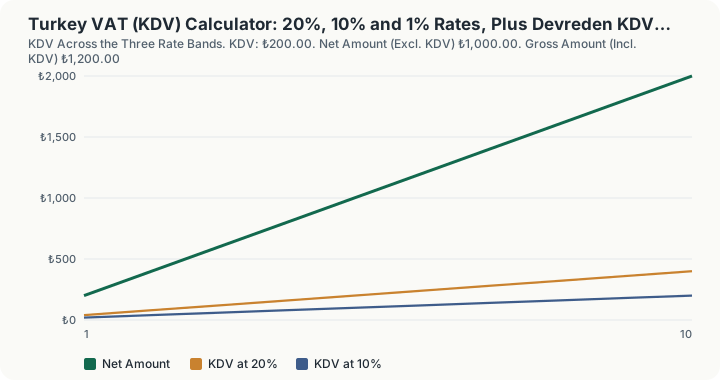
Quick Answer: Adding the 20% general rate of KDV to a net amount of 1,000 TL gives 200 TL of tax and a gross invoice of 1,200 TL. Working backwards from that 1,200 TL gross, the KDV inside it is still 200 TL, because you divide by six rather than deducting 20%. Deducting 20% instead would leave 960 TL and understate the net figure by 40 TL.
What does this calculator do?
Turkish VAT has three rates and one structural feature that makes it behave unlike most VAT systems.
The rates are straightforward. Since a Presidential Decree took effect on 10 July 2023 the general rate has been 20%, raised from 18%, and the reduced rate for the goods and services in list II has been 10%, raised from 8%. The 1% rate for list I, which covers basic foodstuffs, newspapers and certain leasing, was left unchanged. Which list an item falls into is determined by the schedules to the underlying decree, not by any general principle.
The structural feature is devreden KDV. In most VAT systems a business whose input tax exceeds its output tax in a period receives a refund. Turkey does not work that way. Under Article 29 of the VAT Law the excess is carried forward indefinitely to later periods instead. Cash refunds exist only for specific entitlements such as exports, reduced-rate supplies and withholding. A business in a persistently input-heavy position therefore finances the treasury indefinitely, and the carry-forward compounds month after month because each period's brought-forward balance joins the input side of the next.
That has a sharp practical edge for anyone selling at a reduced rate while buying at the standard rate. Such a business can add real value every month, pay no KDV at all, and watch its carry-forward grow. This calculator models that case explicitly, because it is a common position for food producers, publishers and parts of the textile trade.
Turkey has no registration threshold. Unlike the UK or Singapore, liability follows from carrying on a commercial activity, so there is no turnover figure below which a business escapes KDV.
How is this calculated?
Adding KDV to a net amount:
KDV = Net Amount × Rate
Gross = Net + KDV
Extracting KDV from a gross amount. This uses a fraction, not a deduction. If the rate is $r$, the tax inside a gross figure is:
KDV = Gross × r/(1 + r)
At the 20% rate that fraction is 20/120, which is exactly one sixth, or 16.6667% of the gross. At 10% it is one eleventh, and at 1% it is 1/101. It is never the headline rate.
A monthly KDV period. Turkish KDV is filed monthly. Output tax on sales is netted against input tax on purchases, plus anything carried in from the previous month:
Total Input = (Purchases × Purchase Rate) + Brought Forward
Net Position = (Sales × Sales Rate) − Total Input
Where that is positive it is ödenecek KDV, payable with the return. Where it is negative the amount payable is nil and the whole excess becomes devreden KDV carried into the next month. It does not become a refund.
Worked Example
A consultancy issues a 1,000 TL net invoice at the general rate.
Step 1: Apply the 20% rate to the net amount.
1,000 × 20% = 200
KDV = 200 TL
Step 2: Add it to reach the gross invoice.
1,000 + 200 = 1,200
Gross invoice = 1,200 TL
Now a client quotes 1,200 TL as an all-inclusive figure and you need the net.
Step 3: Apply the extraction fraction, one sixth.
1,200 × 20/120 = 200
KDV inside the gross = 200 TL
Step 4: Subtract to recover the net.
1,200 − 200 = 1,000
Net amount = 1,000 TL
Step 5: See what the common error would have given. Deducting 20% of the gross instead:
1,200 − (1,200 × 20%) = 1,200 − 240 = 960
Wrong net = 960 TL, understating the true 1,000 TL by 40 TL.
Now the monthly return. The same business has 100,000 TL of net sales and 60,000 TL of net purchases in the month, both at 20%.
Step 6: Compute output KDV.
100,000 × 20% = 20,000
Output KDV = 20,000 TL
Step 7: Compute input KDV.
60,000 × 20% = 12,000
Input KDV = 12,000 TL
Step 8: Take the difference.
20,000 − 12,000 = 8,000
Payable = 8,000 TL, which is 20% of the 40,000 TL of value added, exactly as a VAT should be.
Finally, the reduced-rate trap. Suppose the same business sells at 10% while still buying at 20%. Output KDV falls to 10,000 TL while input KDV stays at 12,000 TL. The net is negative 2,000 TL, so nothing is payable and 2,000 TL becomes devreden KDV, carried forward. The business still added 40,000 TL of value that month, and still paid no KDV.
What does this calculator not account for?
- Which list your goods fall into. The 1%, 10% and 20% rates apply to items specified in the schedules to the governing decree. The calculator applies whichever rate you select and cannot classify goods or services.
- KDV tevkifat, the partial withholding regime under which the buyer remits part of the seller's VAT directly. The withholding fractions vary by service type under the VAT General Application Communiqué and there is no single ratio that could be applied honestly.
- Refund entitlements. Exports, reduced-rate supplies and withholding can generate genuine cash refunds rather than a carry-forward. The calculator always treats an excess as devreden KDV, which is the ordinary case but not the only one.
- Non-deductible input tax. Certain expenditure carries KDV that cannot be credited at all, so not every lira of input tax you pay is recoverable.
- Exempt and zero-rated supplies, including exports and specified exemptions, which affect both the output side and the recoverability of input tax.
- Import KDV, which is charged on a customs value base rather than a sale price.
- Special regimes for second-hand goods, travel agents and similar trades.
- Filing deadlines, penalties and interest.
- Multi-period modelling. The calculator handles one month with an opening carry-forward. It does not project a carry-forward balance forward over many months.
What mistakes do people make with this?
- Deducting the rate from a gross figure. The tax inside a gross amount is r/(1+r), not r. At 20% that is one sixth of the gross, or 16.6667%, not 20%. This is the single most common KDV arithmetic error and it appears on real invoices.
- Assuming an excess input position produces a refund. In the ordinary case it does not. It carries forward, potentially for years.
- Forgetting that the carry-forward compounds. Last month's devreden KDV joins this month's input side, so a business that would otherwise have paid can find itself carrying forward again.
- Using the pre-July-2023 rates. The general rate was 18% and the reduced rate 8% until 10 July 2023. Anything written before then is out of date, and the 1% rate is the only one that did not move.
- Assuming the reduced rate is good news. Selling at 10% while buying at 20% locks up cash indefinitely. The lower output rate helps the customer, not the seller's cash flow.
- Looking for a registration threshold. There is none. A commercial activity is within KDV from the first invoice.
- Rounding the tax before the fraction. Extract the tax from the gross first, then round, rather than rounding the gross and working from a rounded figure.
Frequently Asked Questions
What is the VAT rate in Turkey?
How do I remove KDV from a gross price?
What is devreden KDV?
Can I get a KDV refund?
Is there a VAT registration threshold in Turkey?
Why does my business never pay KDV despite being profitable?
Sources
- Gelir İdaresi Başkanlığı, consolidated text of Bakanlar Kurulu Kararı 2007/13033, "Mal ve Hizmetlere Uygulanacak Katma Değer Vergisi Oranlarının Tespitine İlişkin Karar", Resmî Gazete 30 December 2007, sayı 26742. cdn.gib.gov.tr/api/gibportal-file/file/getFileResources (read 31 August 2026). Article 1(1) verbatim: "a) Ekli listelerde yer alanlar hariç olmak üzere, vergiye tabi işlemler için, ... % 20; b) Ekli (I) sayılı listede yer alan teslim ve hizmetler için, % 1; c) Ekli (II) sayılı listede yer alan teslim ve hizmetler için, ... % 10".
Also consulted: Cumhurbaşkanı Kararı Sayı 7346, Resmî Gazete 7 July 2023, sayı 32241, amending the Council of Ministers Decision 2007/13033. It replaced "%18" with "%20" in paragraph (a) and "%8" with "%10" in paragraph (c) of Article 1(1), with effect from 10 July 2023; Katma Değer Vergisi Kanunu 3065, Article 29, which provides for the carry-forward of excess input tax rather than its refund in the ordinary case.