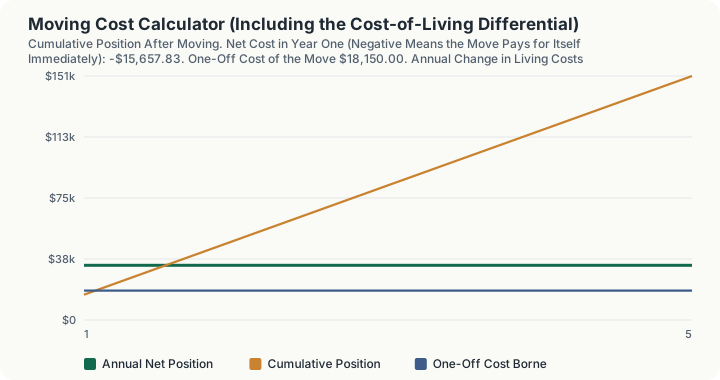
Quick Answer: Moving from California to Texas on a 100,000 dollar annual budget costs 18,150 dollars once, then pays 33,807.83 dollars a year in lower living costs, so year one is a gain of 15,657.83 dollars, not a cost. The move repays itself in 0.54 years, and over five years it leaves the household 150,889.15 dollars ahead.
What does this calculator do?
The removal van is the visible cost of a move and it is almost never the important one. What decides whether a move pays is the permanent annual change in what your life costs at the destination, set against any permanent change in pay. The one-off cost is a number you pay once. The cost-of-living differential is a number you pay, or receive, every year for as long as you stay.
At the defaults here the ratio is stark: the cost-of-living swing is 1.86 times the entire cost of the move, in the first year alone. That is why the headline on this page is a net position rather than a total, and why it is negative, meaning the household is ahead rather than behind.
There is an important limitation to understand about the cost-of-living half. The engine takes a single composite index for each state from the MERIC series and scales the whole budget by the ratio of the two. It does not apportion your spending across housing, groceries, utilities, transport and healthcare, and it does not weight those categories separately. One index, one multiplication. Since housing is by far the most variable component between states, a household whose housing share differs sharply from the composite's implied share will find the composite a poor guide, and should adjust the budget input accordingly.
Everything on the one-off side is a number you supply. No mover's quote, deposit or lease-break penalty is looked up or assumed.
How is this calculated?
One-Off = (∑ items) × (1 + c) − R
Equivalent Budget = B × I_dest/I_origin
Annual Position = Δ Salary × (1 − t) − (Equivalent Budget − B)
Step 1: Total the one-off items. Movers 4,000 plus packing 600 plus storage at 250 a month for 2 months, being 500, plus travel 1,200 plus vehicle shipping 1,000 plus deposits and closing 3,500 plus lease-break or sale costs 2,000 plus temporary housing at 2,200 for 1 month plus setup and replacements 1,500: 4,000 + 600 + 500 + 1,200 + 1,000 + 3,500 + 2,000 + 2,200 + 1,500 = 16,500 dollars
Step 2: Add the contingency. 16,500 x 10% = 1,650 16,500 + 1,650 = 18,150 dollars gross
Step 3: Subtract any employer reimbursement. 18,150 - 0 = 18,150 dollars net one-off cost
Step 4: Take the two composite indices. California: 140.5. Texas: 93.0. Both are MERIC composite figures.
Step 5: Scale the budget by their ratio. 100,000 x (93.0 / 140.5) = 66,192.17 dollars That is what the same basket costs in Texas, on this single composite scaling.
Step 6: Compute the annual cost-of-living change. 66,192.17 - 100,000 = a fall of 33,807.83 dollars a year
Step 7: Compute the after-tax salary change. The default assumes no change in pay: 0 x (1 - 30%) = 0 dollars
Step 8: Combine them into the annual net position. 0 - (-33,807.83) = a gain of 33,807.83 dollars a year
Step 9: Compute the payback period. 18,150 / 33,807.83 = 0.54 years, about six and a half months
Step 10: Compute the first-year net and the five-year cumulative position. Year one: 18,150 - 33,807.83 = a net gain of 15,657.83 dollars Five years: 33,807.83 x 5 - 18,150 = 150,889.15 dollars ahead
Worked Example
The point worth internalising is the ratio between the one-off and the recurring, so the example builds it explicitly.
Step 1: State the one-off cost. 18,150 dollars, paid once.
Step 2: State the recurring change. 33,807.83 dollars a year, every year, for as long as the household stays.
Step 3: Express one as a multiple of the other. 33,807.83 / 18,150 = 1.86 times A single year of the cost-of-living difference is nearly twice the entire cost of the move.
Step 4: Track the cumulative position year by year. Year 1: 33,807.83 - 18,150 = 15,657.83 ahead Year 2: 67,615.66 - 18,150 = 49,465.66 ahead Year 3: 101,423.49 - 18,150 = 83,273.49 ahead Year 4: 135,231.32 - 18,150 = 117,081.32 ahead Year 5: 169,039.15 - 18,150 = 150,889.15 ahead
Step 5: Notice which line dominates. By year five the one-off cost is 12% of the cumulative benefit. Arguing about a mover's quote is arguing about the small term.
Step 6: Now run it in the other direction. Move from Texas to California on the same budget and the equivalent budget becomes 151,075.27 dollars, a rise of 51,075.27 a year. The annual position is negative, so no payback period exists at all: the move never repays its one-off cost, and the verdict on the page says exactly that. A pay rise large enough to cover 51,075.27 after tax, which at a 30% marginal rate means a gross rise of about 72,965 dollars, is what would be needed to make it neutral.
What does this calculator not account for?
- Category weighting of any kind. The destination budget is the origin budget scaled by one composite index ratio. Housing, groceries, utilities, transport and healthcare are not apportioned or weighted separately, even though the underlying table carries sub-indices.
- Your actual spending mix. A renter spending half their budget on housing and a homeowner with a paid-off house face very different differentials, and the composite treats them identically.
- Metro-level variation. The indices are statewide. Austin and Amarillo are one number here, as are San Francisco and Fresno.
- State income tax as a separate line. The composite is a cost-of-living index, not a tax comparison. If the move changes your income tax, enter that effect through the salary change field.
- Property tax and insurance, which can move sharply in the opposite direction from the composite index, particularly for homeowners.
- The tax treatment of employer relocation reimbursement, which since 2018 is generally taxable income to the employee for non-military moves. Enter the after-tax amount if that applies.
- Selling and buying a home, beyond whatever you enter in the exit cost and deposits fields. Agent commission on a sale is frequently the largest single item in a move and it is not defaulted.
- Investment returns on the money not spent, any inflation over the horizon, or any change in either index during it.
- Everything that is not money: proximity to family, the job itself, climate, schools, and whether you will still want to be there in five years.
What mistakes do people make with this?
- Budgeting the mover's quote and stopping. At the defaults the van is 4,000 of an 18,150 dollar move, and the move itself is the smaller half of the decision.
- Omitting the contingency. Moves overrun. The default adds 10% and it is still the item most often left out entirely.
- Entering a household budget that includes savings. The figure should be what you actually spend, because that is what the index scales. Including savings inflates both the current and the equivalent budget and overstates the differential.
- Comparing states when you are comparing cities. A statewide composite is a blunt instrument for a move between two specific metros, and it can point the wrong way.
- Forgetting that a pay cut may come with the move. The salary change field defaults to zero. A destination with a 34% lower cost of living often has lower salaries too, and entering that is what makes the comparison honest.
- Treating a negative headline as an error. The headline is a net position. Negative means the move pays for itself inside the first year, which is what the default scenario does.
- Assuming the payback holds if you leave early. Payback here is 0.54 years, so it survives almost any tenure. On a marginal move it will not, and a two-year stay can convert a paying move into a losing one.
Frequently Asked Questions
How much does it cost to move to another state?
Should I include the cost of living in a moving budget?
How does the calculator compare cost of living between states?
California to Texas: how much does the cost of living actually fall?
What pay cut can I afford when moving somewhere cheaper?
Is employer relocation reimbursement taxable?
Sources
- State cost-of-living indices: MERIC (Missouri Economic Research and Information Center) Composite Cost of Living Data Series, meric.mo.gov/data/cost-of-living-data-series, held in this project as
engine/tables/2026/state-cost-of-living.jsonand verified 2026-08-21. The composite index is the only figure from that table used by this calculator. - The suspension of the moving expense deduction and the income inclusion of employer reimbursements for non-military moves are at Internal Revenue Code section 217(k), added by Public Law 115-97. law.cornell.edu/uscode/text/26/217
Also consulted: Every one-off cost on this page is supplied by the user. No mover's quote, storage rate, deposit or lease-break penalty is looked up, and there is no authority that publishes them.