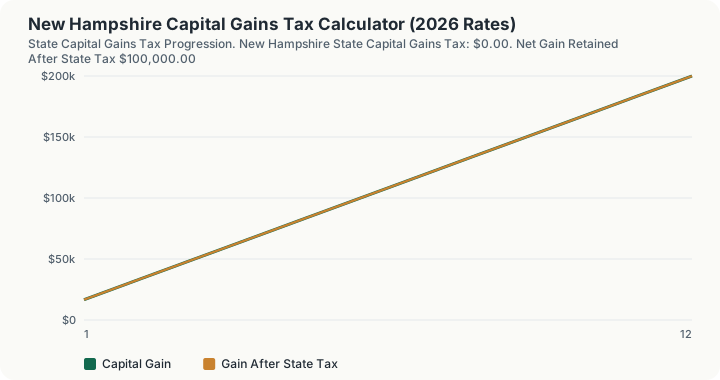
Quick Answer: New Hampshire imposes no state-level tax on capital gains, so an investor realizing a $100,000 gain owes $0 in New Hampshire state tax and keeps the full $100,000, subject only to federal tax.
No Tax on the Gain Itself, at Any Size
New Hampshire levies no broad-based personal income tax on wages or capital gain. Its entry in the engine's capital gains table is flagged as zero-tax with an empty bracket array, so the calculation returns before any rate schedule is consulted.
On the defaults, $100,000 of gain over $75,000 of other income, the New Hampshire tax is $0.00, the effective rate is 0.00%, the marginal rate is 0.00%, and the full $100,000.00 of gain is retained.
The twelve-row sweep reflects that exactly. It steps from a $16,666.67 tier in row 1 to $200,000 in row 12, and the "State Tax Due" column prints $0.00 in every row, so the "Gain After State Tax" column simply repeats the gain column.
How This Is Calculated
New Hampshire has no broad-based individual income tax, and no state tax reaches a realized capital gain. Wage income is untaxed too, so unlike most states there is no ordinary-income schedule for a gain to stack onto. Every input on this page produces the same state answer, which is nothing.
There is no rate schedule to reproduce, so the two identities the calculator applies are simply these.
What the calculator does with your inputs:
- Start with the net gain. The figure you enter is the gain left after capital losses and loss carryforwards have been netted against it.
- Look for a New Hampshire rate schedule. There is none to look up, so the state line resolves to zero before any bracket arithmetic runs. The other-income field has no effect here; it is kept so the page compares cleanly against states where it does matter.
- Effective rate. Zero divided by the realized gain is 0.00%, and it stays 0.00% whether the gain is $10,000 or $10 million.
- Net proceeds. The gain passes through the state layer whole.
- What is still owed. Federal capital gains tax and the federal net investment income tax are unaffected by residence in a no-tax state and are calculated separately.
Worked Example
Consider an investor residing in New Hampshire who realizes $100,000 in capital gains alongside $75,000 in ordinary income during the year.
- Check the state rate. New Hampshire does not levy an individual income tax, and it does not carve out a separate tax on investment gains either, so the state rate applied to this sale is 0.00%.
- Compute the state tax. $100,000 × 0.00% = $0.00. No state return, no state estimated payments, and no state withholding apply to this capital gain.
- Net proceeds. The investor retains the full $100,000 gain after state tax, compared to an investor in a high-tax state who might lose 5% to 13% of the same gain to state liability.
- Federal liability remains. New Hampshire's 0% state rate does not eliminate federal exposure: the gain is still subject to federal long-term or short-term capital gains brackets under IRC § 1(h), plus the 3.8% NIIT surtax where applicable.
What a Flat Zero Sweep Does and Does Not Tell You
Each additional $1,000,000 of gain costs $0.00 in New Hampshire tax, at every point in the sweep and in both directions.
Both of the other inputs are inert. Setting other taxable income to $0 leaves the answer at $0.00, where the same change on the New York page moves the tax by $540.00 on an identical gain. Switching filing status to married filing jointly likewise leaves it at $0.00, where on the New Jersey page that switch is worth $735.00. The engine exits before the stacking and bracket-selection logic runs, so neither field can reach the result.
The reverse question has no crossing point. There is no gain within the input's $100,000,000 range at which a New Hampshire rate begins to apply.
What the sweep is still useful for. With the tax column pinned at zero, the retained-gain column is a straight scale of your entry: $16,666.67 at row 1, $100,000.00 at row 6 and $200,000.00 at row 12. Set against the same tiers computed for a taxing state, the entire difference is the state tax line. The identical $100,000 gain stacked on $75,000 of other income costs $4,550.00 in Nebraska, $4,777.50 in New Mexico, $5,971.75 in New York and $6,370.00 in New Jersey. Those four figures are what a New Hampshire filer is comparing against, and the $0.00 here is only meaningful next to them.
What the $0.00 is an answer to. It covers New Hampshire tax on the gain and nothing more. Federal capital gains tax, the 3.8% net investment income tax and any non-resident tax owed to the state where the asset was sourced all sit outside this figure, and New Hampshire residency does not reduce any of them.
Federal Rules That Still Apply
With the state line at zero, the federal rules are the whole calculation: - Holding period. More than one year of holding produces a long-term gain taxed at 0%, 15%, or 20% by taxable income. A year or less is taxed at ordinary federal rates. - Net Investment Income Tax. The federal 3.8% tax under IRC § 1411 applies once modified AGI exceeds $200,000 for a single filer or $250,000 on a joint return. Note the shape of this: New Hampshire stopped taxing investment income, and the federal government still taxes it. - Federal estimated payments. The IRS generally expects estimated tax when you will owe $1,000 or more after withholding and credits, and generally treats 90% of the current year's tax or 100% of the prior year's as sufficient. New Hampshire residents used to file quarterly interest and dividends estimates; that habit no longer has a state counterpart, but the federal one remains. - Loss netting. IRC § 1211 allows capital losses against capital gains, plus up to $3,000 of excess loss against ordinary income, with the remainder carried forward.
What New Hampshire Charges Instead
New Hampshire's position changed recently, so the year matters. The state never had a broad income tax on wages, but it did tax interest and dividends under RSA 77, the I&D tax, at 5% and then 4% for periods ending on or after December 31, 2023 and 3% for periods ending on or after December 31, 2024. The Department of Revenue Administration reports that the tax was repealed for taxable periods beginning after December 31, 2024, so beginning with 2025 there is no I&D return and no I&D estimate to file.
Two points follow that are specific to this state. First, even while the I&D tax existed it reached interest and dividend income, not capital gains, so a New Hampshire resident selling appreciated stock owed the state nothing before the repeal either. Second, the repeal is not amnesty for earlier years: a 2024 or earlier DP-10 obligation survives on its own terms.
What funds the state is property tax, at a level of reliance among the highest in the country, along with business taxes on enterprises rather than individuals, the Business Profits Tax and the Business Enterprise Tax, plus meals and rooms and other targeted levies. There is no general sales tax, so a New Hampshire household pays its state and local bill mostly through the town tax bill.
Residency and Source Rules
The nearest borders are Massachusetts, Vermont, and Maine, all of which tax capital gains, and all of which take residency questions seriously. Domicile at the moment of recognition is the pivot: a gain realized while still a Massachusetts resident stays taxable in Massachusetts even if the closing check arrives at a New Hampshire address. Working in one state while living in another raises a separate wage sourcing question that does not usually change how a portfolio gain is treated, but it does put a taxpayer in another state's filing system where residency gets examined. And a vacation property sold in Maine or Vermont is generally taxed there on the source gain, whichever state the seller calls home.
What This Does Not Account For
This page is exact about the state answer, which is zero. Everything below sits outside the calculator and still has to be worked out separately: - Federal capital gains tax: long-term rates of 0%, 15%, or 20%, and short-term gains taxed at ordinary rates reaching 37%. - Net Investment Income Tax: the 3.8% federal tax under IRC § 1411 on net investment income above $200,000 of modified AGI for single filers and $250,000 for married filing jointly. - Alternative Minimum Tax: federal AMT under IRC § 55, which reaches the bargain element on an incentive stock option exercise. - Section 1031 like-kind exchanges: federal deferral for real property held for productive use in a trade or business or for investment. - Qualified Small Business Stock: the federal gain exclusion under IRC § 1202, which has its own holding period and issuer tests. - Tax owed to another state: a gain sourced to a state that does tax it, which this calculator does not model.
Common Pitfalls
- Believing the I&D repeal changed capital gains treatment. It did not; that tax reached interest and dividends, and capital gains were outside it before 2025 as well.
- Skipping a pre-2025 filing obligation. The repeal applies to taxable periods beginning after December 31, 2024 and leaves earlier years due.
- Ignoring the federal estimate. No state estimate exists to prompt it, and a large gain can require a federal payment in the quarter it is realized.
- Recognizing a gain before the move from a taxing state is complete. Timing, not the forwarding address, generally decides which state gets it.
- Overlooking basis adjustments. Reinvested distributions and improvements to real property both change the federal gain.
Frequently Asked Questions
Does New Hampshire have a state capital gains tax?
Did the interest and dividends tax apply to capital gains?
When was the interest and dividends tax repealed?
Can capital losses offset capital gains in New Hampshire?
Do I owe quarterly estimated payments on a large gain?
Are retirement distributions taxed in New Hampshire?
Sources
- New Hampshire Department of Revenue Administration, Interest and Dividends Tax: the tax applied to interest and dividend income, carried a 4% rate for periods ending on or after December 31, 2023 and 3% for periods ending on or after December 31, 2024, and was repealed for taxable periods beginning after December 31, 2024, with no 2025 return or estimate required. revenue.nh.gov
- IRS, Topic no. 409, Capital Gains and Losses.. irs.gov
- IRS, Publication 550, Investment Income and Expenses (Including Capital Gains and Losses).. irs.gov/publications/p550
Also consulted: IRS, Estimated Taxes: the $1,000 threshold and the current-year and prior-year safe harbors.