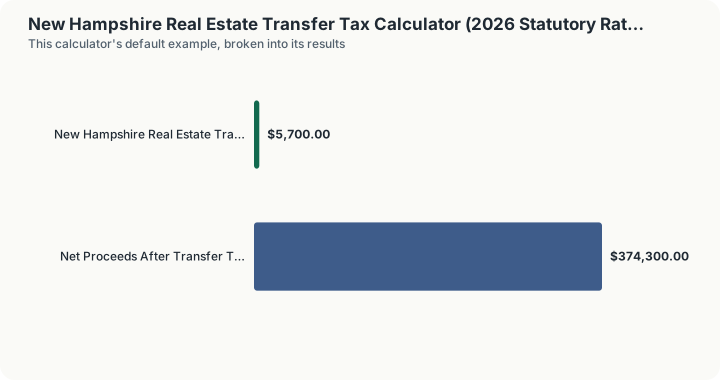
Quick Answer: New Hampshire charges a combined 1.5% real estate transfer tax, split into two separate 0.75% charges, one paid by the buyer and one paid by the seller, so a $380,000 home sale generates $5,700 in total tax, $2,850 from each party.
Overview
New Hampshire's Real Estate Transfer Tax under RSA 78-B:1 is structured as two mirror-image halves rather than one blended rate: the buyer pays $0.75 per $100, and the seller separately pays another $0.75 per $100, for a combined 1.5% of the sale price. That statutory split-by-design makes New Hampshire's payer question far less ambiguous than in most flat-rate states, where the purchase contract alone decides the allocation.
At 1.5% combined, New Hampshire's rate is notably high for a state with no income tax and no sales tax, well above flat-rate neighbors elsewhere in New England like Massachusetts at 0.456%, though still below Pennsylvania's typical 2% combined rate outside Philadelphia. A $380,000 New Hampshire sale generates $5,700 in total tax, split into two $2,850 halves paid independently by each side of the transaction.
Because both halves are levied under the same statute rather than one combined bill assigned to a single party, a New Hampshire closing statement should show the buyer's and seller's transfer tax obligations as two distinct line items rather than one negotiated total.
How This Is Calculated
New Hampshire is unusual in charging both sides of the deal the same rate by statute: RSA 78-B:1 assesses $0.75 per $100 on the buyer and $0.75 per $100 on the seller, computed independently.
The engine applies the combined 1.5% to the full price, which is what changes hands at the closing table in total. Each side owes exactly half of it. Both halves are flat with no brackets, so the combined effective rate stays at 1.5% whatever the house costs. A state with no sales tax and no income tax on wages recovers a good deal here instead.
Worked Example
New Hampshire charges both sides of the deal at the same rate by statute, so the combined figure is the one that matters at the closing table.
Step 1 -- The consideration. Contract sale price = $380,000
Step 2 -- The combined statutory rate. RSA 78-B:1, $0.75 per $100 from the buyer plus $0.75 per $100 from the seller = 1.5%
Step 3 -- Apply the combined rate. $380,000 x 0.015 = $5,700.00
Step 4 -- Net of the full combined tax. $380,000.00 - $5,700.00 = $374,300.00
Step 5 -- The effective rate. $5,700.00 / $380,000 = 1.500%
The calculator's $1,500,000 scenario, where the rate still refuses to move.
Step 6 -- The luxury sale at the combined rate. $1,500,000 x 0.015 = $22,500.00
Step 7 -- The effective rate, unchanged. $22,500.00 / $1,500,000 = 1.500%
At 1.5% combined, New Hampshire's transfer tax is among the heaviest in the country in a state that levies no general income or sales tax, which is not a coincidence. Read Step 4 with the same caution the split demands: the engine subtracts the whole combined tax from the price, so that figure is the transaction's net rather than the seller's. The seller's own statutory half of the baseline bill is $2,850, and the buyer owes an identical $2,850 independently. The calculator does not perform that halving, so it is not shown as a step. There is no bracket, no exemption tier and no mansion surcharge, so the 1.5% in Steps 5 and 7 holds from the smallest lot sale to the largest.
Splitting the 1.5% and Walking the Price
New Hampshire's transfer tax is written as $0.75 per $100 charged to the buyer and the same again to the seller. The engine applies the combined 1.5% in one multiplication and reports a single figure, so the split is yours to perform.
Each additional $1,000 of sale price costs $15.00 in combined tax, $7.50 to each side. Moving the price from $380,000 to $381,000 moves the total from $5,700.00 to $5,715.00.
The split, priced at three points. At the $380,000 baseline the combined tax is $5,700.00, so each party pays $2,850.00. At $250,000 the combined figure is $3,750.00 and each side pays $1,875.00. At $1,500,000 it is $22,500.00 and each side pays $11,250.00. The calculator never shows those halves; the headline and the net-proceeds output both work from the combined figure, which means the "Net Proceeds After Transfer Tax" line of $374,300.00 at the baseline understates what a seller actually keeps by the buyer's $2,850.00 half.
The reverse question: how large must a New Hampshire sale be before the combined tax reaches $10,000? At $666,666 the tax is $9,999.99 and at $666,667 it is $10,000.01. Nothing statutory happens there; it is where 1.5% of the price crosses the round number.
No high-value cliff, and no minimum applied. A $999,999 sale owes $14,999.99 and a $1,000,000 sale owes $15,000.00, so the extra dollar costs one and a half cents. The "Mansion Tax / High-Value Surcharge" output reads $0.00 at every price on this page, unlike the New Jersey and New York pages where crossing $1,000,000 adds a surcharge on the whole consideration. At the other end of the range the engine applies no statutory minimum either, so a very low-value transfer returns a proportionally tiny figure rather than a floor.
Why 1.5% is the number to remember. It is the highest flat transfer tax rate in this batch of state calculators: the same $380,000 sale costs $5,700.00 here, $1,938.00 in Nevada, $855.00 in Nebraska and $0.00 in Montana and New Mexico.
What This Does Not Account For
- The buyer and seller halves are not reported separately. The engine computes the combined 1.5% and the net proceeds output subtracts all of it from the sale price, including the buyer's half.
- No statutory minimum is applied at the low end of the price range.
- The $20 minimum tax. Very low-value transfers still owe at least $20 in combined tax even if 1.5% of the consideration would otherwise compute to less; this only matters well below this calculator's minimum input range.
- Statutory exemptions. RSA 78-B:2 exempts certain transfers, including some between spouses, transfers to correct a title defect, and specific transfers to or from government entities; this calculator assumes a standard taxable arm's-length sale.
- Transfers of certain timeshare and easement interests, which New Hampshire taxes under separate valuation rules not modeled here.
- Recording fees, which the county register of deeds charges separately from the transfer tax itself.
Common Pitfalls
- Assuming only one party pays. Unlike most states, where custom (not statute) assigns the tax to the seller, New Hampshire law explicitly makes both buyer and seller independently liable for their own 0.75% share.
- Quoting only "1.5%" without explaining the split. While 1.5% is the correct combined figure, describing it as a single tax obscures that it is really two coexisting taxes, which matters for anyone trying to reconcile a New Hampshire closing statement line by line.
- Forgetting the $20 statutory minimum on unusually low-value transfers.
- Assuming the tax is negotiable away entirely. The purchase agreement can shift who ultimately bears the economic cost between the parties, but neither party can be released from the legal filing and payment obligation itself.
Frequently Asked Questions
Is New Hampshire's transfer tax really paid by both the buyer and the seller?
Can the buyer and seller negotiate who pays New Hampshire's transfer tax?
Does New Hampshire have a mansion tax for expensive homes?
Is there a minimum transfer tax in New Hampshire?
Are any New Hampshire property transfers exempt from the transfer tax?
Sources
- New Hampshire Department of Revenue Administration, Real Estate Transfer Tax (RSA 78-B:1) revenue.nh.gov