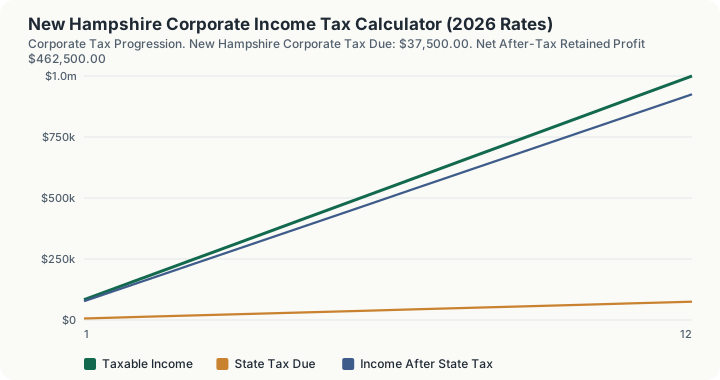
Quick Answer: On $500,000 of pre-apportioned taxable income, New Hampshire's flat 7.50% corporate income tax rate produces $37,500.00 in state tax due and $462,500.00 in net after-tax profit.
The 7.50% Is the Profits Tax and Only the Profits Tax
New Hampshire has no broad-based personal income tax, and that reputation does not carry over to corporations. The Business Profits Tax runs at a flat 7.50%, which turns this calculator's $500,000 baseline into $37,500.00 of state tax and leaves $462,500.00 retained.
The rate is flat, so the two rate outputs on this page never diverge on their own. Both the effective rate and the marginal rate read 7.50% whether the apportioned income is $83,333.33, where the tier schedule opens at $6,250.00 of tax, or $1,000,000, where it closes at $75,000.00. Twelve times the income, twelve times the tax, no bracket lookup anywhere in the code path.
What that flatness hides is that the Business Profits Tax is one of two New Hampshire business taxes and this calculator models only that one. The Business Enterprise Tax falls on compensation, interest and dividends paid out rather than on profit, so a New Hampshire business with no profit at all can owe it, and BET paid is creditable against BPT. Nothing on this page computes that interaction.
How This Is Calculated
The calculator multiplies the apportioned taxable income you enter by 7.50%, subtracts the credits you enter, and floors the result at zero.
- Read the apportioned gross business profits you entered. The figure is treated as already apportioned to New Hampshire and already net of the state's compensation deduction, depreciation adjustments and NOL carryforward.
- Apply the flat 7.50% rate. New Hampshire's entry in the corporate rate table is one unbounded band.
- Subtract the entered credits, dollar for dollar, from the computed tax.
- Floor the result at zero.
- Divide net tax by income for the effective rate, which returns 7.50% whenever no credits are entered.
- Build the twelve-row tier schedule, each row re-running step 2 on your income times the row number over six.
Worked Example
Using this calculator's baseline scenario: a corporation with $500,000 in taxable income apportioned to New Hampshire.
- Start with apportioned taxable income. $500,000 of gross business profits has been apportioned to New Hampshire before state tax.
- Apply the flat statutory rate. $500,000 x 7.50% = $37,500.00, with no bracket lookup required.
- New Hampshire corporate tax due: $37,500.00.
- Net retained profit. $500,000 - $37,500.00 = $462,500.00, before any separate federal liability.
Pricing the Next Dollar and the Last Useful Credit
New Hampshire's rate schedule contains no threshold, so the only step anywhere in this calculation comes from the credit field. It is worth walking, because unlike a bracket edge it can silently waste money.
At $37,499 of entered credits. The computed $37,500.00 less $37,499 leaves $1.00 of Business Profits Tax due.
At $37,500 of entered credits. Liability lands on $0.00 exactly.
At $37,501 of entered credits. Liability is still $0.00. The additional credit dollar produced no benefit in this model.
That is the zero floor, and the calculator neither carries the surplus forward nor tells you how much of the credit went unused. Read a $0.00 headline as "fully offset", not as "exactly matched".
Each additional $1,000 of apportioned profit costs $75.00. New Hampshire's rate is the highest in this set of flat-rate states, and the per-thousand figure is the cleanest way to see it: the same $1,000 costs $45.50 in a 4.55% state and $65.00 in a 6.50% state.
The reverse question: how much profit can be apportioned to New Hampshire before the Business Profits Tax reaches $10,000? At $133,333 the tax is $9,999.98. At $133,334 it is $10,000.05. There is no statutory line at that point; it is simply where 7.50% of the base crosses five figures.
Right method against wrong method. Entering $500,000 of total company profits when only 40% is apportioned to New Hampshire produces $37,500.00 rather than the $15,000.00 that $200,000 of apportioned profit would produce, a $22,500.00 overstatement. The calculator cannot detect that error, because apportionment happens entirely before the input box.
Reading the tier schedule as a scale check. Rows 1 through 12 are your own entry multiplied by the row number and divided by six, so row 3 prices $250,000 of profit at $18,750.00 and row 9 prices $750,000 at $56,250.00. Every row divides out to the same 7.50%, which makes the table a useful sanity check on an apportionment estimate: if your own bracketing of possible New Hampshire profit does not land between two adjacent rows, one of the two figures is wrong.
What This Does Not Account For
- The Business Enterprise Tax is not computed, and neither is the BET credit against BPT. A New Hampshire filer's combined obligation is not the $37,500.00 shown here, and a filer with no profit can owe BET while this page returns $0.00.
- No minimum tax or filing threshold is applied. New Hampshire exempts smaller filers from the BPT by reference to gross business income, and the calculator tests nothing of the kind.
- No apportionment is performed. The single sales factor with market-based sourcing determines the number you type in.
- No state modifications or NOL carryforwards are computed. The compensation deduction for owner services, the state's section 179 position, and the statutory dollar cap on the NOL deduction all change the base first.
- Credits are taken at face value, with no eligibility test, cap, ordering rule or carryforward.
- Federal corporate income tax (21% under IRC § 11) is separate and not included.
- BEAT and GILTI provisions under the federal international regime are not reflected.
- Local municipal corporate earnings taxes are outside the model.
Common Pitfalls
- Treating New Hampshire as a low-tax state for corporations. No personal income tax does not imply a light corporate rate: at 7.50%, $500,000 of apportioned profit costs $37,500.00, against $32,500.00 at 6.50% and $22,750.00 at 4.55%.
- Ignoring the BET side entirely. Because BET is creditable against BPT, the $37,500.00 here is a ceiling on the profits-tax half of a combined computation, not the combined figure.
- Entering book profit rather than apportioned gross business profits. Each $1,000 of difference between those two bases is worth $75.00.
- Reading the effective rate output as new information. Without credits it is always 7.50%, identical to the marginal rate, because there is a single band.
Frequently Asked Questions
Does New Hampshire tax corporate profit?
What does each extra $1,000 of New Hampshire profit cost?
How much profit before the tax reaches $10,000?
Does this include the Business Enterprise Tax?
Why does the result show $0.00 when I enter large credits?
Sources
- New Hampshire Department of Revenue Administration: Business Profits Tax Statutes and Guidance (2026). revenue.nh.gov
- Multistate Tax Commission (MTC): Uniform Apportionment and Allocation Guidelines. mtc.gov