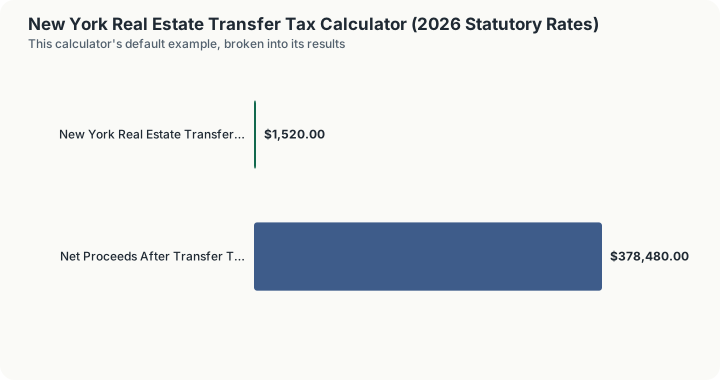
Quick Answer: New York charges a base 0.4% real estate transfer tax on every sale, plus a statewide 1% "mansion tax" that applies to the entire purchase price the instant it reaches $1,000,000. On the calculator's $380,000 baseline sale, that works out to $1,520.00 in transfer tax, all of it base tax, with no mansion tax due.
Overview
New York layers two separate transfer taxes on most residential sales. The base real estate transfer tax under Tax Law Section 1402 is a flat 0.4% of consideration, applying at every price point statewide. On top of that, a statewide mansion tax under Section 1402-a adds a flat 1% of the entire purchase price, not just the excess, once consideration reaches $1,000,000, a cliff rather than a marginal bracket. A home selling for $999,999 owes no mansion tax; the identical home at $1,000,000 owes a full $10,000 in mansion tax alone.
New York City layers its own additional progressive mansion tax, reaching up to 3.9% on the highest-value sales, on top of these statewide figures; that city-specific surcharge is not modeled here, which covers only the statewide base tax and statewide cliff. By custom in most of the state, the seller pays the base 0.4% tax and the buyer pays the 1% mansion tax, though the purchase contract can reassign either obligation.
How This Is Calculated
New York's structure is two levies with two completely different shapes: a flat 0.4% on every sale, and a mansion tax that is a cliff, not a bracket.
The base tax is $2.00 per $500 of consideration under Tax Law 1402, applied at every price with no threshold. The engine then tests the price against $1,000,000. Below it, no mansion tax. At or above it, 1% of the entire sale price, not 1% of the excess, under Tax Law 1402-a. A $999,999 sale pays $4,000. A $1,000,000 sale pays $14,000. That $10,000 step at a single dollar of price is the point of the cliff and the reason contracts get written just under the line.
New York City layers its own progressive supplemental mansion tax, up to 3.9%, on top of this. That is city-specific rather than statewide and is not in the figure above.
Worked Example
New York charges a flat base tax on every sale and then a mansion tax that arrives all at once. Take the baseline sale first, where only the base tax applies.
Step 1 -- The consideration. Contract sale price = $380,000
Step 2 -- The base transfer tax rate. Tax Law 1402, $2.00 per $500 of consideration = 0.4%
Step 3 -- Apply the base rate. $380,000 x 0.004 = $1,520.00
Step 4 -- The mansion tax test. $380,000 is below the $1,000,000 threshold, so the mansion tax is $0.00
Step 5 -- Total transfer tax due. $1,520.00 + $0.00 = $1,520.00
Step 6 -- Net proceeds after tax. $380,000.00 - $1,520.00 = $378,480.00
Step 7 -- The effective rate. $1,520.00 / $380,000 = 0.400%
Now the boundary itself, priced from both sides. This is the number people come to a New York transfer tax calculator to find.
Step 8 -- A $999,000 sale: base tax. $999,000 x 0.004 = $3,996.00
Step 9 -- A $999,000 sale: mansion tax. Below the threshold, so $0.00, and the total is $3,996.00
Step 10 -- A $1,000,000 sale: base tax. $1,000,000 x 0.004 = $4,000.00
Step 11 -- A $1,000,000 sale: mansion tax at 1% of the FULL price. $1,000,000 x 0.01 = $10,000.00
Step 12 -- A $1,000,000 sale: total transfer tax due. $4,000.00 + $10,000.00 = $14,000.00
A thousand dollars of extra price adds $10,004.00 of tax. Read Step 11 twice, because it is the most misunderstood line in New York transfer tax law: the 1% is applied to the entire consideration, not to the $1 by which the price exceeds the threshold. A marginal reading would produce a mansion tax of one cent at $1,000,001; the statute produces $10,000.01. The calculator's luxury scenario shows the same rule at a larger price: at $1,500,000 the base tax is $6,000.00, the mansion tax is $15,000.00, and the total is $21,000.00, an effective rate of 1.400%. Above the threshold the effective rate is pinned at 1.4% because both components are flat percentages of the full price. By custom the seller pays the base 0.4% and the buyer pays the 1% mansion tax, though the contract governs. New York City layers its own progressive supplemental mansion tax, up to 3.9%, on top of every figure above, and that city surcharge is not modelled here.
What This Does Not Account For
- New York City's supplemental mansion tax. NYC layers its own progressive surcharge, up to 3.9% on the highest tiers, on top of the statewide rates modeled here; this calculator covers the statewide base and cliff only.
- Commercial and mixed-use property nuances. Different rules can apply to commercial transfers, cooperative apartment stock transfers, and multi-family buildings with more than three units.
- Negotiated allocation of who pays. While the seller customarily pays the base transfer tax and the buyer customarily pays the mansion tax, the purchase contract can shift either obligation.
- Exemptions and credits. Certain transfers, such as those between spouses, into revocable trusts, or by government entities, may be exempt; this calculator assumes a standard arm's-length sale.
- County recording fees and other closing costs. Title insurance, attorney fees (customary in New York), and mortgage recording tax on the buyer's loan are separate line items not included here.
Common Pitfalls
- Treating the mansion tax as marginal. The single most common modeling error is calculating 1% only on the amount above $1,000,000. New York applies the 1% to the full price once the threshold is met.
- Forgetting NYC's additional surcharge. Buyers and sellers in New York City frequently underestimate total tax by applying only the statewide rate and ignoring the city's own progressive mansion tax add-on.
- Assuming a $999,999 sale and a $1,000,000 sale carry nearly the same tax bill. The cliff creates a discontinuity of roughly $10,000 at that exact boundary, which can meaningfully affect negotiation strategy near the threshold.
- Confusing the mortgage recording tax with the transfer tax. New York also imposes a separate mortgage recording tax on the buyer's financing, which is unrelated to the seller-side transfer tax modeled here.
- Assuming the seller always pays everything. Local custom assigns the base transfer tax to the seller and the mansion tax to the buyer, but the contract of sale governs and can differ.
Frequently Asked Questions
What is New York's real estate transfer tax rate?
What is the New York mansion tax and when does it apply?
Is the mansion tax calculated only on the amount above $1,000,000?
Who pays New York's transfer tax and mansion tax, the buyer or the seller?
Does this calculator include New York City's extra mansion tax surcharge?
Sources
- New York State Department of Taxation and Finance, Real Estate Transfer Tax (Tax Law Article 31, Section 1402) and Real Estate Transfer Tax Return for Mansion Tax (Section 1402-a). tax.ny.gov