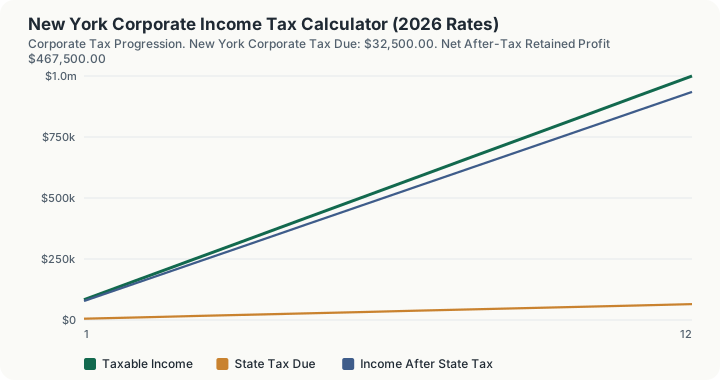
Quick Answer: On $500,000 of pre-apportioned taxable income, New York's flat 6.50% corporate income tax rate produces $32,500.00 in state tax due and $467,500.00 in net after-tax profit.
6.50% Is the Business Income Base, and Nothing Else
New York's Article 9-A franchise tax is not computed once. The state computes a business income base at 6.50%, a business capital base, and a fixed dollar minimum scaled to New York receipts, then charges whichever comes out highest. This calculator computes the first of those three and stops.
Within that base the rate is genuinely flat, which the tier schedule makes plain. It opens at $83,333.33 of apportioned income against $5,416.67 of tax and closes at $1,000,000 against $65,000.00. The effective rate output and the marginal rate output both read 6.50% at every row, because New York's entry in the corporate rate table is a single unbounded band rather than a bracket array.
The $500,000 baseline therefore produces $32,500.00. The same figure would come out of Alabama, Tennessee or West Virginia, which share the 6.50% rate. What does not carry across is New York City: a corporation operating in the five boroughs owes a separate city corporate tax on top of everything computed here, and none of it appears in the $32,500.00.
How This Is Calculated
The calculator multiplies the apportioned business income you enter by 6.50%, subtracts the credits you enter, and floors the answer at zero.
- Read the apportioned business income you entered. It is treated as already apportioned to New York and already net of New York modifications, prior net operating loss conversion and post-reform NOL carryforwards.
- Apply the flat 6.50% rate from the single-band rate table entry.
- Subtract the entered credits from the computed tax, dollar for dollar.
- Floor the result at zero.
- Divide net tax by income for the effective rate, which returns 6.50% whenever no credits are entered.
- Build the twelve-row tier schedule, re-running step 2 on your income times the row number over six.
Worked Example
Using this calculator's baseline scenario: a corporation with $500,000 in taxable income apportioned to New York.
- Start with apportioned business income. $500,000 has been apportioned to New York before state tax.
- Apply the flat statutory rate. $500,000 x 6.50% = $32,500.00, with no bracket lookup required.
- New York business income base tax: $32,500.00.
- Net retained profit. $500,000 - $32,500.00 = $467,500.00, before any separate federal or New York City liability.
Reading the Tier Schedule Against the Credit Floor
New York's business income rate has no threshold in it, so the single discontinuity in this model belongs to the credit field.
At $32,499 of entered credits. The computed $32,500.00 less $32,499 leaves $1.00 of tax due.
At $32,500 of entered credits. Liability is $0.00 exactly.
At $32,501 of entered credits. Liability is still $0.00, and the extra credit dollar has been dropped.
That floor is a maximum against zero with nothing behind it: no carryforward, no refund, and no output reporting how much credit went unused. It also interacts badly with the part of New York's regime this calculator omits. Because the state charges the highest of three bases, a corporation whose business income base is fully credited to $0.00 here may still owe the capital base or the fixed dollar minimum, and this page will not say so.
Each additional $1,000 of apportioned business income costs $65.00. The step is identical everywhere on the sweep, which is why row 12 of the schedule is exactly double row 6.
The reverse question: how much business income can be apportioned to New York before the base tax reaches $10,000? At $153,846 the tax is $9,999.99 and at $153,847 it is $10,000.06. Nothing statutory happens at that point; it is where 6.50% of the base crosses the round number.
One structural exception the flat rate conceals. Qualified New York manufacturers face a 0% business income rate. This calculator has no manufacturer flag, so such a filer would see $32,500.00 on the $500,000 baseline where the correct business income base figure is $0.00. That is the largest single error this page can produce, and it comes from a missing input rather than from the arithmetic.
Reading the tier schedule as a scale check. Each row is your entry multiplied by the row number and divided by six, so row 3 prices $250,000 of apportioned income at $16,250.00 and row 9 prices $750,000 at $48,750.00. Every row divides out to the same 6.50%, which is what makes the table useful as a bracket check on an apportionment estimate rather than as a tax schedule: if your own high and low estimates of New York income do not straddle two adjacent rows, one of them is wrong.
What the sweep cannot tell you, in one figure. Because the business income base is linear, the only way this page produces a number other than 6.50% of what you type is through the credit field, and that field is floored at zero. Between $0 and $32,500 of credits on the baseline, every credit dollar is worth a full dollar; past $32,500 it is worth nothing; and at no point does the page compare the result against the capital base or the fixed dollar minimum that might actually govern the bill.
What This Does Not Account For
- The capital base tax and the fixed dollar minimum are not computed. New York charges the highest of the three measures, so the $32,500.00 here is only one candidate.
- The 0% qualified manufacturer rate is not available. There is no input for manufacturer status, and the calculator always applies 6.50%.
- New York City's corporate tax is not included. It is a separate city-level computation layered on top of the state figure.
- No apportionment is performed. The single receipts factor with customer-based sourcing, and mandatory unitary combined reporting where the ownership and unitary tests are met, all determine the number you type in.
- No New York modifications or NOL usage is computed, including subsidiary capital, investment income and related-party expense treatment.
- Credits are taken at face value, with no eligibility test, cap, ordering rule or carryforward.
- Federal corporate income tax (21% under IRC § 11) is separate and not included.
- BEAT and GILTI provisions under the federal international regime are not reflected.
Common Pitfalls
- Treating the 6.50% result as the New York franchise tax. It is the business income base only, and the state bills the highest of three bases.
- Forgetting the city layer. For an operation inside New York City the $32,500.00 understates the corporate income burden by the whole city tax.
- Entering worldwide income rather than the New York share. Each $1,000 of over-entry costs $65.00 in the displayed answer.
- Manufacturer filers taking the headline at face value. At 0% on the business income base, the correct figure for a qualified New York manufacturer is $0.00 rather than the $32,500.00 shown.
Frequently Asked Questions
What is New York's corporate income tax rate?
What does each extra $1,000 of New York income cost?
How much income before the tax reaches $10,000?
Does this include New York City corporate tax?
Why might my actual New York bill exceed this figure?
Sources
- New York State Department of Taxation and Finance: Article 9-A Franchise Tax on General Business Corporations (2026). tax.ny.gov
- Multistate Tax Commission (MTC): Uniform Apportionment and Allocation Guidelines. mtc.gov