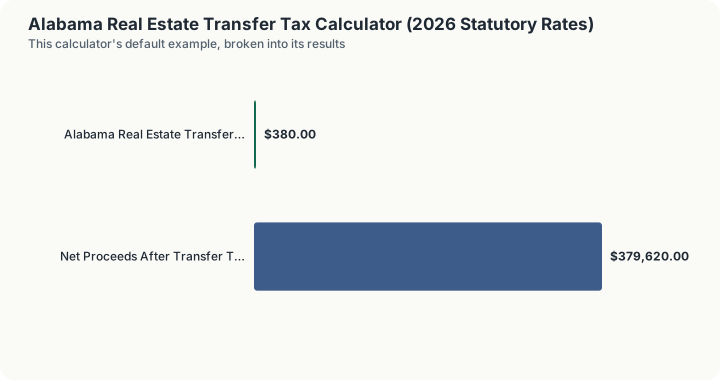
Quick Answer: A $380,000 home sale in Alabama owes $380.00 in state deed transfer tax, a flat 0.1% rate applied to the full sale price with no brackets, exemptions by value, or mansion surcharge.
Overview
Alabama's deed tax is governed by Code Section 40-22-1, which sets the rate at $0.50 per $500 of property value, an even 0.1% of the sale price with no bracket schedule and no local add-on anywhere in the state. Only Colorado charges a lower nominal state rate among states that levy a real estate transfer tax at all, which places Alabama near the very bottom of the national range rather than merely somewhere in the low end.
Payment responsibility is not fixed by statute; Alabama buyers and sellers negotiate the allocation in the purchase contract, and in many transactions the buyer ends up covering it at recording, a reversal of the seller-pays norm found in states like Georgia or South Carolina. A $100,000 lot and a $5,000,000 estate both pay the identical 0.1%, so the tax scales in perfect proportion to price with nothing to model beyond straight multiplication.
How This Is Calculated
Alabama's deed tax is one of the lowest in the country and one of the simplest: a single 0.1% rate, no county or municipal surcharge on top of it, and no threshold anywhere in the schedule.
The engine passes the sale price to the calculateStateRealEstateTransferTax primitive, which reads Alabama's flat rate of 0.001 from the statutory table and multiplies. It reports the tax due, the effective rate, and net proceeds after the tax comes out of the price. Because there are no brackets, the effective rate reads 0.100% at every price, and a $50,000 vacant lot and a $50,000,000 commercial parcel are taxed at the same rate.
Worked Example
Take a Birmingham three-bedroom under contract at the calculator's baseline price and walk the deed tax from the rate table through to the seller's net.
Step 1 -- The consideration. Contract sale price = $380,000
Step 2 -- The statutory rate. Ala. Code 40-22-1, $0.50 per $500 of value = 0.1%
Step 3 -- Apply the rate to the full price. $380,000 x 0.001 = $380.00
Step 4 -- Net proceeds after the deed tax. $380,000.00 - $380.00 = $379,620.00
Step 5 -- The effective rate. $380.00 / $380,000 = 0.100%
Now run the calculator's luxury scenario, a $1,500,000 sale, and watch for a bracket that never arrives.
Step 6 -- The same rate at nearly four times the price. $1,500,000 x 0.001 = $1,500.00
Step 7 -- The effective rate at the higher price. $1,500.00 / $1,500,000 = 0.100%
Steps 5 and 7 are the point of the exercise. In a bracketed state the effective rate rises as the price climbs; in Alabama it does not move by a single basis point. The tax ratio ($1,500 / $380 = 3.947) is exactly the price ratio ($1,500,000 / $380,000 = 3.947), which is the arithmetic signature of a genuinely flat tax. A $50,000 vacant lot and a $50,000,000 commercial parcel are both taxed at 0.1%, so once you know the price you can produce the Alabama deed tax mentally by moving the decimal point three places, and the calculator exists mainly to keep the net-proceeds and cross-state comparisons honest rather than to do anything you could not do on the back of the contract.
What This Does Not Account For
- County and municipal recording fees. Alabama counties charge separate deed recording fees at the probate office, typically a flat per-page or per-document charge unrelated to sale price, which this calculator does not include.
- Mortgage recording tax. Alabama levies a separate mortgage recording tax (roughly 0.15% of the loan amount) on any mortgage instrument recorded alongside the deed. This is a distinct tax from the deed transfer tax modeled here and applies to the buyer's financing, not the sale price itself.
- Exemptions for certain transfer types. Transfers between spouses, transfers into a revocable trust, and certain transfers incident to divorce or inheritance may be exempt from the deed tax under Alabama law. This calculator assumes a standard arm's-length sale subject to the full tax.
- Title insurance, attorney fees, and other closing costs. The deed tax is only one line item on an Alabama closing statement; title search fees, attorney fees, and survey costs are separate and not modeled here.
Common Pitfalls
- Assuming Alabama has no transfer tax at all. Alabama does levy a deed tax, just at a very low flat rate compared to states like Delaware or Connecticut. Sellers sometimes assume the absence of a well-known "transfer tax" line item means Alabama charges nothing, then are surprised at closing.
- Confusing the deed tax with the mortgage recording tax. These are two separate Alabama taxes with different bases (sale price versus loan amount) and different rates. Adding them together incorrectly, or applying one rate to the wrong base, produces the wrong total.
- Forgetting who customarily pays. In most Alabama transactions the deed tax is paid by the buyer at recording, though this is a matter of contract and can be negotiated either way; always confirm the allocation in the purchase agreement rather than assuming.
- Applying an out-of-state rate by habit. Real estate agents and buyers relocating from states with higher or bracketed transfer taxes sometimes overestimate Alabama's tax by applying a rate structure from their previous state.
Frequently Asked Questions
What is Alabama's real estate transfer tax rate?
Who pays the real estate transfer tax in Alabama?
Does Alabama have a mansion tax on expensive homes?
Are any property transfers exempt from Alabama's deed tax?
Is the Alabama deed tax the same as a mortgage tax?
Sources
- Alabama Department of Revenue: Deed Tax guidance under Alabama Code 40-22-1. revenue.alabama.gov