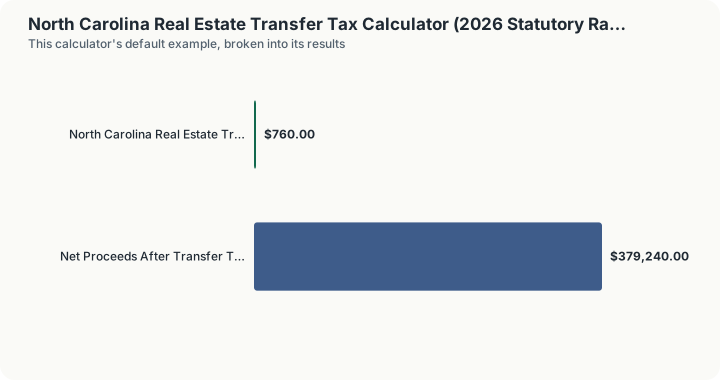
Quick Answer: North Carolina charges a flat statewide excise tax of $1.00 per $500 of value, which is 0.2% of the sale price, on real property conveyances, with seven coastal counties authorized to add an additional 1% local land transfer tax. On the calculator's $380,000 baseline sale, the statewide rate alone produces $760.00 in excise tax.
Overview
North Carolina's excise tax on conveyances runs $1.00 per $500 of value, 0.2% of the sale price, under N.C.G.S. Section 105-228.28, a rate that applies uniformly across the state's 100 counties with one narrow exception. Seven counties, Camden, Chowan, Currituck, Dare, Pasquotank, Perquimans, and Washington, all in the state's northeastern corner near the Outer Banks, are separately authorized to levy an additional 1% local land transfer tax, more than tripling the effective rate for property in those counties.
By statewide custom, the seller pays the excise tax, though the purchase contract can specify a different allocation and the closing statement should always be checked. This calculator applies North Carolina's standard 0.2% statewide rate; a transaction specifically in one of the seven authorized coastal counties should budget for the additional 1% local tax on top of that baseline.
On the calculator's $380,000 baseline, the statewide 0.2% rate produces $760 in tax due; the same sale inside one of the seven authorized Outer Banks counties, at a combined 1.2%, would owe $4,560 instead, a difference large enough to matter in a coastal property negotiation.
How This Is Calculated
North Carolina charges an excise tax on conveyances of $1.00 per $500 of value, a flat 0.2% statewide, and seven coastal counties are authorized to charge considerably more.
The engine reads the 0.002 rate under N.C.G.S. 105-228.28 and multiplies the full sale price by it in exact arithmetic. There is no bracket walk and no mansion-tax cliff. Camden, Chowan, Currituck, Dare, Pasquotank, Perquimans and Washington counties may levy an additional 1% local land transfer tax, six times the state rate, and that is not reflected in this statewide baseline.
Worked Example
The excise tax on conveyances, worked from a $380,000 Raleigh sale.
Step 1 -- The consideration. Contract sale price = $380,000
Step 2 -- The statutory rate. N.C.G.S. 105-228.28, $1.00 per $500 of value = 0.2%
Step 3 -- Apply the rate. $380,000 x 0.002 = $760.00
Step 4 -- Cross-check by the per-$500 method. 760 x $1.00 = $760.00
Step 5 -- Net proceeds after the excise tax. $380,000.00 - $760.00 = $379,240.00
Step 6 -- The effective rate. $760.00 / $380,000 = 0.200%
The calculator's $1,500,000 scenario applies the same rate with no tier to cross.
Step 7 -- The luxury sale. $1,500,000 x 0.002 = $3,000.00
Step 8 -- The effective rate, unchanged. $3,000.00 / $1,500,000 = 0.200%
North Carolina's arithmetic is unusually easy to verify because the per-$500 count in Step 4 falls out of the price exactly: 760 units of $500, one dollar apiece. The complication is geographic rather than mathematical. Seven coastal counties (Camden, Chowan, Currituck, Dare, Pasquotank, Perquimans and Washington) are authorised to levy an additional local land transfer tax of up to 1% on top of the state excise, which would take the Step 3 figure from $760 to as much as $4,560 on the same $380,000 sale, six times the statewide baseline. Everywhere else in the state, Steps 3 and 7 are the whole bill, and the seller customarily pays it.
Pricing A North Carolina Excise Tax Up And Down The Price Ladder
North Carolina's excise tax on conveyances is $1.00 per $500 of value, a flat 0.2%, so the price sweep is a straight line with no bracket and no cliff anywhere in it.
The marginal cost of the next unit. Raising the sale price from $380,000 to $390,000 moves the excise tax from $760.00 to $780.00. Every additional $10,000 of consideration costs exactly $20.00, at every price the calculator accepts. At $1,500,000 the tax is $3,000.00, which is the $380,000 figure scaled precisely by price with the effective rate holding at 0.200% throughout.
The reverse question: what price sits behind a given fee? Multiply by 500. A $760.00 excise line corresponds to $380,000 of consideration and a $3,000.00 line to $1,500,000. Because North Carolina rounds to whole $500 increments of value in statute, a recorded fee will always be a whole number of dollars, and this calculator reproduces that exactly at any price divisible by $500.
Net proceeds, which is the figure a seller actually wants. On the $380,000 baseline the engine reports $379,240.00 of net proceeds after the excise tax, and on the $1,500,000 sale $1,497,000.00. The gap between price and proceeds is 0.2% at every price, so the excise tax never becomes a material factor in a North Carolina pricing decision the way a 2% transfer tax does elsewhere.
Right method against wrong method. The expensive error is in the seven coastal counties. Camden, Chowan, Currituck, Dare, Pasquotank, Perquimans and Washington are statutorily authorised to levy an additional local land transfer tax of up to 1% of value on top of the state excise. This calculator holds one statewide rate of 0.2% and no county table at all, so the $760.00 it reports on a $380,000 sale in Dare County could be understated by up to six times the amount shown if the local levy is in force there.
A second error, and it is the more common one. Confusing the excise tax with the county register of deeds recording fee. The recording fee is a flat per-page charge for filing the instrument, unrelated to consideration, and it appears in no figure on this page. A closing statement showing both will not reconcile against the $760.00 alone.
What else is outside the model. North Carolina exempts a number of conveyance types from the excise tax, including transfers by gift, transfers between spouses, and instruments securing debt; the engine tests for none of them and applies 0.2% to whatever price you enter. It also assumes the seller pays, which is the customary North Carolina allocation but is ultimately set by the purchase contract, and it computes no real estate commission, title insurance premium or settlement charge.
What This Does Not Account For
- The seven-county local land transfer tax option. Camden, Chowan, Currituck, Dare, Pasquotank, Perquimans, and Washington counties can add up to an additional 1% on top of the statewide 0.2% rate; this calculator shows the statewide baseline only.
- County recording fees. North Carolina registers of deeds also charge a separate, flat recording fee unrelated to sale price.
- Title insurance and attorney fees. North Carolina customarily requires an attorney to close real estate transactions, and attorney fees are a distinct cost from the excise tax.
- Real estate commissions. Agent commissions are negotiated separately and are typically the largest single closing cost.
- Exemptions. Certain transfers, including some governmental conveyances and specific corrective deeds, may be exempt or partially exempt from the excise tax under N.C.G.S. 105-228.29.
Common Pitfalls
- Applying the statewide 0.2% rate to an Outer Banks property without checking the local option. A sale in Currituck or Dare county can carry up to 1.2% combined tax, not 0.2%.
- Confusing the excise tax with property tax. North Carolina's annual ad valorem property tax is a completely separate obligation from the one-time excise tax paid at conveyance.
- Assuming the buyer pays the excise tax. By statewide custom, the seller pays North Carolina's excise tax, though the purchase contract ultimately controls the allocation.
- Forgetting that the local option is per-county, not statewide. Only seven specific counties, all with legislative authorization, may impose the additional local rate; the other 93 counties use the statewide 0.2% rate only.
- Assuming the local rate is always the maximum allowed. Each of the seven counties sets its own adopted rate up to the 1% cap, so the actual local rate should be confirmed rather than assumed.
Frequently Asked Questions
What is North Carolina's real estate transfer tax rate?
Do any North Carolina counties charge more than the statewide rate?
Why do those particular seven counties have the local option?
Who typically pays North Carolina's excise tax, the buyer or the seller?
Does this calculator include the seven-county local option?
Sources
- North Carolina Department of Revenue, Excise Tax on Conveyances (N.C.G.S. Section 105-228.28 through 105-228.37). ncdor.gov