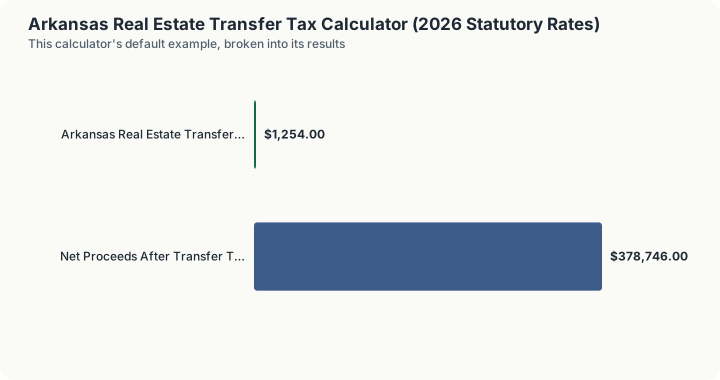
Quick Answer: A $380,000 home sale in Arkansas owes $1,254.00 in state Real Property Transfer Tax, a flat 0.33% rate applied to the full sale price with no brackets or exemption by value.
$3.30 per $1,000, and Nothing Else
Arkansas collects its Real Property Transfer Tax under Title 26-60 of the state code at a flat $3.30 per $1,000 of consideration, equal to 0.33% of the sale price, with a single statewide rate and no additional county or municipal layer anywhere in the state. That puts Arkansas roughly in the middle of the national range: noticeably higher than neighbors like Missouri, which has no transfer tax at all, but well below bracketed states such as Connecticut or Washington at the top end.
The statute leaves the question of who pays unresolved, so the allocation is whatever the purchase contract says, and it can fall to the buyer, the seller, or be split, depending on local custom and negotiation. Because the rate never changes with price or location, a seller can estimate the tax due at any Arkansas address by dividing the sale price by 1,000 and multiplying by 3.30, without needing to check which county the property sits in.
Walking the Price Ladder, and Where the Edge Is Not
This page renders no schedule table, so the figures below come from running the sale price through the engine one value at a time. The line is perfectly straight: $0.33 at $100, $3.30 at $1,000, $33.00 at $10,000, $330.00 at $100,000, $825.00 at $250,000, $1,254.00 at the $380,000 default, $1,650.00 at $500,000, $3,300.00 at $1,000,000, $4,950.00 at $1,500,000, $6,600.00 at $2,000,000 and $16,500.00 at $5,000,000. The effective rate reads 0.330% at every one of those prices.
There is no bracket edge anywhere in that range, and saying so is the honest finding. The one place a threshold appears to exist is an artifact of rounding, not of statute: at $499 the tax is $1.65 and the effective rate prints 0.331%, at $500 the tax is still $1.65 at 0.330%, and at $501 it is $1.65 again at 0.329%. The dollar figure never moved; only the ratio's third decimal did, because the engine rounds the tax to cents before dividing. No exemption fires at $500 in Arkansas.
Marginal cost of the next unit of price. Each additional $1,000 of consideration costs $3.30. Each additional $10,000 costs $33.00: the engine returns $1,254.00 at $380,000 and $1,287.00 at $390,000. Each additional $100,000 costs $330.00, which is why $1,000,000 and $1,010,000 return $3,300.00 and $3,333.00.
The reverse question. To owe exactly $1,650.00 the consideration is $500,000; to owe $3,300.00 it is $1,000,000; to owe $10,032.00 it is $3,040,000. Working backwards is exact here in a way it is not in a bracketed state, because one rate covers the whole range.
Is there an Arkansas mansion tax? No. The mansionTax output is $0.00 at $1,000,000, $0.00 at $2,000,000 and $0.00 at $5,000,000. The $5,000,000 figure of $16,500.00 is the flat rate applied to the whole price, not a base charge plus a luxury tier.
Right base against wrong base, priced. The recurring mistake is reading "$3.30 per $1,000" as $3.30 per $1,000 of the mortgage rather than of the consideration. On a $380,000 purchase with 20% down, the loan is $304,000, and running that figure as the base returns $1,003.20 against the correct $1,254.00. The shortfall is the tax on the $76,000 of equity the borrower brought to the table, $250.80, and it is a shortfall the closer discovers at the recorder's window. A second mis-scaling, reading the rate as $0.33 per $1,000, returns $125.40 on the same sale: exactly one tenth of the right answer.
How This Is Calculated
Arkansas charges $3.30 per $1,000 of consideration, a flat statewide rate with no county or city layer authorized on top of it.
The engine reads Arkansas's rate of 0.0033 from the statutory table and multiplies the full sale price by it, then reports tax due, the effective rate, and net proceeds. With no bracket schedule, the effective rate reads 0.330% at every price point, and a $75,000 rural parcel and a $7,500,000 commercial property carry the same proportional burden.
Worked Example
Price a Little Rock sale at the calculator's default and take the Real Property Transfer Tax apart operation by operation.
Step 1 -- The consideration. Contract sale price = $380,000
Step 2 -- The statutory rate. Ark. Code Title 26-60, $3.30 per $1,000 of consideration = 0.33%
Step 3 -- Apply the rate. $380,000 x 0.0033 = $1,254.00
Step 4 -- Cross-check by the per-$1,000 method. 380 x $3.30 = $1,254.00
Step 5 -- Net proceeds after the tax. $380,000.00 - $1,254.00 = $378,746.00
Step 6 -- The effective rate. $1,254.00 / $380,000 = 0.330%
The calculator's second scenario takes the price to $1,500,000.
Step 7 -- The luxury sale at the same rate. $1,500,000 x 0.0033 = $4,950.00
Step 8 -- The effective rate at $1.5M. $4,950.00 / $1,500,000 = 0.330%
Arkansas sits in the middle of the national range, well above Alabama's and Georgia's 0.1% and a long way below Delaware's combined 4%. The useful property is the one Steps 6 and 8 demonstrate: because there is no bracket schedule, one third of one percent is the whole story at every price, and a seller can sanity-check a settlement statement by dividing the price by 300. Arkansas customarily splits the tax, with the seller paying it out of proceeds in most of the state, which makes Step 5 rather than Step 3 the number a seller should be budgeting against.
What This Does Not Account For
- County recording fees. Arkansas county circuit clerks charge separate flat recording fees to file a deed, which are unrelated to sale price and not included in this calculator's output.
- Mortgage-related fees. Any loan origination or lender-required fees tied to financing the purchase are separate from the state transfer tax and are not modeled here.
- Exemptions for certain transfer types. Arkansas law exempts certain transfers, including those between spouses, into revocable trusts, and by will or intestate succession, from the transfer tax. This calculator assumes a standard taxable arm's-length sale.
- Title insurance and closing agent fees. As with any state, the transfer tax is only one line item among several on an Arkansas closing statement; title search, title insurance, and attorney or closing agent fees are separate and not captured here.
Common Pitfalls
- Underestimating the tax on higher-value sales. Because 0.33% feels small in percentage terms, sellers on larger transactions sometimes underestimate the dollar impact; a $2,000,000 sale still generates $6,600 in transfer tax at this flat rate.
- Confusing Arkansas's rate with a neighboring state's rate. States bordering Arkansas, including Missouri (no transfer tax) and Louisiana (no transfer tax), have very different transfer tax regimes, and buyers or sellers moving across state lines sometimes carry over the wrong assumption.
- Assuming the rate is negotiable. The 0.33% rate is set by statute and applies uniformly; unlike some closing cost allocations, it is not something a buyer and seller can negotiate away, only reallocate between themselves by contract as to who pays it.
- Overlooking who customarily pays. Arkansas law does not dictate which party bears the transfer tax; in practice this is set by the purchase contract and can vary by local custom, so it should always be confirmed rather than assumed.
Frequently Asked Questions
What is Arkansas's real estate transfer tax rate?
Who pays the real estate transfer tax in Arkansas?
Does Arkansas have a mansion tax on expensive homes?
Are any property transfers exempt from Arkansas's transfer tax?
How does Arkansas's transfer tax compare to neighboring states?
Sources
- Arkansas Department of Finance and Administration: Real Property Transfer Tax guidance, Arkansas Code Title 26, Chapter 60. dfa.arkansas.gov