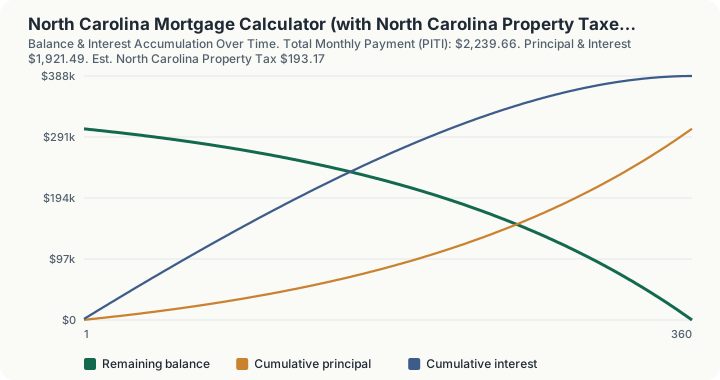
Quick Answer: A $380,000 North Carolina home with 20% down at 6.5% runs about $2,239.66 a month once principal, interest, an estimated 0.61% property tax rate, and $125 of insurance are combined.
Overview
North Carolina carries one of the lower effective property tax rates in the Southeast, which is one reason the state has drawn steady inbound migration to metro areas like Raleigh, Charlotte, and the Triad over the past decade. This calculator models a standard 30-year fixed-rate mortgage using the same amortization engine that powers every lending calculator on this platform, then adds an estimated property tax escrow based on a 0.61% statewide effective rate and a flat $125 monthly insurance placeholder to produce a total monthly PITI (principal, interest, taxes, insurance) figure.
That 0.61% figure sits below the national median effective property tax rate, but North Carolina's county-by-county variation is still meaningful. Urban counties experiencing rapid growth, such as Wake and Mecklenburg, periodically undergo revaluation cycles that can push assessed values, and therefore tax bills, up sharply even when the nominal rate stays flat. Rural counties in the eastern and western parts of the state often carry lower absolute tax bills but sometimes higher nominal rates applied to lower home values. Buyers should treat the 0.61% default as a reasonable statewide planning number, not a substitute for the specific county tax rate published by the local tax assessor's office.
How This Is Calculated
The calculator runs a standard fixed-rate amortization and then layers two escrow estimates on top of the raw debt service number.
- Down payment and loan principal. Home price is multiplied by the down payment percentage to determine cash due at closing. Subtracting that from the home price yields the financed loan amount. At the default inputs, $380,000 minus 20% down ($76,000) leaves a $304,000 loan balance.
- Monthly interest rate. The annual mortgage rate (APR) is divided by 12 to get a periodic monthly rate applied over a fixed 360-month, 30-year amortization schedule.
- Principal and interest (P&I). The standard amortizing payment formula, PMT = P × [r(1+r)^n] / [(1+r)^n − 1], runs against the loan principal, monthly rate, and 360 periods using the site's Decimal.js-based amortization primitive, avoiding the floating-point rounding drift common in spreadsheet mortgage formulas.
- Property tax escrow. Home price is multiplied by the 0.61% effective rate and divided by 12 to produce a monthly property tax line item.
- Insurance escrow. A flat $125 monthly homeowners insurance estimate is added as a national baseline placeholder.
- Total monthly payment (PITI). Principal and interest, property tax, and insurance are summed into the headline payment figure.
Worked Example
Using the calculator's default inputs of a $380,000 home price, 20% down payment, and a 6.5% fixed 30-year rate:
- Down payment: $380,000 × 20% = $76,000
- Loan principal: $380,000 − $76,000 = $304,000
- Monthly interest rate: 6.5% ÷ 12 = 0.5416667%
- Monthly principal and interest: $1,921.49
- Monthly estimated North Carolina property tax (on the full home price): $380,000 × 0.61% ÷ 12 = $193.17
- Monthly insurance estimate: $125.00
- Total monthly payment (PITI): $1,921.49 + $193.17 + $125.00 = $2,239.66
Across the full 360-month schedule, this loan accumulates roughly $387,733 in total interest on top of the $304,000 borrowed, meaning total principal and interest payments sum to nearly $691,735 over 30 years. Because North Carolina's low property tax load keeps the escrow portion of the payment relatively small compared to many other states, the mortgage rate itself does more of the work in determining affordability here than it does in high-tax states, making rate shopping especially valuable for North Carolina buyers.
What This Does Not Account For
- Highway Use Tax on vehicles has no bearing here, but excise tax on deeds does. North Carolina charges an excise tax (sometimes called a revenue stamp) on the recorded deed, generally $2 per $1,000 of sale price, paid by the seller in most transactions. This is a closing cost that this monthly payment calculator does not include.
- County revaluation cycles. North Carolina counties are required to reassess property values on a cycle set by state law, typically every four to eight years. A recent revaluation in a fast-growing county can raise the effective tax bill well above the 0.61% statewide default even without any change in the nominal rate.
- Private mortgage insurance (PMI). The default 20% down payment assumption avoids PMI. Buyers putting down less than 20% on a conventional loan should expect an additional monthly PMI premium not reflected here.
- HOA dues and special assessments. Many newer North Carolina subdivisions, especially in the Triangle and Charlotte suburbs, carry homeowners association dues that are not part of the mortgage payment but function as a recurring housing cost.
- NC Housing Finance Agency assistance programs. Down payment assistance and below-market rate programs available to eligible North Carolina first-time buyers are not modeled in this calculator's baseline rate assumptions.
- Flood and wind coverage in coastal counties. Homes near the Outer Banks or other coastal counties often require separate flood and windstorm coverage well above the flat $125 insurance placeholder used here.
Common Pitfalls
- Assuming 0.61% applies evenly statewide. Effective rates vary from well under 0.4% in some rural counties to over 1% in parts of urban Wake and Durham counties, so the default should be replaced with the local county rate whenever precision matters.
- Missing the impact of a recent revaluation. Buyers who budget off a prior year's tax bill can be caught off guard when a county-wide reassessment raises the taxable value of the home they are buying.
- Overlooking builder incentives that mask true rate cost. New construction buyers in fast-growing North Carolina metros sometimes see below-market rate buydowns funded by builder incentives that reset to a higher rate after an initial period, which this calculator's flat-rate model does not capture.
- Forgetting HOA dues when comparing total housing cost. A lower mortgage payment in an HOA community can still result in higher total monthly housing cost once dues are added.
- Ignoring the excise tax at closing. While typically a seller cost, buyers negotiating closing cost credits should understand this line item exists separately from property tax.
Frequently Asked Questions
Why is North Carolina's property tax shown as 0.61% here?
How often does North Carolina reassess home values?
Does this calculator include North Carolina's deed excise tax?
What down payment avoids PMI in North Carolina?
Is $125 a realistic insurance estimate for coastal North Carolina?
Why does the 30-year term matter so much for the total interest figure?
Sources
- North Carolina Department of Revenue, Property Tax Division, county effective tax rate and reassessment cycle data. ncdor.gov
- Consumer Financial Protection Bureau, Regulation Z (Truth in Lending Act) and Loan Estimate/Closing Disclosure standards. ecfr.gov/current/title-12/chapter-X/part-1026
Also consulted: North Carolina General Statutes, Chapter 105, Article 8E, real property excise tax (revenue stamps); North Carolina Housing Finance Agency, first-time buyer down payment assistance program guidelines.