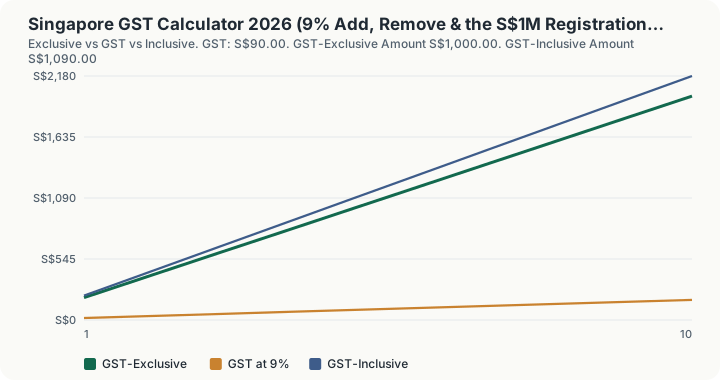
Quick Answer: On a S$1,090 GST-inclusive price at the 9% standard rate, the GST contained in that price is S$90.00, leaving a GST-exclusive amount of S$1,000.00. The GST is 9/109 of the inclusive price, which is 8.2569%, not 9%. Deducting 9% instead would give S$991.90 as the exclusive figure, an error of S$8.10 on a single S$1,090 invoice.
What does this calculator do?
Singapore's Goods and Services Tax is a broad-based consumption tax charged at a standard rate of 9%. The rate itself is the easy part. The part that produces wrong invoices, wrong accruals and wrong GST returns is the direction of travel: whether the figure in front of you already contains GST or not.
Adding GST is straightforward. S$1,000 exclusive plus 9% is S$1,090. Removing GST is where people go wrong, because the instinct is to subtract 9% from the inclusive figure. That is arithmetically the wrong operation. The 9% was applied to the smaller exclusive base, so the GST is a smaller share of the larger inclusive total. The correct extraction uses the GST fraction, r divided by 1 plus r, which at 9% is 9/109 or 8.2569% of the inclusive price.
This calculator does three separate things. It converts between exclusive, GST and inclusive in either direction and shows the size of the naive-deduction error explicitly. It runs the IRAS compulsory registration test against the S$1,000,000 threshold on both the retrospective and prospective views. And it computes the net GST position of a registered business as output tax less input tax, which is what makes GST a tax on value added rather than a tax on turnover.
How is this calculated?
The rate depends only on the supply type. Standard-rated supplies carry 9%. Zero-rated supplies (exports, international services) and exempt supplies (residential property sale and lease, most financial services, investment precious metals, digital payment tokens) both carry 0% in this calculator, because neither adds GST to the amount charged. The distinction between zero-rated and exempt matters for input tax recovery, not for the tax on the invoice, and the calculator does not model that difference.
The general form of the two directions is:
GST_add = A × r; GST_remove = A × r/(1 + r)
where A is the amount you entered and r is 0.09 for a standard-rated supply.
Step 1: Take the amount and the direction. The default is S$1,090 treated as GST-inclusive, with the direction set to remove.
Step 2: Apply the GST fraction to the inclusive amount. S$1,090 x 0.09 / 1.09 = S$90.00
Step 3: Subtract the GST to get the exclusive amount. S$1,090.00 - S$90.00 = S$1,000.00
Step 4: Compute the naive figure a 9% deduction would give. S$1,090 - (S$1,090 x 0.09) = S$991.90
Step 5: Report the size of that error. S$1,000.00 - S$991.90 = S$8.10
The registration test is a separate computation and does not touch the amounts above. It takes past-year taxable turnover and expected turnover for the next 12 months, compares each against S$1,000,000, and registers if either is strictly greater. It is an OR of two independent views, not an AND.
Step 6: Take the higher of the two turnover figures. max(S$850,000, S$950,000) = S$950,000
Step 7: Compare against the threshold. S$950,000 is not greater than S$1,000,000, so the status is Not required to register
Step 8: Report the headroom remaining. S$1,000,000 - S$950,000 = S$50,000
The net position calculation is a third, independent computation. It uses the higher of your two turnover figures as standard-rated sales, applies 9% to that and 9% to your taxable purchases, and takes the difference.
Step 9: Output tax on sales. S$950,000 x 0.09 = S$85,500
Step 10: Input tax on purchases. S$400,000 x 0.09 = S$36,000
Step 11: Net GST remitted to IRAS. S$85,500 - S$36,000 = S$49,500
Step 12: Value added, which is what that net figure is 9% of. S$950,000 - S$400,000 = S$550,000, and 9% of S$550,000 is S$49,500
Worked Example
A design studio issues a single invoice for S$1,090 and needs to split it for its GST return.
Step 1: Identify the direction. The client was quoted S$1,090 all-in, so the figure is GST-inclusive.
Step 2: Extract the GST with the fraction. S$1,090 x 9/109 = S$90.00
Step 3: Back out the fee. S$1,090.00 - S$90.00 = S$1,000.00
Step 4: Sanity-check by rebuilding forwards. S$1,000.00 x 0.09 = S$90.00, and S$1,000.00 + S$90.00 = S$1,090.00
Had the studio deducted 9% instead, it would have booked revenue of S$991.90 and GST of S$98.10, overstating its output tax by S$8.10 on this invoice alone. On S$950,000 of annual turnover the same mistake compounds into roughly S$7,000 of overstated output tax.
What does this calculator not account for?
- Zero-rated and exempt supplies are collapsed into one 0% option. The calculator charges no GST on either, which is correct for the invoice amount. It does not model the real difference between them, which is that a zero-rated supplier recovers input tax in full while an exempt supplier generally cannot.
- The net position uses the higher of your two turnover figures as standard-rated sales. That is a modelling choice made in the config, not an IRAS rule. If your sales mix includes zero-rated or exempt supplies, your true output tax is lower than the figure shown.
- Input tax is assumed fully claimable. The calculator applies 9% to every dollar of taxable purchases. It does not apply the blocked input tax rules (club subscriptions, medical expenses, private motor cars, family benefits), partial exemption apportionment, or the requirement to hold a valid tax invoice.
- Registration date mechanics are described in the output text but not scheduled. The calculator tells you whether you must register and why; it does not compute application windows or effective dates, and there is no timeline output.
- No accounting scheme adjustments. Cash accounting, the Major Exporter Scheme, the Gross Margin Scheme, the Tourist Refund Scheme, reverse charge on imported services and the Discounted Sale Price Scheme are all outside the model.
- Voluntary registration is flagged in the output text as carrying a two-year minimum and GIRO conditions, but nothing about that is calculated.
What mistakes do people make with this?
Deducting 9% from an inclusive price. This is the single most common Singapore GST error and it appears on real invoices. The correct divisor is 1.09, not a 9% subtraction. On S$1,090 the gap is S$8.10.
Treating the two registration views as a joint test. They are independent. Expecting to exceed S$1,000,000 in the next 12 months triggers registration on the prospective view immediately, even if last year's turnover was far below the threshold.
Waiting for the calendar year to end. The prospective view does not wait. Once you reasonably expect to cross the threshold, the obligation is live.
Thinking GST costs a registered business 9% of sales. It does not. A registered business remits output tax less input tax. In the default case that is S$49,500 on S$950,000 of sales, which is 9% of the S$550,000 of value added, not 9% of turnover.
Assuming exempt and zero-rated are interchangeable. Both put zero GST on the invoice. Only one of them lets you reclaim input tax.
Frequently Asked Questions
How much GST is in a S$1,090 price in Singapore?
Why is removing GST not just taking 9% off?
When must a Singapore business register for GST?
How much GST does a registered business actually pay?
Can input tax exceed output tax?
Sources
- Inland Revenue Authority of Singapore, "Goods and Services Tax (GST): What It Is and How It Works", iras.gov.sg/taxes/goods-services-tax-(gst)/basics-of-gst/goods-and-services-tax-(gst)-what-it-is-and-how-it-works, read 2026-08-30 for the 9% standard rate and the worked output-tax-less-input-tax example.
- Inland Revenue Authority of Singapore, "Do I need to register for GST", iras.gov.sg/taxes/goods-services-tax-(gst)/gst-registration-deregistration/do-i-need-to-register-for-gst: read 2026-08-30 for the S$1 million compulsory registration threshold and the retrospective and prospective views.