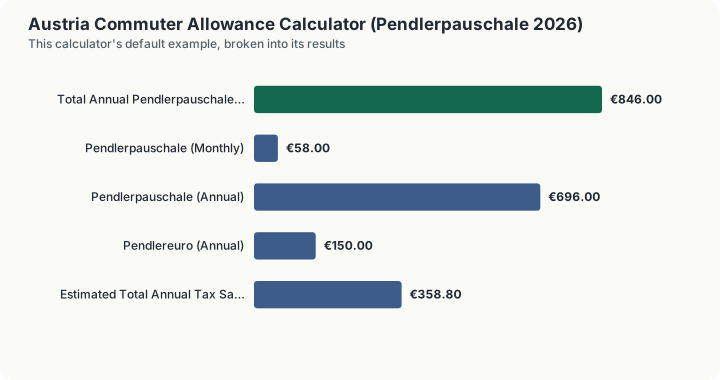
Quick Answer: A commuter travelling 25km one-way to work, where public transport is reasonably usable, qualifies for the kleine Pendlerpauschale at €58/month (€696/year), plus a Pendlereuro of €150/year (€6 per one-way km for 2026) -- a combined €846/year benefit, worth an estimated €358.80/year in actual tax saving at a 30% marginal rate.
Overview
The Pendlerpauschale (commuter allowance) is one of the largest and most commonly claimed tax breaks on an Austrian payslip, compensating employees for the cost of a long commute between home and work. It comes in two forms -- the smaller "kleine" Pendlerpauschale, for commutes where public transport is a reasonably usable option, and the larger "große" Pendlerpauschale, for commutes where it isn't. The kleine version has three distance bands and starts at 20km one way; the große version has four bands and starts at just 2km. Alongside it sits the Pendlereuro, a separate, smaller-value but direct tax credit, which stands at €6 per one-way kilometre per year after the Budgetbegleitgesetz 2025 tripled it from €2, as compensation for the discontinuation of the separate Klimabonus payment.
The distinctively Austrian feature here is that the two instruments run on different arithmetic and different tax mechanics from the same input. The Pendlerpauschale is a stepped lump sum: it jumps at 20km, 40km and 60km and is flat in between, so a 39km commute and a 21km commute are worth exactly the same. The Pendlereuro is strictly linear in the same distance. And the Pendlereuro is not a standalone relief: entitlement to it exists only where a Pendlerpauschale is due, so the same 20km and 2km thresholds gate both. That is why a 19km commute with usable public transport produces nothing at all from this calculator rather than €114 of Pendlereuro.
This calculator determines which Pendlerpauschale band applies to your commute, the monthly and annual amount, the Pendlereuro you're entitled to, and an estimate of the actual tax saving this produces -- since the Pendlerpauschale is a deduction (Werbungskosten) that only saves you your marginal tax rate on the amount, while the Pendlereuro is a direct credit that reduces your tax bill euro-for-euro.
How This Is Calculated
- Determine eligibility type. If public transport is reasonably usable for at least half the route (considering travel time, transfers, and accessibility), only the kleine Pendlerpauschale is available, starting at a 20km minimum one-way distance. If it isn't reasonably usable, the larger große Pendlerpauschale applies instead, starting at just 2km.
- Look up the distance band. - Kleine Pendlerpauschale: 20-40km → €58/month; 40-60km → €113/month; 60km+ → €168/month. - Große Pendlerpauschale: 2-20km → €31/month; 20-40km → €123/month; 40-60km → €214/month; 60km+ → €306/month.
- Add the Pendlereuro. For 2026, this is €6 per one-way kilometre per year -- for example, a 35km one-way commute earns €210/year, on top of whichever Pendlerpauschale band applies. The calculator pays it only where a Pendlerpauschale band was actually reached, matching the statutory condition that the Pendlereuro is due to taxpayers entitled to a Pendlerpauschale.
- Estimate the tax effect. The Pendlerpauschale reduces taxable income (a deduction), so its cash value depends on your marginal tax bracket. The Pendlereuro, by contrast, is a direct tax credit (Absetzbetrag) and reduces your final tax bill one-for-one, regardless of your bracket.
Worked Example
Using the calculator's default inputs -- 25km one-way, public transport reasonably usable, 30% marginal rate:
- Eligibility: public transport is reasonable, and 25km ≥ the 20km minimum, so the kleine Pendlerpauschale applies.
- Band: 25km falls in the 20-40km band → €58/month, €696/year.
- Pendlereuro: 25km × €6 = €150/year.
- Total annual benefit (deduction + credit face value): €696 + €150 = €846.
- Estimated tax saving: (€696 × 30%) + €150 = €208.80 + €150 = €358.80/year.
What This Does Not Account For
- The enhanced Verkehrsabsetzbetrag -- employees with modest income who also qualify for a Pendlerpauschale can additionally receive a higher base commuting tax credit (up to €853 versus the standard €496); this is not modeled here to keep this calculator focused purely on the Pendlerpauschale/Pendlereuro mechanics. See the Austria Net Salary Calculator for the base Verkehrsabsetzbetrag treatment.
- Partial-week or hybrid/remote work patterns. The Pendlerpauschale has separate reduced tiers for employees who commute on fewer than 11 days a month (two-thirds or one-third of the full monthly amount) -- this calculator assumes a standard full-time commuting pattern.
- The formal "reasonableness" (Zumutbarkeit) test itself, which depends on precise travel-time comparisons between car and public transport defined by regulation, not just distance -- this calculator takes your eligibility answer (reasonable or not) as a given input rather than deriving it from timetables.
- Multiple jobs or split work locations, which require separate Pendlerpauschale calculations per employment relationship.
- The Werbungskostenpauschale interaction. The Pendlerpauschale is claimed on top of the €132 flat Werbungskosten allowance rather than absorbed by it, but this calculator reports the Pendlerpauschale in isolation and does not compute your full Werbungskosten position.
- Employer-provided transport (Werkverkehr) and a Jobticket, which switch off the Pendlerpauschale for the covered stretch of the route.
Common Pitfalls
- Assuming distance alone determines eligibility. The kleine vs große distinction depends on whether public transport is reasonably usable, not simply on which pays more -- you cannot choose the große Pendlerpauschale over the kleine just because it's larger if public transport is genuinely a reasonable option for your commute.
- Forgetting the Pendlereuro is separate from and additional to the Pendlerpauschale. They are calculated on different bases (a monthly banded amount vs. a flat per-km rate) and have different tax mechanics (deduction vs. credit) -- some taxpayers claim only one and leave money on the table.
- Treating the Pendlerpauschale's annual value as the actual cash saving. Because it's a deduction, not a credit, its real value to you is the annual amount multiplied by your marginal tax rate -- a 20% earner and a 48% earner with an identical commute get very different real benefits from the same Pendlerpauschale figure.
- Not re-filing form L 34 (or re-running the BMF Pendlerrechner) after a move or job change. The Pendlerpauschale doesn't update automatically -- a changed commute distance or a change in public transport reasonableness needs to be reported to your employer to adjust payroll withholding.
- Missing the minimum distance thresholds entirely. A short commute below 20km with reasonable public transport, or below 2km even without reasonable transport, gets no Pendlerpauschale at all -- only the Pendlereuro-equivalent commuting relief built into the standard Verkehrsabsetzbetrag.
Frequently Asked Questions
What's the difference between kleine and große Pendlerpauschale?
How much did the Pendlereuro increase?
Is the Pendlerpauschale automatic, or do I need to apply for it?
Does the Pendlerpauschale change if I work part-time or work from home some days?
Can I get the Pendlerpauschale for a commute under 20km if public transport is available but very inconvenient?
Sources
- BMF's official Pendlerrechner (pendlerrechner.bmf.gv.at) -- the authoritative tool for establishing your own route, your eligibility type, and therefore your distance band. This calculator takes the reasonableness answer as an input rather than deriving it, so the Pendlerrechner result governs where the two disagree. bmf.gv.at
Also consulted: EStG §16 Abs 1 Z 6 lit c and lit d -- the statutory Pendlerpauschale amounts, quoted as annual figures: 696 / 1 356 / 2 016 Euro for the kleine variant and 372 / 1 476 / 2 568 / 3 672 Euro for the große variant. The monthly amounts shown by this calculator are those annual figures divided by 12; EStG §33 Abs 5 Z 4 -- the Pendlereuro at six euros per kilometre of the one-way route per year, and the condition that it is due to taxpayers entitled to a Pendlerpauschale; Verification note: ris.bka.gv.at, the official statute database, returned repeated HTTP 503 errors on 28 August 2026, so the §16 and §33 texts above were read from a verbatim reproduction of the consolidated statute rather than from RIS itself.