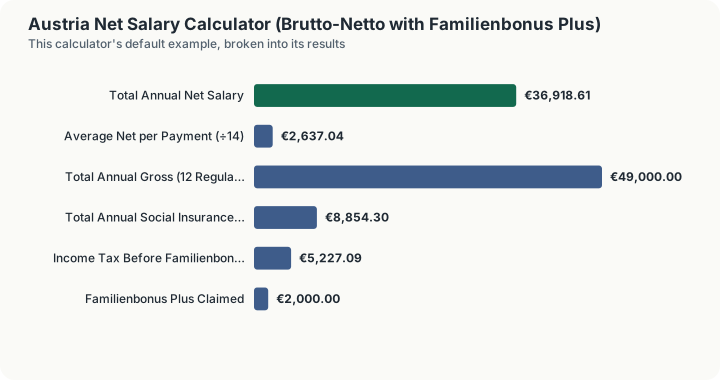
Quick Answer: An Austrian employee earning €3,500/month gross (paid over the standard 14 payments: 12 regular months plus a 13th and 14th special payment) with 1 child under 18 takes home a total annual net salary of €36,918.61 -- after €8,854.30 in employee social insurance (SV) contributions and €3,227.09 in income tax, once the €2,000 Familienbonus Plus tax credit is applied. That works out to an average of €2,637.04 per payment across the 14-payment year.
Overview
Austria pays most employees over 14 salary installments a year: 12 regular monthly payments, plus a 13th ("Urlaubsgeld") and a 14th ("Weihnachtsgeld") special payment, each typically equal to one regular month's gross salary. Converting a gross (Brutto) salary into a net (Netto) take-home figure means running two separate calculations -- one for the 12 regular months under the ordinary progressive tariff, and one for the 13th/14th month under a specially favorable flat-rate scheme -- and then layering employee social insurance contributions and family tax credits on top of both.
This calculator reproduces that full Austrian Brutto-Netto computation for calendar year 2026: employee-side social insurance (Sozialversicherung) at the tiered rate structure that applies to salaried employees (Arbeiter/Angestellte), the 2026 progressive income tax brackets, the base Verkehrsabsetzbetrag (commuter/employee tax credit), the special 6%/27%/35.75% taxation of the 13th and 14th salary under the Jahressechstel rule, and the Familienbonus Plus -- the per-child tax credit that is one of the most valuable and most-often-miscalculated parts of an Austrian payslip, precisely because it is non-refundable: it can only offset tax you actually owe, and any excess is simply lost rather than paid out or carried forward.
How This Is Calculated
- Split gross salary into regular and special payments. Regular annual gross = monthly gross × 12. Special payments (13th + 14th) = monthly gross × 2.
- Apply employee social insurance (SV) at the tiered 2026 rate. The Dienstnehmeranteil combines Krankenversicherung (KV, 3.87%), Pensionsversicherung (PV, 10.25%), Arbeitslosenversicherung (AV, tiered: 0% up to €2,225/month, 1% to €2,427, 2% to €2,630, then the full 2.95% above that), Arbeiterkammerumlage (AK, 0.5%) and Wohnbauförderungsbeitrag (WF, 0.5%) -- a full 18.07% for most salaried employees. Each regular month is capped at the monthly Höchstbeitragsgrundlage (€6,930 for 2026); the combined 13th/14th special payment is capped separately at the annual Sonderzahlungen ceiling (€13,860).
- Tax the regular 12 months under the progressive tariff. Regular taxable income = regular annual gross minus regular SV. The 2026 brackets run 0% to €13,539, then 20%/30%/40%/48%/50%/55% at each successive threshold up to €1,000,000 (the 55% top rate is temporary through 2029). The base Verkehrsabsetzbetrag (€496) is then subtracted.
- Tax the 13th/14th month under the Jahressechstel rule. The Jahressechstel (one-sixth of the regularized annual gross) sets the ceiling for preferential treatment. If the special payments are at or below that ceiling and the ceiling itself exceeds the €2,615 annual Freigrenze, a single €620 Freibetrag is subtracted once, and the remainder is taxed at 6% (up to €24,380), then 27%, then 35.75% -- far below the ordinary tariff. Any amount by which special payments exceed the Jahressechstel (a "Sechstelüberhang") is instead taxed together with regular income at the full ordinary tariff.
- Apply the Familienbonus Plus. €2,000/year per child under 18, €700/year per child 18+ (while Familienbeihilfe continues), summed and then capped at your combined tax liability before the credit -- it is a non-refundable credit, so it cannot create a refund or go negative.
- Net salary = total gross − total SV − final tax.
Worked Example
Using the calculator's default inputs -- €3,500/month, 1 child under 18:
- Regular annual gross: €3,500 × 12 = €42,000. Special payments: €3,500 × 2 = €7,000. Total gross: €49,000.
- SV rate: 3,500/month is above the €2,630 AV threshold, so the full 18.07% applies. Regular SV = €3,500 × 18.07% × 12 = €7,589.40. Special-payment SV = €7,000 × 18.07% = €1,264.90. Total SV = €8,854.30.
- Regular taxable income: €42,000 − €7,589.40 = €34,410.60, which falls in the 30% bracket: tax = €1,690.60 (from the 20% bracket) + (€34,410.60 − €21,992) × 30% = €1,690.60 + €3,725.58 = €5,416.18. After the €496 Verkehrsabsetzbetrag: €4,920.18.
- 13th/14th taxation: Jahressechstel = €42,000 ÷ 6 = €7,000, exactly equal to the special payments (no Sechstelüberhang). Net of SV: €7,000 − €1,264.90 = €5,735.10. After the €620 Freibetrag: €5,115.10, entirely within the 6% tier: tax = €306.91.
- Total tax before Familienbonus: €4,920.18 + €306.91 = €5,227.09.
- Familienbonus Plus: 1 child under 18 = €2,000 requested; tax liability (€5,227.09) comfortably covers it, so the full €2,000 is claimed. Final tax: €3,227.09.
- Total annual net: €49,000 − €8,854.30 − €3,227.09 = €36,918.61 (≈ €2,637.04 per payment across 14 payments, or €3,076.55/month if you think of it as 12 regular months plus two separate bonus payouts).
What This Does Not Account For
- The enhanced (higher) Verkehrsabsetzbetrag (€853) available to lower-income employees who also qualify for a Pendlerpauschale, and the separate €804 Zuschlag for income up to €19,761. Both phase out to the €496 base at higher income. Only the base €496 amount is applied here, to avoid double-counting with the dedicated Austria Commuter Allowance Calculator.
- The Arbeitslosenversicherung tier being read from your regular monthly gross. In real payroll the reduced 0%/1%/2% tiers are applied against each month's own contribution base, so an employee whose pay crosses €2,630 partway through the year will see a blended rate this calculator does not reproduce.
- The Alleinverdiener-/Alleinerzieherabsetzbetrag (sole-earner/sole-parent tax credit), Pendlerpauschale/Pendlereuro, church tax (Kirchenbeitrag), or any itemized Sonderausgaben/Werbungskosten beyond the flat SV deduction -- all of which would further reduce final tax for eligible taxpayers.
- The Kindermehrbetrag, a separate, partially refundable top-up for very low earners whose Familienbonus Plus is capped by insufficient tax liability -- this calculator shows the Familienbonus Plus cap itself (the "unused" amount) but does not add the Kindermehrbetrag on top.
- The small flat Werbungskosten-Pauschale (€132/year) and Sonderausgabenpauschale (€60/year) available to every employee -- together worth at most €192/year of extra deduction, a negligible effect we chose to omit rather than assume unverified.
- Part-year employment, unpaid leave, or irregular special payments that don't exactly equal the standard "2 extra monthly salaries" pattern -- see the dedicated Austria 13th/14th Salary Tax Calculator for entering exact, unequal special-payment amounts.
- Employer-side costs (Dienstgeberanteil, roughly an additional ~21% on top of gross) are not shown -- this calculator computes only the employee's own net take-home.
Common Pitfalls
- Assuming the Familienbonus Plus is a straight cash refund. It is a non-refundable credit: if your tax liability before the credit is lower than your requested Familienbonus Plus, the excess is simply lost, not carried forward or paid out (subject to the separate Kindermehrbetrag rules for low earners, not modeled here).
- Forgetting that the 13th/14th month is taxed completely differently from regular salary. Applying your regular marginal tax rate to the 13th/14th month overstates the tax due -- it is taxed at a flat 6% (for most earners) after a modest exemption, not at your marginal rate.
- Ignoring the Sechstelüberhang. If your actual bonus/13th/14th payments exceed one-sixth of your annualized regular salary (e.g. from an extra one-off bonus lumped in as a "sonstiger Bezug"), the excess loses the preferential rate entirely and is taxed at the full ordinary tariff alongside your regular income.
- Not checking the AV low-income tiering. Employees earning at or below roughly €2,630/month pay a reduced (or zero) Arbeitslosenversicherung contribution -- a meaningful difference for part-time and lower-wage earners that a flat "18%" assumption misses.
- Splitting the Familienbonus Plus incorrectly between parents. Parents can split each child's Familienbonus Plus 100/0, 50/50, or any other combination, but the combined claim can never exceed the full per-child amount -- double-claiming the full amount on both parents' returns will be caught and adjusted.
Frequently Asked Questions
How much is the Familienbonus Plus worth in 2026?
Is the Familienbonus Plus refundable if I don't owe enough tax?
Why is my 13th/14th salary taxed so much more lightly than my regular pay?
What happens if my employer pays an extra bonus beyond the standard 13th/14th?
Does this calculator account for church tax or other payroll deductions?
Why does my SV rate change depending on my income?
Sources
- EStG §33 Abs 3a and BMF's Familienbonus Plus guidance -- €2,000 per child under 18 and €700 per child 18 or over, non-refundable and capped at the tax liability before the credit. bmf.gv.at
Also consulted: Dachverband der österreichischen Sozialversicherungen, "Tarifsystem für Dienstgeberinnen und Lohnverrechnerinnen" (official PDF), Stand 19 September 2025, gültig ab 1 Jänner 2026 -- employee SV contribution rates and Höchstbeitragsgrundlage, fetched and verified directly; WKO (wko.at/steuern/einkommen-koerperschaftsteuer-2026) -- the 2026 income tax brackets, re-verified on 28 August 2026 at 13,539 / 21,992 / 36,458 / 70,365 / 104,859 / 1,000,000 with rates 0/20/30/40/48/50/55%, and the Verkehrsabsetzbetrag at €496 base, €853 enhanced, €804 Zuschlag; ÖGK, "Veränderliche Werte 2026" -- the €6,930 monthly and €13,860 annual Sonderzahlungen Höchstbeitragsgrundlage and the Arbeitslosenversicherung low-income tiers at €2,225 / €2,427 / €2,630, re-verified on 28 August 2026; Dachverband der österreichischen Sozialversicherungen, "Tarifsystem", gültig ab 1.1.2026 -- the component employee rates KV 3.87%, PV 10.25%, AV 2.95%, AK 0.5%, WF 0.5%; EStG §67 Abs 1 and Abs 2 -- the Jahressechstel definition, the €2,615 Freigrenze, the €620 Freibetrag and the 0%/6%/27%/35.75% band widths, re-verified on 28 August 2026 and cross-checked against WKO's Sonstige Bezüge guidance; Verification note: ris.bka.gv.at returned repeated HTTP 503 errors on 28 August 2026, so §33 and §67 were read from a verbatim reproduction of the consolidated statute and cross-checked against WKO rather than fetched from RIS directly.