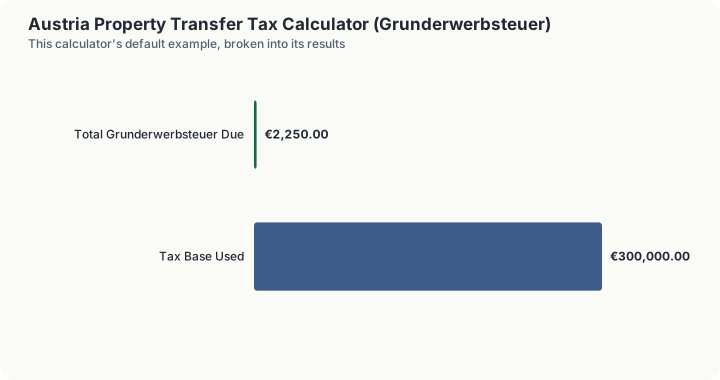
Quick Answer: A gratuitous property transfer within the family with a €300,000 Grundstückswert owes €2,250 in Grunderwerbsteuer under the favorable Stufentarif (0.5% on the first €250,000, 2% on the remaining €50,000) -- an effective rate of just 0.75%, versus €10,500 (3.5% flat) if the same €300,000 were taxed at the standard rate applied to unrelated-party sales.
Overview
Austria's Grunderwerbsteuer (property transfer tax, GrESt) is due whenever real estate changes hands -- by sale, gift, or inheritance. For an arm's-length sale between unrelated parties, the tax is a flat 3.5% of the higher of the purchase price or fair market value. But for gratuitous transfers within the family circle -- between spouses, registered partners, direct-line relatives (parents, children, grandchildren), and siblings -- the law substitutes a much lower Grundstückswert (a statutorily-defined property value, typically well below market value) as the tax base, and applies a progressive Stufentarif instead of the flat rate: 0.5% on the first €250,000, 2% on the next €150,000, and 3.5% only on the portion above €400,000.
This calculator computes the Grunderwerbsteuer due under both methods, so you can see exactly how much a family transfer (a common way to pass on a family home, a business premises, or an investment property to the next generation) saves compared to a standard sale.
How This Is Calculated
Standard (arm's-length) transfers:
Family (gratuitous) transfers -- the Stufentarif, applied to the Grundstückswert:
| Portion of Grundstückswert | Rate |
|---|---|
| First €250,000 | 0.5% |
| Next €150,000 (€250,000-€400,000) | 2.0% |
| Above €400,000 | 3.5% |
The Grundstückswert itself is determined either via the Pauschalwertmodell (a formulaic combination of land value and building value, per the Grundstückswertverordnung) or via a documented comparison to a recognized Immobilienpreisspiegel (property price index) -- whichever the taxpayer chooses, since the lower of the two is generally permitted. Under the Pauschalwertmodell:
The Bodenwert (per-square-metre land value) comes from the Finanzamt's own Bodenwertkatalog for your specific Katastralgemeinde (cadastral municipality); the Hochrechnungsfaktor and Baukostenfaktor are separately published, municipality- and Bundesland-specific factors set by regulation. Because these figures are property- and location-specific rather than universal constants, this calculator asks you to enter the Grundstückswert directly (obtained from BMF's own online Grundstückswert-Rechner at service.bmf.gv.at, or from a notary/tax adviser who has run the Pauschalwertmodell for your specific property).
Worked Example
Family transfer, €300,000 Grundstückswert: 1. First €250,000 at 0.5% = €1,250 2. Remaining €50,000 (€250,000-€300,000) at 2% = €1,000 3. Total: €2,250 -- an effective rate of 0.75%.
Family transfer, €500,000 Grundstückswert (all three tiers): 1. First €250,000 at 0.5% = €1,250 2. Next €150,000 at 2% = €3,000 3. Remaining €100,000 (above €400,000) at 3.5% = €3,500 4. Total: €7,750 -- an effective rate of 1.55%.
Standard sale, €350,000 purchase price: €350,000 × 3.5% = €12,250 -- nearly 5.5x higher than the family-transfer tax on a comparable €300,000 Grundstückswert, because both the base (market price vs. the typically much lower Grundstückswert) and the rate structure (flat 3.5% vs. the tiered Stufentarif starting at 0.5%) work against the standard transfer.
What This Does Not Account For
- The exact Bodenwert, Hochrechnungsfaktor, Baukostenfaktor, and age-deduction values needed to compute a Grundstückswert from scratch via the Pauschalwertmodell -- these are property- and municipality-specific figures published by the Finanzamt and by regulation, which this calculator asks you to supply directly (via BMF's own Grundstückswert-Rechner) rather than approximate with unverified hardcoded defaults.
- The Immobilienpreisspiegel comparison method, an alternative way to establish the Grundstückswert using recognized market-price indices -- only the Pauschalwertmodell approach is described here.
- Notary fees, land registry (Grundbuch) entry fees (typically 1.1% of value), and legal fees -- this calculator computes only the Grunderwerbsteuer itself, one component of total transfer costs.
- Exemptions and reductions, such as the reduced or zero tax on certain agricultural land transfers, or specific business-succession relief provisions, which have their own separate rules not modeled here.
- The five-year aggregation rule, under which multiple gratuitous transfers to the same recipient from the same transferor within five years are added together for Stufentarif purposes, potentially pushing a later, smaller transfer into a higher tier than it would face in isolation.
Common Pitfalls
- Using the purchase price instead of the Grundstückswert for a family transfer. Even where no money changes hands (a pure gift) or where consideration is below 30% of the property's value, family transfers are taxed on the Grundstückswert, not on any nominal consideration paid -- using the wrong base is one of the most common errors in DIY estimates.
- Assuming the Stufentarif is a flat rate at whichever tier you land in. It is progressive, like income tax brackets -- a €500,000 Grundstückswert is not taxed at a flat 3.5%; only the portion above €400,000 is.
- Confusing Grundstückswert with market value. The Grundstückswert (particularly under the Pauschalwertmodell) is often substantially below what the property would sell for on the open market -- that gap is precisely why family transfers get favorable tax treatment, not an error in the calculation.
- Forgetting the five-year lookback for gifts between the same parties. Splitting a large transfer into several smaller ones to unrelated parties doesn't reset the Stufentarif -- the tax office aggregates gratuitous transfers between the same transferor and recipient within a five-year window.
- Not distinguishing "family circle" correctly. The favorable Stufentarif applies to a specific, statutorily-defined circle of relatives (spouses, registered partners, direct-line relatives, siblings, and a few others) -- transfers to more distant relatives or unrelated parties don't qualify, even if the transfer is still gratuitous.
Frequently Asked Questions
What counts as a "family" transfer for Grunderwerbsteuer purposes?
Is the Grundstückswert the same as what I could sell the property for?
How do I actually find my property's Grundstückswert?
Does a mortgage or other debt assumed as part of the transfer change anything?
Why is the family-transfer tax so much lower than a normal sale?
Sources
- BMF's official Grundstückswert-Rechner (service.bmf.gv.at) -- the authoritative tool for computing your own property's Grundstückswert; referenced as the recommended source for the Bodenwert, Hochrechnungsfaktor, Baukostenfaktor, and age-deduction inputs this calculator does not hardcode. bmf.gv.at
Also consulted: brandauer-rechtsanwaelte.at (2026 Grunderwerbsteuer overview) and finfo.at (Grunderwerbsteuer in Österreich 2026) -- Stufentarif thresholds and rates, cross-checked and in exact agreement; Grundstückswertverordnung (GrWV), via RIS.bka.gv.at (Austria's official legal information system) -- Pauschalwertmodell structural formula, corroborated by the same two secondary sources describing the Grundwert/Gebäudewert combination identically; Verification note: the specific current Baukostenfaktor (€/m²) value and the exact age-deduction percentage schedule under the Grundstückswertverordnung could not be independently confirmed this session (RIS.bka.gv.at returned repeated server errors on every fetch attempt) -- these figures are therefore left as direct inputs for you to supply from the Finanzamt's own published tables rather than assumed.