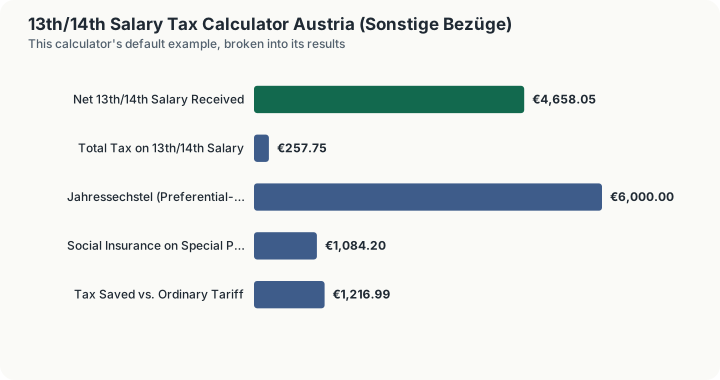
Quick Answer: An employee earning €3,000/month with a standard 13th (Urlaubsgeld) and 14th (Weihnachtsgeld) salary of €3,000 each pays only €257.75 in tax on that combined €6,000 of special payments -- an effective rate of just 4.3%, saving an estimated €1,216.99 compared to what the same amount would owe if simply added to regular income and taxed at ordinary rates.
Overview
Austria's 13th and 14th monthly salary payments -- the Urlaubsgeld (holiday pay, paid mid-year) and Weihnachtsgeld (Christmas bonus, paid at year-end) -- are among the most valuable quirks of the Austrian payroll system. Rather than being taxed at your regular marginal tax rate, these "sonstige Bezüge" (special payments) qualify for a dramatically more favorable flat-rate schedule under Section 67 of the Income Tax Act (EStG): 6%, 27%, or 35.75%, depending on the size of the payment, up to a ceiling called the Jahressechstel (literally, "annual sixth") -- one-sixth of your regularized annual salary.
This calculator computes exactly how much tax you'll actually pay on your 13th and 14th salary, working through the Jahressechstel ceiling, the one-time €620 exemption, the tiered preferential rates, and -- for anyone whose actual bonus payments run larger than the standard two extra monthly salaries -- what happens to the portion that exceeds the Jahressechstel (called a "Sechstelüberhang"), which loses the preferential treatment entirely.
How This Is Calculated
- Compute the Jahressechstel. This is one-sixth of your regularized annual gross salary (in the standard case, simply your monthly gross × 12, ÷ 6 -- which works out to exactly two monthly salaries, matching the standard 13th+14th structure).
- Check the Freigrenze. If the Jahressechstel itself is at or below the 2026 annual threshold (€2,615), your special payments are entirely tax-free, regardless of their size (though social insurance still applies).
- Split into "within Jahressechstel" and "Sechstelüberhang". If your 13th+14th (plus any other special payments during the year) exceed the Jahressechstel, only the amount up to the Jahressechstel gets preferential treatment; the excess ("Sechstelüberhang") is taxed together with your regular salary at the ordinary progressive tariff instead.
- Apply the €620 Freibetrag once. This deduction is subtracted a single time from the aggregate special payments within the Jahressechstel (net of social insurance) -- not once per payment.
- Apply the tiered rates. 6% on the first €24,380 of the remaining amount, 27% on the next €25,000, 35.75% on the next €33,333, and -- only in extreme cases beyond roughly €83,333 -- the ordinary marginal tariff rate on any further residual.
Worked Example
Using the calculator's default inputs -- €3,000/month regular salary, €3,000 13th salary, €3,000 14th salary:
- Jahressechstel: (€3,000 × 12) ÷ 6 = €6,000. Special payments total exactly €6,000 -- no Sechstelüberhang.
- Freigrenze check: €6,000 is well above the €2,615 threshold, so tax applies.
- Social insurance on special payments: €6,000 × 18.07% = €1,084.20. Net of SV: €6,000 − €1,084.20 = €4,915.80.
- After the €620 Freibetrag: €4,915.80 − €620 = €4,295.80, entirely within the first 6% tier.
- Tax: €4,295.80 × 6% = €257.75.
- Net special payments received: €6,000 − €1,084.20 − €257.75 = €4,658.05 -- an effective rate of just 4.3% on the gross special payment.
- Comparison: if this same €4,915.80 (net of SV) were instead added to regular taxable income and taxed at the ordinary progressive tariff, it would owe €1,474.74 in tax -- meaning the special-payment treatment saves €1,216.99.
What This Does Not Account For
- Additional bonuses or commissions classified as "sonstige Bezüge" beyond the standard 13th/14th are supported here (via the Sechstelüberhang calculation) but only if you enter their actual gross amounts in the 13th/14th fields -- this calculator does not separately track a third or fourth special payment category.
- Church tax (Kirchenbeitrag) or other post-tax payroll deductions.
- Part-year employment, where the Jahressechstel calculation uses a more complex averaging formula based on months actually worked, rather than the simple monthly-gross × 12 ÷ 6 shortcut used here (which is exact for a full-year, standard-structure employee).
- The rare residual band beyond €83,333 of within-Sechstel special payments (net of the Freibetrag) -- §67 Abs 1 directs that special payments above €83,333 are taxed like current pay, and this calculator implements that as the taxpayer's ordinary marginal rate on the residual rather than a full re-run of the tariff on combined income. The two agree except in the narrow case where the residual itself straddles a bracket boundary.
- The social insurance rate applied to the special payments. This calculator charges the same employee contribution rate on the 13th/14th as on regular pay, picking the Arbeitslosenversicherung tier from your regular monthly gross. In real payroll the tier is set by the contribution base of the month in which the special payment falls, which can differ where your monthly pay varies across the year.
- Special payments beyond the €13,860 annual Sonderzahlungen contribution ceiling. The calculator caps social insurance there, which is correct, but it does not model the separate monthly ceiling interaction for employees whose regular pay is itself at the €6,930 monthly ceiling for only part of the year.
Common Pitfalls
- Applying your regular marginal tax rate to the 13th/14th salary. This is the single most common overestimate -- most employees' special payments are taxed at a flat 6%, far below their marginal rate on regular income (which can be 30%, 40%, or higher).
- Forgetting the €620 Freibetrag only applies once per year, not per payment. It's a single deduction from the combined 13th+14th (and any other sonstige Bezüge) within the Jahressechstel, not €620 off each individual payment.
- Assuming all bonuses automatically qualify for the preferential rate. Only payments that genuinely qualify as "sonstige Bezüge" under §67 EStG (paid at longer intervals than the normal pay period) get this treatment, and even then, only up to the Jahressechstel ceiling -- regular monthly bonuses paid every month are ordinary income, taxed at your regular marginal rate.
- Missing the Sechstelüberhang effect on a large one-off bonus. An employer paying a large discretionary bonus alongside the standard 13th/14th can inadvertently push part of it above the Jahressechstel, where it loses the preferential rate -- the "size" of a bonus, not just its label, determines its tax treatment.
- Ignoring the Freigrenze for low earners. If your Jahressechstel is small enough (below €2,615 for 2026), your entire 13th/14th salary is fully tax-free -- a fact some employees underestimate, assuming any bonus payment is automatically taxed.
Frequently Asked Questions
Why is my 13th/14th salary taxed less than my regular salary?
What is the Jahressechstel, exactly?
What happens if my bonus is bigger than one month's salary?
Is there a minimum income below which the 13th/14th is tax-free?
Do I need to do anything to get this favorable treatment, or is it automatic?
Sources
- Austrian Federal Ministry of Finance, the official authority for the national tax authority this calculator relates to. bmf.gv.at
Also consulted: EStG §67 Abs 1 and Abs 2 -- the statutory text setting the €2,615 Freigrenze on the Jahressechstel, the €620 Freibetrag, and the band structure quoted verbatim as "für die ersten 620 Euro 0%", "für die nächsten 24 380 Euro 6%", "für die nächsten 25 000 Euro 27%", "für die nächsten 33 333 Euro 35,75%", with anything above the Jahressechstel or above €83,333 taxed like current pay. Abs 2 defines the Jahressechstel as one sixth of the current pay already received, annualized; WKO (wko.at/lohnverrechnung/sonstige-bezuege-steuerliche-behandlung) -- confirms the same €2,615 Freigrenze and €620 Freibetrag for 2026, and that the Freibetrag is taken once within the Jahressechstel from the first special payment of the year; ÖGK, "Veränderliche Werte 2026" -- the €13,860 annual Sonderzahlungen contribution ceiling and the Arbeitslosenversicherung low-income tiers used to net the special payments down before the preferential rates apply; Verification note: ris.bka.gv.at returned repeated HTTP 503 errors on 28 August 2026, so §67 was read from a verbatim reproduction of the consolidated statute and cross-checked against WKO rather than fetched from RIS itself.