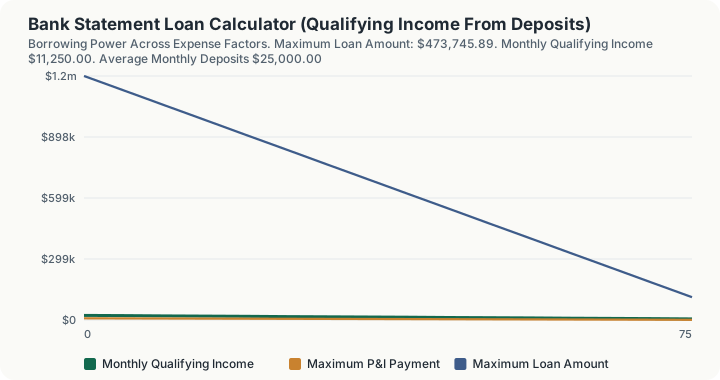
Quick Answer: $600,000 of business deposits across 24 months, cut by a 10% ineligible-deposit haircut and a 50% expense factor, yield $11,250 of monthly qualifying income and a maximum loan of $473,745.89 at 7.5% over 360 months against a 45% DTI overlay. That qualifying income is 45.00% of what actually lands in the account.
What does this calculator do?
A bank statement loan exists because a tax return is a bad description of a self-employed borrower's capacity to pay a mortgage. The return is optimised to minimise tax. The deposits are not optimised at all, so a lender willing to look at them can underwrite a business owner that a full-documentation programme would decline.
What the borrower usually misunderstands is where the money goes between the deposit and the loan. Roughly half of it disappears, and almost none of that is negotiable at the rate table. The chain is:
deposits, then the ineligible-deposit haircut, then the expense factor, then the ownership share, then the number of months, then the DTI ceiling, then the present value of a payment.
The expense factor is the one that dominates. It is an assumption about the cost of running your business, not a measurement of it, and no authority publishes one. A service business with almost no cost of goods and a wholesale distributor with a 70% cost of goods can be handed the same 50% factor by the same lender. That is why a CPA letter establishing a real, documented factor is often worth more than any rate concession you could win.
This page is distinct from the 1099 income mortgage calculator, which derives income from issued 1099 forms and is governed by the declining-income rule. Nothing here looks at a tax return at all, which is the entire point of the product.
How is this calculated?
qualifying income_monthly = (D × (1 − h) × (1 − f) × s)/m
where $D$ is total deposits, $h$ is the ineligible-deposit percentage, $f$ is the expense factor, $s$ is the ownership share and $m$ is the number of months of statements. The loan is then the present value of the largest principal-and-interest payment the DTI ceiling leaves room for.
Step 1: Find the average monthly deposit, for reference. $600,000 / 24 = $25,000 a month
Step 2: Strip out ineligible deposits. $600,000 x 10% = $60,000 removed
Step 3: What remains is eligible deposits. $600,000 - $60,000 = $540,000
Step 4: Apply the expense factor to the eligible deposits. $540,000 x 50% = $270,000 of assumed business expenses
Step 5: Subtract to get business net income. $540,000 - $270,000 = $270,000
Step 6: Take your ownership share. $270,000 x 100% = $270,000
Step 7: Divide by the number of months of statements. $270,000 / 24 = $11,250 of monthly qualifying income
Step 8: Apply the DTI ceiling. $11,250 x 45% = $5,062.50 of total monthly debt allowed
Step 9: Remove the other monthly debts. $5,062.50 - $900 = $4,162.50 of maximum housing payment
Step 10: Remove taxes, insurance and HOA. $4,162.50 - $850 = $3,312.50 available for principal and interest
Step 11: Take the present value of that payment. $3,312.50 for 360 months at 7.5% / 12 = $473,745.89 maximum loan amount
The engine also reports the effective yield: $11,250 of qualifying income against $25,000 of average monthly deposits is 45.00% of deposits, and it reruns the whole chain at an expense factor ten points lower so the value of that argument is visible in dollars.
Worked Example
The single most useful thing to price on this page is what the expense factor is worth, because it is the input with the most room to move and the least published basis.
Step 1: Take ten points off the factor. 50% - 10% = 40% expense factor
Step 2: Recompute business net income on the same eligible deposits. $540,000 x (1 - 40%) = $324,000
Step 3: Convert to monthly qualifying income. $324,000 / 24 = $13,500 a month
Step 4: Rerun the DTI chain. $13,500 x 45% = $6,075.00, less $900, less $850 = $4,325.00 of principal and interest
Step 5: Take the present value. $4,325.00 for 360 months at 7.5% / 12 gives a loan of about $618,551
Step 6: The difference. Ten points of expense factor is worth $144,805.35 of additional loan at these inputs.
Compare that against what a rate concession buys. Moving the rate from 7.5% to 7.0% on the same $3,312.50 payment raises the loan by roughly $24,000. The expense factor is worth about six times as much, and it is the conversation almost nobody has.
The table on the page runs the same comparison across every expense factor from 0% to 75% in five-point steps, so you can see the whole curve rather than one point on it.
What does this calculator not account for?
- Whether your deposits are actually acceptable. Lenders differ on cash deposits, related-party transfers, seasonal spikes and deposits that cannot be tied to invoices. The engine applies one flat haircut percentage that you supply.
- Credit, reserves and LTV overlays. The calculation is income to loan size only. A non-QM investor will also impose reserve months, credit tiers and a maximum LTV, any of which can cut the loan below this figure.
- Personal bank statement programmes. Some lenders will underwrite personal rather than business accounts, usually with a different or zero expense factor. The engine models the business-account structure only.
- Business debt paid from the business account. Some underwriters will exclude it from your DTI; the engine counts whatever you enter as other monthly debts.
- Interest-only or 40-year features. The term input covers the amortisation length, but the engine always prices a fully amortising payment.
- The appraisal. No property value is an input, so no LTV test is applied.
What mistakes do people make with this?
- Confusing deposits with revenue or profit. The programme starts from what landed in the account. Invoiced-but-unpaid revenue does nothing for you.
- Moving money between your own accounts. Every internal transfer inflates gross deposits and is stripped out in underwriting, so it adds nothing and can raise your ineligible-deposit percentage.
- Accepting the first expense factor quoted. It is an assumption, and a documented one can replace it. At these defaults ten points is worth $144,805.
- Choosing 24 months without checking. Twenty-four months smooths a seasonal business. Twelve months favours a business that has recently grown, because the weaker early year is excluded entirely.
- Forgetting the ownership share. A 50% partner qualifies on half the business net income even though the whole business deposits into the account.
- Treating the 45% DTI as regulatory. It is not. See the FAQ below.
Frequently Asked Questions
How much of my deposits actually counts as income?
Can I get the expense factor lowered?
Is a bank statement loan capped at 43% debt-to-income?
Should I submit 12 months or 24 months of statements?
Do I still need tax returns?
Why is my rate higher than a conventional mortgage?
Sources
- 12 CFR 1026.43(c)(1), (c)(2) and (c)(4), ability-to-repay: the creditor must make a reasonable and good faith determination of ability to repay, considering income and the monthly debt-to-income ratio, and must verify income using third-party records. Read 2026-08-30 at consumerfinance.gov/rules-policy/regulations/1026/43
Also consulted: The expense factor, the ineligible-deposit haircut, the maximum DTI and the interest rate are all lender credit policy. No public authority publishes any of them, and the engine treats every one as a user input rather than a sourced constant.