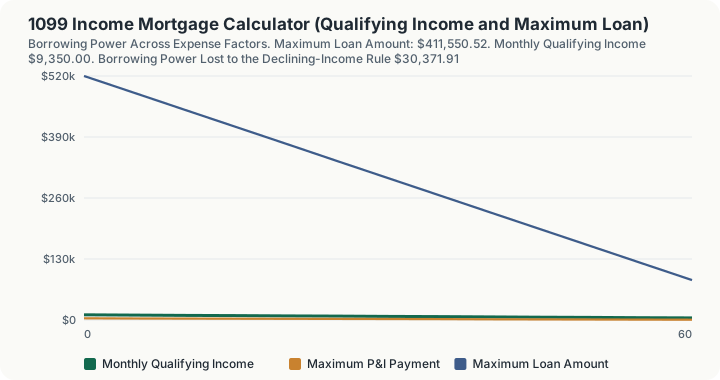
Quick Answer: Two years of Form 1099 receipts, $145,000 then $132,000, support a maximum loan of $411,550.52 at 7.25% over 360 months, after a 15% expense factor, $650 of other monthly debts and a 45% DTI overlay. Because receipts fell year over year, the most recent year is used alone rather than averaged, which costs $30,371.91 of borrowing power against the $441,922.43 a two-year average would have supported.
What does this calculator do?
A contractor paid on Form 1099 does not have an income number. The lender derives one, and that derivation is the whole decision. Two people with identical bank balances and identical credit can be quoted loan amounts $100,000 apart because one of them had a soft year immediately before applying, or because one of them deducts expenses harder than the other.
This page is about the derivation, not about a payment schedule. It answers a single question: given what your 1099s actually say, what is the largest loan an underwriter will size for you, and which of your own inputs is costing you the most?
Two mechanisms dominate, and both are counter-intuitive:
The declining-income rule. When the most recent year is lower than the prior year, the two years are not averaged. The lower recent year stands alone. A borrower whose receipts fell 9% does not take a 4.5% haircut on qualifying income; they take the full 9%.
The expense factor. Gross receipts are reduced by business expenses before anything else happens. Every dollar you deducted aggressively for tax purposes is a dollar you cannot borrow against. This is the one place where tax optimisation and mortgage qualification point in opposite directions.
Neither the expense factor nor the DTI ceiling is a published figure. The 43% number people quote came from the pre-2021 General QM definition, which the 2021 amendments replaced with a price-based test. It is now a lender or investor overlay, not a regulatory line, which is why it appears here as an input you set rather than a constant the engine imposes.
How is this calculated?
The engine runs two functions. The first turns two years of receipts into a monthly qualifying income; the second turns that income into a loan amount by taking the present value of the largest principal-and-interest payment the DTI ceiling leaves room for.
qualifying income_monthly = (G × (1 − e))/12
L_max = P_max × (1 − (1 + i)⁻ⁿ)/i
where $G$ is the gross figure actually used, $e$ is the expense factor, P_max is the maximum principal-and-interest payment, $i$ is the monthly rate and $n$ is the term in months.
Step 1: Compare the two years and pick the basis. Recent $132,000 is less than prior $145,000, so the declining-income rule applies and the recent year is used alone: $132,000
Step 2: Apply the expense factor to that gross. $132,000 x 15% = $19,800 of business expenses
Step 3: Subtract the expenses to get net annual qualifying income. $132,000 - $19,800 = $112,200
Step 4: Divide by twelve. $112,200 / 12 = $9,350 of monthly qualifying income
Step 5: Apply the DTI ceiling to that income. $9,350 x 45% = $4,207.50 of total monthly debt allowed
Step 6: Remove the other monthly debts. $4,207.50 - $650 = $3,557.50 of maximum housing payment
Step 7: Remove taxes, insurance and HOA, which sit inside the housing payment. $3,557.50 - $750 = $2,807.50 available for principal and interest
Step 8: Take the present value of that payment at the note rate and term. $2,807.50 for 360 months at 7.25% / 12 = $411,550.52 maximum loan amount
The engine then runs the same chain a second time on a two-year average, purely so the cost of the declining-income rule appears as a number rather than a warning.
Worked Example
Take the default contractor and price the two things they could actually change.
Step 1: What the declining year cost. Averaged gross would be ($145,000 + $132,000) / 2 = $138,500
Step 2: The same expense factor on the averaged gross. $138,500 x 85% = $117,725, and $117,725 / 12 = $9,810.42 a month
Step 3: The loan that averaged income would have supported. Running steps 5 through 8 on $9,810.42 gives $441,922.43
Step 4: The cost of the soft year. $441,922.43 - $411,550.52 = $30,371.91 of lost borrowing power
That is roughly $2,300 of loan for every $1,000 of receipts the recent year came in under the prior one. It is also entirely a timing effect: the same two years in the opposite order would be averaged.
Step 5: What the expense factor is worth. The sensitivity table on the page reruns the whole chain at expense factors from 0% to 60% in five-point steps, holding everything else fixed. Each row shows the monthly qualifying income, the maximum principal-and-interest payment and the resulting loan. Reading the table is the fastest way to see whether documenting a lower factor is worth more to you than shopping a lower rate.
What does this calculator not account for?
- Credit score, reserves, and loan-level pricing. The engine sizes the loan from income and the DTI ceiling only. It does not model the reserve requirements, credit tiers or LTV overlays that a non-QM investor will also apply, any of which can cut the loan below the figure shown.
- Property value. There is no LTV test here at all. The number returned is what your income supports; the appraisal may support less.
- Self-employment tax and income tax. Qualifying income is a gross-of-tax underwriting figure. It is not spendable income and this page does not compute what you keep.
- Any part-year or seasonal weighting. The engine uses two annual totals. It does not model year-to-date receipts, seasonality, or a partial third year, all of which some underwriters will look at.
- Non-1099 income. W-2 wages, rental income, retirement income and a co-borrower's earnings are not inputs. If you have them, your real qualifying income is higher than what this page derives.
- Whether the lender uses your Schedule C expenses instead of a flat factor. Both approaches exist. The engine applies whatever single percentage you enter.
What mistakes do people make with this?
- Assuming the two years will be averaged. They are averaged only when the recent year is at least as high as the prior year. If you had a soft year, apply after your next strong one if you can.
- Deducting hard right before applying. Aggressive Schedule C deductions lower your tax bill and lower your loan by roughly the same proportion. The trade is real and it runs in both directions.
- Quoting the 43% DTI figure as a rule. It has not been the General QM standard since 2021, when the price-based test replaced it. Ask your lender what their actual overlay is and enter that.
- Forgetting that taxes and insurance sit inside the ceiling. Every $100 of monthly property tax removes $100 from the principal-and-interest allowance, which at these defaults is about $14,700 of loan.
- Treating the output as a pre-approval. This is the income side of the underwrite only.
Frequently Asked Questions
Why do lenders use my most recent year alone when my income dropped?
Can I qualify with only one year of 1099 income?
What expense factor will my lender use?
Is the 43% debt-to-income limit a legal requirement?
Will paying off my car loan increase what I can borrow?
Does a longer term help?
Sources
- 12 CFR 1026.43(c)(1), (c)(2) and (c)(4), ability-to-repay: the creditor must make a reasonable and good faith determination of ability to repay, considering income and the monthly debt-to-income ratio, and must verify income using third-party records. Read 2026-08-30 at consumerfinance.gov/rules-policy/regulations/1026/43
Also consulted: The expense factor, the interest rate and the maximum DTI are lender credit policy. No public authority publishes them, and the engine treats all three as user inputs rather than sourced constants.