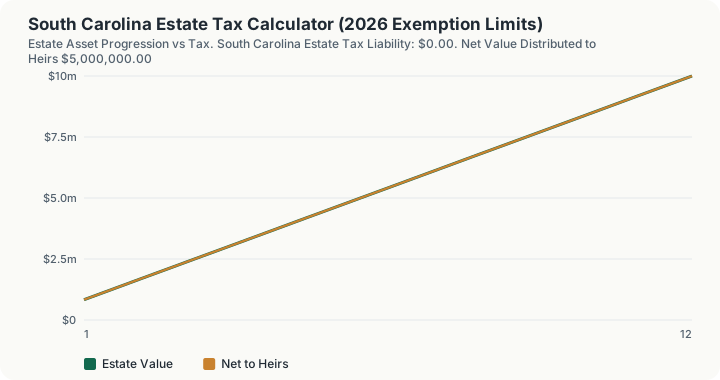
Quick Answer: South Carolina has no state-level estate tax, so a $5,000,000 estate owes $0 in South Carolina estate tax. Federal exemption rules apply separately.
No Statute, No Schedule: What That Means Here
South Carolina charges no estate tax and no inheritance tax, and neither does either state it borders.
That places South Carolina in the larger group of 38 states that repealed or never adopted a separate estate tax, as opposed to the 12 states that still run one alongside the federal system.
The practical result is that a South Carolina estate's tax exposure depends entirely on federal law, not state statute. That means state legislative changes in South Carolina have no bearing on the calculation, unlike in states that still set their own exemption and rate schedule.
It also means the calculation is unusually stable for South Carolina families: the number to watch is the federal exemption, published and adjusted at the national level, not a South Carolina statute that could shift with a single legislative session.
Real property is the one exception worth flagging: a home or land South Carolina residents own in a state that does levy its own estate tax stays subject to that state's rules, no matter how simple the South Carolina side of the math is, or that South Carolina is a South Atlantic coastal state.
How This Is Calculated
There is no South Carolina estate tax statute, so there is no exemption to clear and no rate schedule to walk. The calculator confirms that rather than computing against a threshold, and the state tax line is $0 at every estate size.
- Value the gross estate. Fair market value at the date of death of all real property, business interests, securities, cash, and life insurance proceeds the decedent owned.
- Subtract allowable deductions. Debts, administrative expenses, qualifying charitable bequests, and the unlimited marital deduction come off the gross figure. This is bookkeeping here rather than tax math, since no state rate is applied to the result.
- Look South Carolina up in the state table. It is not among the twelve states that impose an estate tax, so no exemption threshold or bracket schedule is loaded.
- Return $0. The net estate passes to beneficiaries with no South Carolina reduction, whether it is $500,000 or $50,000,000.
The federal estate tax is a separate return with its own exemption, above $15,000,000 per individual for 2026, and this calculator does not compute it. It also does not carry over a deceased spouse's unused federal exemption, add back lifetime taxable gifts, or apply the generation-skipping transfer tax.
Worked Example
- Start with the gross estate. This example uses a $5,000,000 gross estate: the fair market value of all real property, business interests, equities, cash, and life insurance the decedent owned at death, before deductions.
- Check South Carolina's estate tax status. South Carolina is one of the 38 states with no separate state-level estate tax, so there is no state exemption threshold or bracket schedule to apply.
- Compute the state estate tax due. Because South Carolina taxes no estates at any size, the calculator returns $0.00 in state tax. A $5,000,000 estate and a $50,000,000 estate both owe South Carolina nothing.
- Distribute the net estate. With no state tax subtracted, the full $5,000,000.00 gross estate passes to beneficiaries as the net estate distributed.
- What this excludes. This is South Carolina's state-level result only; federal estate tax is computed separately against the $15,000,000+ federal exemption per individual for 2026 on IRS Form 706.
The Flat Line: What the Sweep Returns at Every Estate Size
Most calculators in this family have a boundary somewhere. This one does not, and the sweep is the proof rather than the assertion. Running grossEstateValue from $0 to $5,000,000 in $1,000,000 steps returns the same headline at every point: $0.00, with a step delta of $0.00 between each pair. Pushed to the input's ceiling of $1,000,000,000, the figure is still $0.00 and netEstateDistributed is the full $1,000,000,000.00.
The marginal cost of the next million
Each additional $1,000,000 of estate costs $0.00 in South Carolina estate tax. That is true at $1,000,000, at $50,000,000, and at the $1,000,000,000 input maximum, and it is the one figure on this page that a snippet can carry without qualification. The effective rate output holds at 0.00% across the entire sweep, because the numerator never leaves zero.
The reverse question, inverted
On a state with a schedule the useful question is how much can pass before the tax starts. Here that question has to be turned around: at what estate size does South Carolina first take anything? The answer from the sweep is that it never does, at any value the input accepts. The grossEstateValue field caps at $1,000,000,000 and the tax at that cap is $0.00, so there is no crossing point inside the calculator's own domain.
Deductions have no effect either. The engine subtracts estateDeductions from gross to get the net estate before calling the state routine, so entering $0 or the field's $100,000,000 maximum changes the net estate figure but leaves the South Carolina tax at $0.00 in both cases. The deduction field is live arithmetic that cannot alter this state's result.
One reporting quirk worth naming
The exemptionThreshold output reads $0.00 on this page. That is the engine reporting an absent statute with a number rather than with "not applicable": when the state table's hasEstateTax flag is false, the routine returns zeros for the exemption, the taxable-above figure and the tax, and never reads the exemption, rateMin, rateMax or brackets fields at all. South Carolina's row does carry those fields, all set to zero and all unused. Read $0.00 there as "no threshold exists", not as "the threshold is zero and everything above it is taxed".
Right method against wrong method, priced
The error that costs real money is accruing a state estate liability at a neighbouring schedule's rate. Take a $5,000,000 estate. This calculator returns $0.00. The same $5,000,000 estate run through the Rhode Island calculator in this corpus, on the same engine and the same 2026 tables, returns $303,660.00. An executor who reserved on that basis would hold back $303,660 that South Carolina has no claim to, and would distribute $4,696,340.00 where the correct South Carolina distribution is the full $5,000,000.00.
The second error runs the other way: assuming the absence of an estate tax means no death tax of any kind. That distinction is real elsewhere, and this engine does keep a separate inheritance-tax table listing the five states that levy one on beneficiaries. South Carolina is not among them, but note the limitation precisely: this calculator never consults that table. Its config imports the money and state-tax primitives only, so the $0.00 headline is a statement about South Carolina's estate tax and nothing else.
What This Does Not Account For
- Federal generation-skipping transfer (GST) tax under IRC Chapter 13.
- Ancillary probate requirements for real property situated in other jurisdictions.
- Complex liquidity discounts for minority non-voting family business entities.
- State-specific inheritance taxes levied directly on beneficiaries (e.g. PA, NJ, MD, KY, NE).
Common Pitfalls
- Assuming State Exemption Matches Federal: Forgetting that states like Oregon ($1.0M) and Massachusetts ($2.0M) tax estates far below the federal threshold.
- The "Cliff" Effect in Specific States: Failing to recognize that states like New York eliminate the exemption entirely if the estate exceeds 105% of the threshold.
- Out-of-State Real Property Exposure: Holding real estate in states with active estate taxes exposes non-resident estates to proportional state estate taxes.
- Failing to Fund Revocable Living Trusts: Assets held outside trust structures are subjected to public probate proceedings and statutory executor fees.
Frequently Asked Questions
Does South Carolina have a state estate tax?
Does South Carolina have an inheritance tax?
When is state estate tax due?
What assets are included in the taxable estate?
Sources
- South Carolina Department of Revenue: General state tax administration; South Carolina levies no state-level estate tax, so only the federal estate tax applies. dor.sc.gov