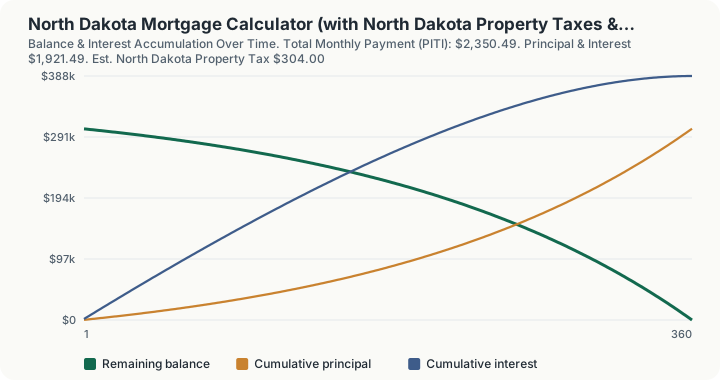
Quick Answer: A $380,000 North Dakota home with 20% down at 6.5% costs about $2,350 a month once principal, interest, an estimated 0.96% property tax rate, and $125 of insurance are added together.
Overview
North Dakota's property tax system is shaped by county mill levies set on a mix of city, county, school district, and park district budgets, layered on top of a state-mandated true and full value assessment standard. This calculator models a standard 30-year fixed-rate mortgage with the same amortization engine used across the platform's lending calculators, then adds an escrow estimate built on a 0.96% statewide effective property tax rate and a flat $125 monthly insurance placeholder to arrive at a total PITI (principal, interest, taxes, insurance) payment.
North Dakota's tax base has historically been shaped by its energy sector, particularly oil-producing counties in the western part of the state around the Bakken formation, where local governments have sometimes been able to fund infrastructure through severance and production tax revenue rather than leaning as heavily on property taxes. Eastern counties and the Fargo-Grand Forks corridor, which lack that revenue source, tend to rely more directly on property mill levies. The 0.96% default used here is a reasonable statewide planning estimate, but it should be checked against the specific county auditor's published mill rate before finalizing any purchase decision, since North Dakota expresses local rates in mills rather than a simple percentage, which can make direct comparison confusing for buyers moving from other states.
How This Is Calculated
The calculator performs a standard fixed-rate amortization and layers two escrow-style estimates on top of the raw debt service figure.
- Down payment and loan principal. The home price is multiplied by the down payment percentage to determine cash due at closing, and the remainder becomes the financed loan amount. At the default inputs, $380,000 minus 20% down ($76,000) leaves a $304,000 loan.
- Monthly interest rate. The annual mortgage APR is divided by 12 to produce the periodic monthly rate applied across a fixed 360-month, 30-year schedule.
- Principal and interest (P&I). The standard amortizing payment formula, PMT = P × [r(1+r)^n] / [(1+r)^n − 1], is applied to the loan principal, monthly rate, and 360 periods through the site's Decimal.js-based amortization primitive, which avoids the floating-point rounding drift seen in ordinary spreadsheet mortgage functions.
- Property tax escrow. Home price is multiplied by the 0.96% effective rate and divided by 12 to produce a monthly property tax line item.
- Insurance escrow. A flat $125 monthly homeowners insurance placeholder is added as a national baseline estimate.
- Total monthly payment (PITI). Principal and interest, property tax, and insurance sum into the headline monthly payment figure.
Worked Example
Using the calculator's default inputs of a $380,000 home price, 20% down payment, and a 6.5% fixed 30-year mortgage rate:
- Down payment: $380,000 × 20% = $76,000
- Loan principal: $380,000 − $76,000 = $304,000
- Monthly interest rate: 6.5% ÷ 12 = 0.5416667%
- Monthly principal and interest: $1,921.49
- Monthly estimated North Dakota property tax (on the full home price): $380,000 × 0.96% ÷ 12 = $304.00
- Monthly insurance estimate: $125.00
- Total monthly payment (PITI): $1,921.49 + $304.00 + $125.00 = $2,350.49
Over the full 360-month term, this loan generates roughly $387,733 in cumulative interest on the $304,000 borrowed, meaning total principal and interest payments over 30 years approach $691,735. Because $380,000 is well above North Dakota's typical statewide median home price, this worked example represents a larger-than-typical North Dakota mortgage; buyers financing a home closer to the state's actual median price should expect a proportionally smaller monthly payment using the same rate and down payment assumptions.
What This Does Not Account For
- Mill levy structure. North Dakota counties, cities, school districts, and park districts each levy separate mills that combine into a single tax bill. This calculator collapses all of that into one blended statewide percentage and cannot reflect a specific taxing district's actual combined mill rate.
- Homestead credit for seniors and disabled residents. North Dakota offers a Homestead Property Tax Credit that reduces the taxable value for qualifying senior citizens and permanently disabled homeowners; this calculator does not net out any credit.
- Agricultural land valuation rules. Properties with attached agricultural acreage are assessed differently than residential-only parcels, which this calculator does not model.
- Energy-sector economic volatility. In oil-producing counties, local tax bases and housing demand have historically moved with commodity prices, an effect this static calculator cannot forecast.
- Private mortgage insurance (PMI). The default 20% down payment avoids PMI; buyers financing with less than 20% down on a conventional loan should budget for an additional monthly PMI premium not reflected here.
- Severe weather-related insurance costs. North Dakota's exposure to hail and wind damage can push actual homeowners insurance premiums above the flat $125 placeholder used in this calculator.
Common Pitfalls
- Confusing mills with a simple percentage. North Dakota tax bills are often quoted in mills (dollars of tax per $1,000 of taxable value), which requires an extra conversion step that buyers accustomed to states that quote a straight percentage can easily get wrong.
- Applying the statewide average to a specific county. Because North Dakota's effective rates vary based on whether a county has significant energy production revenue supplementing its budget, 0.96% can understate or overstate a specific parcel's actual bill by a meaningful margin.
- Forgetting the taxable value versus true and full value distinction. North Dakota assesses residential property at a percentage of true and full value before applying mills, which is a step this calculator's simplified effective-rate model does not separately expose.
- Overlooking hail and wind insurance riders. Standard homeowners policies in North Dakota sometimes carry higher deductibles or separate riders for hail damage, which the flat insurance estimate does not capture.
- Ignoring seasonal construction and closing timelines. North Dakota's winter climate can affect appraisal scheduling and closing timelines in ways that do not show up in a static monthly payment number but matter for real-world planning.
Frequently Asked Questions
Why does this calculator use 0.96% for North Dakota property tax?
Does North Dakota offer property tax relief for seniors?
How does this calculator handle North Dakota's mill levy system?
What down payment avoids PMI in North Dakota?
Is the $125 insurance placeholder accurate for North Dakota?
Why is the worked example's home price higher than North Dakota's typical median?
Sources
- North Dakota Office of State Tax Commissioner, Property Tax Division, mill levy and equalization data. tax.nd.gov
- Consumer Financial Protection Bureau, Regulation Z (Truth in Lending Act) and Loan Estimate/Closing Disclosure standards. ecfr.gov/current/title-12/chapter-X/part-1026
Also consulted: North Dakota Century Code, Chapter 57-02, property assessment and true and full value standards; North Dakota Housing Finance Agency, first-time homebuyer program guidelines.