Quick Answer: Connecticut's cost of living is 17.8% above the U.S. national average (composite index 117.8), so a $75,000.00 national-average household budget costs about $88,350.00 a year in Connecticut.
Expensive in Two Directions at Once
Connecticut's composite cost-of-living index is 117.8 against the 100.0 baseline, ranking the state 8th of 50 on cost.
What distinguishes it from other expensive states is the shape of the sub-indices rather than their level. Housing is 129.5 and utilities are 128.4, barely a point apart. In most high-cost states utilities stay near parity while housing carries the whole premium; here both categories sit close to 30 points above the national line. Groceries add 107.5.
The practical consequence is that reducing your housing spend removes a smaller share of the Connecticut premium than the same move would elsewhere. The calculator itself does not model that: it returns $88,350.00 on the default $75,000 baseline by multiplying against 117.8 and dividing by 100, a differential of $13,350.00, with the sub-indices playing no part in the arithmetic.
Key Index Components for Connecticut:
- Composite Benchmark Index: 117.8 (Rank #8)
- Housing Cost Index: 129.5
- Utilities Cost Index: 128.4
- Grocery Cost Index: 107.5
How This Is Calculated
Housing at 129.5 and utilities at 128.4 are both close to 30 points over the national line. Groceries add 107.5. The composite of 117.8 is what the calculator applies to your budget.
- Baseline budget. You enter annual household spending priced at the national benchmark, index 100.0.
- Composite lookup. Connecticut's composite index of 117.8 is read from the 2026 MERIC state table, along with its rank of #8 among the 50 states.
- Single-factor scaling. The baseline is multiplied by 117.8 and divided by 100. Nothing further is computed. Housing 129.5, groceries 107.5 and utilities 128.4 are reported as separate index ratios; the engine assigns no share of your budget to any of them and applies no weighting.
- Differential. The dollar and percentage difference against the baseline are taken from the scaled result. The percentage is +17.8% regardless of what is entered.
Worked Example
Using this calculator's baseline scenario: a household needing $75,000.00 a year to sustain a standard basket of goods, priced at the U.S. national average (composite index 100.0).
- National baseline. $75,000.00 is the reference spending level at the national-average price level (index 100.0).
- Apply Connecticut's composite index. Connecticut's composite index of 117.8 (rank #8 nationally) means local prices run 17.8% above the national basket. Scaling: $75,000.00 × (117.8 ÷ 100) = $88,350.00.
- Dollar differential. The engine returns +$13,350.00, the amount by which the budget has to grow to hold the same basket.
- Percentage. That is +17.8%, identical at every budget size.
The Sweep Is a Ray, Not a Staircase
Nothing in this calculator brackets, steps or phases out. A sweep across the input range produces a perfectly straight line, and reporting that honestly is more useful than manufacturing an edge:
| Baseline entered | Connecticut adjusted | Differential |
|---|---|---|
| $10,000 | $11,780.00 | $1,780.00 |
| $50,000 | $58,900.00 | $8,900.00 |
| $75,000 | $88,350.00 | $13,350.00 |
| $100,000 | $117,800.00 | $17,800.00 |
| $150,000 | $176,700.00 | $26,700.00 |
| $200,000 | $235,600.00 | $35,600.00 |
Composite 117.8 and differential 17.8% on every row. At a $200,000 baseline the differential alone reaches $35,600.00, which is close to half the entire default budget this page starts from.
The next thousand dollars. A $75,000 baseline returns $88,350.00; a $76,000 baseline returns $89,528.00. That step is the Connecticut cost of one further thousand dollars of national-baseline spending, and it is the same step at $20,000 as at $190,000.
What a Connecticut Budget Is Worth at National Prices
The reverse calculation is the one that matters for anyone weighing an offer in or out of the state. What national baseline maps onto $75,000 of Connecticut spending?
Running the engine down to the dollar:
- A baseline of $63,667 returns $74,999.73.
- A baseline of $63,668 returns $75,000.90.
$75,000 spent in Connecticut therefore buys roughly what $63,668 buys at national-average prices. Forward, the same relationship reads the other way: holding a $75,000 national-average standard of living in Connecticut takes $88,350.00.
Two Methods, One Wrong, Priced Against the Engine
The recurring error is reversing a percentage differential by subtracting it from the wrong base. Connecticut is 17.8% above national, so it looks reasonable to say $75,000 of Connecticut spending equals $75,000 minus 17.8%, or $61,650 of national baseline.
Run $61,650 through the calculator and it returns $72,623.70, not $75,000. It undershoots because a 17.8% increase and a 17.8% decrease are taken against different bases and do not cancel.
The correct method divides by the index, and running the engine confirms it: $63,668 in, $75,000.90 out. The distance between $61,650 and $63,668 is what the shortcut costs before any tax, insurance or commuting cost enters the picture, and none of those is modelled here.
What the Multiplier Schedule Table Is Built From
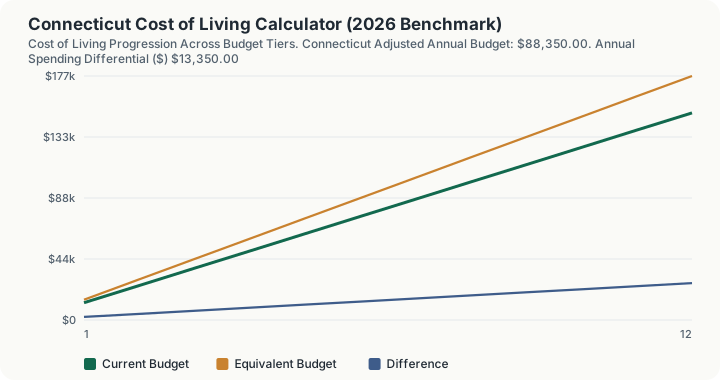
The 12-row table below the calculator moves one variable per row, the budget, and can be read straight down as a progression.
Row i scales the baseline to budget × i ÷ 6 and prices it at the composite 117.8, on every row without exception. At the default $75,000 that produces $12,500.00 steps: row 1 prices $12,500.00 and returns $14,725.00; row 2 prices $25,000.00 and returns $29,450.00; row 4 prices $50,000.00 and returns $58,900.00; row 6 prices the $75,000.00 you entered and returns $88,350.00, the headline exactly; row 12 prices $150,000.00 and returns $176,700.00.
The difference column is the same 17.8% of each row's tier all the way down, from $2,225.00 at row 1 to $8,900.00 at row 4, $13,350.00 at row 6 and $26,700.00 at row 12. Both columns are strictly proportional to the budget, which means the table contains no information the headline does not: it is there to let you find your own budget on a line rather than retyping the input, and to show that the Connecticut premium neither compounds nor eases across a twelve-fold range of household sizes.
The three sub-indices this page prints -- housing 129.5, groceries 107.5, utilities 128.4 -- do not appear in the table and are not applied to a budget anywhere. They are worth reading because housing and energy price almost identically against the national line here, which is unusual and is the substance of the Connecticut case, but that observation comes from comparing the published indices, not from anything the engine computes. Your result is one multiplication against the composite.
What This Does Not Account For
- One index for the entire state. Greenwich, Hartford, New Haven and rural Windham County all receive the identical 117.8 multiplier. There is no metro, county or ZIP input, and Connecticut's Fairfield County skew is among the largest within-state gradients in the country.
- No category weighting. The engine does not know your rent or your heating bill, and applies no share of the budget to housing, groceries or utilities.
- No taxes. Connecticut's graduated income tax, sales tax, and its high municipal property mill rates are all absent here. Property tax in particular is one of the state's largest household costs and is computed by a separate calculator on this site.
- No date or inflation input. The 117.8 is a static table value; this config is not tax-year sensitive and takes no year field.
- No commuting cost. The New York commuter relationship that shapes Fairfield County pricing is not a line item in any index used here.
Common Pitfalls
- Assuming a cheaper house solves it. Utilities at 128.4 sit almost level with housing at 129.5, so cutting the shelter line removes less of the premium than in a state where energy prices near parity.
- Reversing the differential by subtraction. $61,650 returns $72,623.70, not $75,000. The verified inverse is $63,668.
- Reading the composite as a Fairfield County figure. One number covers the whole state; the tool has no geography input below state level.
- Expecting the premium to soften at higher budgets. It is 17.8% at $10,000 and 17.8% at $200,000, where the differential reaches $35,600.00.
Frequently Asked Questions
Is Connecticut expensive to live in?
What is the biggest cost factor in Connecticut?
How much salary do I need to maintain my lifestyle in Connecticut?
Does the 17.8% differential vary with budget size?
Sources
- U.S. Bureau of Economic Analysis (BEA): Regional Price Parities. bea.gov/data/prices-inflation/regional-price-parities-state-and-metro-area
- U.S. Bureau of Labor Statistics (BLS): Consumer Expenditure Survey. bls.gov/cex
- Connecticut Department of Revenue Services, the official state tax authority for Connecticut rates, rules and forms. portal.ct.gov/drs
Also consulted: MERIC: Cost of Living Data Series (2025/2026), composite index 117.8, rank #8.