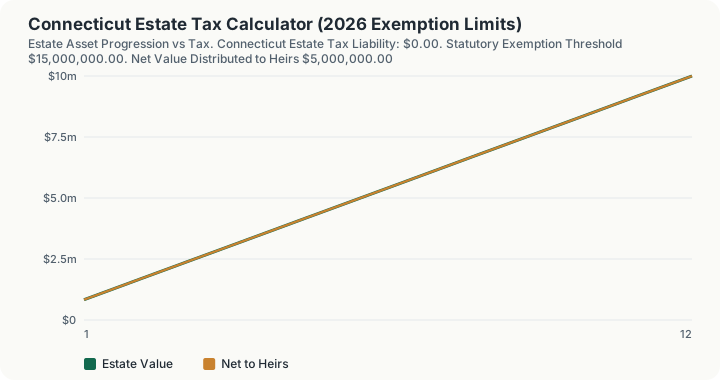
Quick Answer: Connecticut's state estate tax exemption is $15,000,000, so a $5,000,000 estate falls entirely below the threshold and owes $0 in Connecticut estate tax; only value above $15,000,000 would be taxed, up to 12.0%.
One Exemption, One Rate, No Ladder
Connecticut's record in the engine's 2026 state estate tax table sets hasEstateTax to true with an exemption of $15,000,000 and a single bracket: minimum $15,000,000, no maximum, rate 12%. There is no second band and no graduated ramp, so the marginal rate and the top rate are the same number everywhere above the line.
At the default $5,000,000 gross estate the calculator returns $0.00, an effective rate of 0.00%, an exemption threshold of $15,000,000, and $5,000,000.00 distributed to heirs. The whole story of this page is what happens on the other side of that threshold.
How This Is Calculated
The calculator starts from two numbers you enter: the gross estate at fair market value, and the deductions the estate can claim. It subtracts the second from the first, floors the result at zero, then applies Connecticut's schedule to that figure. Nothing else feeds the result.
- Value the gross estate. Date-of-death fair market value of all real property, business interests, securities, cash, and life insurance proceeds the decedent owned.
- Subtract allowable deductions. Debts, administrative expenses, charitable bequests, and the marital deduction come off the gross figure as a single number you supply. A negative result is floored at zero.
- Compare the net estate against the $15,000,000 exemption. If it is less than or equal to the exemption, the function returns a tax of $0 immediately.
- Apply the single 12% bracket. Above the exemption the engine runs the net estate through a marginal bracket summation whose only band starts at $15,000,000 and has no upper limit, so the portion above $15,000,000 is multiplied by 12%. Because that band starts exactly at the exemption, the bracket summation and the subtract-then-multiply formula above produce the same figure.
- Effective rate. Tax divided by the net estate, which rises toward 12% as the estate grows rather than stepping.
- Subtract the tax from the net estate to get what beneficiaries receive.
That is the entire computation. The engine applies no credits of any kind here: no gift tax offset, no state death tax credit table, no portability, no QTIP election.
Worked Example
- Start with the gross estate. A $5,000,000 gross estate at date-of-death fair market value, before deductions.
- Compare against Connecticut's exemption. The threshold is $15,000,000; the estate sits below it, so none of it is taxable.
- Taxable estate above exemption. $0.
- Compute the tax due. $0.00, even though the rate above the threshold is 12.0%.
- Distribute the net estate. The full $5,000,000.00 passes to beneficiaries.
- What this leaves out. Connecticut's state-level result only; the federal estate tax is not computed here.
Walking the $15,000,000 Threshold
Every figure below is a separate run of this calculator.
At a $14,999,000 estate, one thousand dollars below the line. Connecticut estate tax = $0.00. Taxable estate above exemption $0. Net to heirs $14,999,000.00.
At a $15,000,000 estate, exactly on the line. Connecticut estate tax = $0.00. The comparison is inclusive, so an estate equal to the exemption still owes nothing.
At a $15,000,001 estate, one dollar over. Connecticut estate tax = $0.12. Taxable estate above exemption $1. Net to heirs $15,000,000.88.
At a $15,001,000 estate, one thousand dollars over. Connecticut estate tax = $120.00. Taxable estate above exemption $1,000. Net to heirs $15,000,880.00.
At a $15,010,000 estate. Connecticut estate tax = $1,200.00, an effective rate of 0.01%.
At a $15,100,000 estate. Connecticut estate tax = $12,000.00, an effective rate of 0.08%.
This is the single most important property of Connecticut's schedule: crossing the exemption costs twelve cents, not a lump sum. The step from $15,000,000 to $15,000,001 changes the tax from $0.00 to $0.12, and the step from $15,000,000 to $15,001,000 changes it from $0.00 to $120.00. There is no cliff at which a small amount of extra value triggers tax on the whole estate. Contrast that with a state whose exemption phases out: there, an estate a fraction over the line can owe tax computed on every dollar it holds.
The Marginal Cost of the Next Million
Above the exemption the rate never changes, so the marginal figures are exact and constant. Each additional $1,000,000 of estate value costs $120,000.00 in Connecticut estate tax, and each additional $1,000 costs $120.00.
The sweep confirms it at scale. $16,000,000 returns $120,000.00. $17,000,000 returns $240,000.00. $20,000,000 returns $600,000.00. $25,000,000 returns $1,200,000.00. $30,000,000 returns $1,800,000.00. $40,000,000 returns $3,000,000.00. $50,000,000 returns $4,200,000.00. Every gap between consecutive million-dollar steps in that list is exactly $120,000.
The effective rate climbs as the exemption is diluted but never reaches the marginal rate: 0.75% at $16,000,000, 1.41% at $17,000,000, 3.00% at $20,000,000, 4.80% at $25,000,000, 6.00% at $30,000,000, 7.50% at $40,000,000, 8.40% at $50,000,000, and 10.20% at $100,000,000, where the tax is $10,200,000.00. Reading the 12% headline rate as the rate you will pay overstates the bill at every finite estate size.
The Reverse Question: How Much Passes Untaxed
The exemption is the answer, and it is exact. A net estate of $15,000,000 passes with $0.00 of Connecticut estate tax and $15,000,000.00 distributed to heirs. That is the largest figure the calculator returns a zero for.
Deductions extend it in gross terms, because the exemption is tested against the net estate rather than the gross. A $20,000,000 gross estate with $5,000,000 of deductions returns $0.00 of tax and $15,000,000.00 to heirs. Push the deductions one dollar higher, to $5,000,001, and the tax is still $0.00 with $14,999,999.00 distributed. A $16,000,000 gross estate with $1,000,000 of deductions likewise returns $0.00. The deduction dollar and the exemption dollar are worth the same thing at the margin here: each removes one dollar from the base that the 12% band would otherwise reach, so each is worth $0.12.
What This Does Not Account For
- Any statutory cap on total liability. The engine's Connecticut record contains a single unbounded 12% bracket and no cap field, so the tax keeps rising linearly forever: $10,200,000.00 at a $100,000,000 estate. If a statutory ceiling on total Connecticut estate tax applies to an estate, this calculator does not model it and will overstate the bill above that point.
- Federal estate tax under IRC Chapter 11. Not computed. The engine's 2026 tables contain no federal exemption figure, no unified credit, and no portability of a deceased spouse's unused exclusion.
- Lifetime taxable gifts. Not added back into the taxable estate.
- QTIP elections, credit shelter trusts, and state QTIP decoupling. None of these are modelled; they change what the taxable estate is, and the calculator takes that figure as typed.
- Federal generation-skipping transfer tax under IRC Chapter 13. Not computed.
- Valuation discounts. Minority-interest and lack-of-marketability adjustments are not applied; enter the discounted value your appraisal supports.
- Out-of-state situs. One jurisdiction per run, with no apportionment between states.
Common Pitfalls
- Expecting a cliff at the exemption. There is none. One dollar over the line costs $0.12, and one thousand dollars over costs $120.00.
- Reading 12% as the effective rate. At a $20,000,000 estate the effective rate is 3.00% and the tax is $600,000.00, not $2,400,000.
- Entering the gross estate when deductions are substantial. A $20,000,000 gross estate with $5,000,000 of deductions owes $0.00; entering $20,000,000 with no deductions returns $600,000.00. The error is worth $600,000.
- Assuming a credit will reduce the figure. No credit of any kind is applied in this code path.
- Treating the headline as a total death tax bill. No federal component is included.
Frequently Asked Questions
Does Connecticut have a state estate tax?
What happens if the estate is one dollar over the exemption?
What does each extra million dollars of estate value cost?
Does Connecticut have an inheritance tax?
Do deductions reduce the Connecticut estate tax?
Sources
- Connecticut Department of Revenue Services: Estate Tax Guidance (2026), Conn. Gen. Stat. section 12-391. portal.ct.gov/drs
Engine table: engine/tables/2026/state-estate-tax.json, Connecticut entry: exemption $15,000,000, single bracket from $15,000,000 with no maximum at 12%.