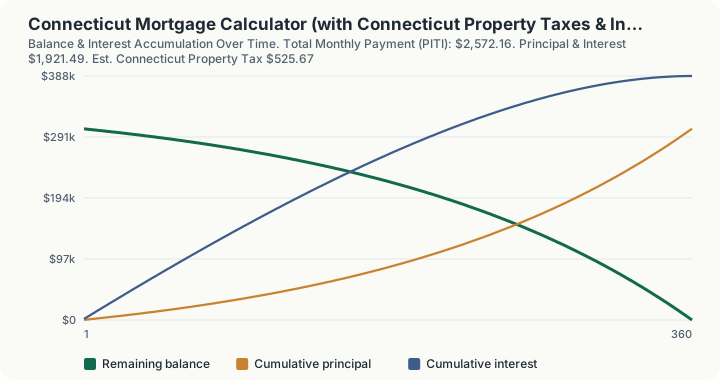
Quick Answer: On a $380,000 Connecticut home with 20% down at 6.5%, expect a total monthly payment near $2,572.16, of which $525.67 is property tax alone, reflecting Connecticut's 1.66% effective rate, the third highest in the country.
Overview
Connecticut consistently ranks alongside New Jersey and Illinois as one of the highest property tax states in the nation, and that reality changes the math of homeownership more than the mortgage rate itself in many cases. This calculator models a full Connecticut mortgage payment, not just principal and interest, by applying a 1.66% effective property tax rate to the home's purchase price and adding a flat monthly insurance estimate, producing a total PITI (Principal, Interest, Taxes, Insurance) figure that better represents what actually leaves a Connecticut homeowner's bank account each month.
The gap between principal-and-interest and the full PITI payment is unusually wide in Connecticut compared to lower-tax states. A buyer comparing a Connecticut listing against a similarly priced home in a state with a 0.5% effective rate needs to budget for roughly three times more in monthly tax escrow, even though the loan itself is identical. This calculator exists specifically so Connecticut buyers do not anchor on a principal-and-interest number pulled from a national average calculator that ignores the state's tax structure entirely.
How This Is Calculated
The engine runs a standard 30-year (360-month) fixed-rate amortization on the financed balance, then layers Connecticut-specific carrying costs on top:
- Down payment and loan principal. The down payment percentage is applied to the home price, and the remainder becomes the amortized loan principal.
- Principal and interest. The loan principal is amortized over 360 months using the standard installment formula, PMT = P × r / (1 − (1 + r)^−n), where r is the monthly rate (annual APR ÷ 12).
- Property tax. Connecticut's statewide effective average of 1.66% is applied to the full home purchase price (not the loan balance) and divided by 12 to produce a monthly escrow estimate.
- Homeowners insurance. A flat $125 monthly estimate is added to represent typical Connecticut coverage costs, which can vary meaningfully by proximity to the coastline and flood zone designation.
- Total PITI. Principal and interest, monthly property tax, and monthly insurance are summed into the headline monthly payment figure.
Worked Example
Using the calculator's baseline inputs: a $380,000 home, 20% down, and a 6.5% 30-year fixed rate.
- Down payment: $380,000 × 20% = $76,000
- Loan principal: $380,000 − $76,000 = $304,000
- Monthly rate: 6.5% ÷ 12 = 0.5417%
- Principal and interest: amortizing $304,000 over 360 months at that rate yields approximately $1,921.49 per month
- Monthly property tax: $380,000 × 1.66% ÷ 12 = $525.67
- Monthly insurance: $125.00 flat estimate
- Total PITI: $1,921.49 + $525.67 + $125.00 = approximately $2,572.16 per month
Over the full 30-year term, the loan accrues roughly $387,733 in total interest on top of the $304,000 principal, a figure worth comparing against the cumulative property tax bill, which at a static 1.66% rate on the original price would run close to $189,000 across the same 30 years if the assessed value never changed.
What This Does Not Account For
- Local mill rate variation. Connecticut property tax is set town by town through local mill rates, and actual bills in cities like Hartford or Bridgeport can run meaningfully higher than the 1.66% statewide effective average used here, while some lower-cost towns sit below it.
- Connecticut's PURA-regulated homeowners insurance market. Coastal properties in Fairfield and New London counties often carry higher premiums due to windstorm and flood exposure than the flat $125 estimate reflects.
- Private mortgage insurance (PMI). This calculator assumes the standard 20% down payment scenario avoids PMI; a lower down payment scenario would add a PMI line item not modeled here.
- Connecticut conveyance tax. A one-time state and municipal conveyance tax applies at the time of sale, not as an ongoing monthly cost, and is not part of this recurring payment estimate.
- Reassessment cycles. Connecticut municipalities revalue property on a five-year cycle in most towns, meaning the tax figure here reflects current pricing and could shift after the next town-wide revaluation.
Common Pitfalls
- Budgeting only for principal and interest. In a high-tax state like Connecticut, the tax and insurance portion of PITI can exceed $650 a month on a mid-priced home, and skipping it in a pre-approval budget is the single most common Connecticut mortgage-shopping mistake.
- Assuming the mill rate is uniform statewide. Connecticut has over 150 separate taxing jurisdictions, and mill rates can differ by more than double between neighboring towns, so the 1.66% figure is a planning average, not a specific-address quote.
- Overlooking escrow cushion requirements. Lenders typically collect two to three months of extra tax and insurance reserve at closing, which adds to upfront cash needs beyond the down payment shown here.
- Comparing Connecticut listings to out-of-state prices without adjusting for tax. A home priced $30,000 lower in another state can still cost more monthly once Connecticut's above-average property tax is factored in, or vice versa.
- Ignoring the effect of extra principal payments. Even modest additional monthly principal payments compound meaningfully against a $304,000, 6.5% balance, since so much of the early amortization schedule is interest.
Frequently Asked Questions
Why is Connecticut's property tax so much higher than the national average?
Does this calculator use my actual town's mill rate?
What happens to my payment if I put down less than 20%?
Is homeowners insurance regulated differently in Connecticut than other states?
How often does Connecticut property tax get reassessed?
Sources
- Connecticut Department of Revenue Services, Real Estate Conveyance Tax guidance. portal.ct.gov/drs
- Consumer Financial Protection Bureau, Regulation Z and mortgage disclosure standards. ecfr.gov/current/title-12/chapter-X/part-1026
Also consulted: Connecticut Office of Policy and Management, Municipal Mill Rates and Property Tax Data; Connecticut Insurance Department, homeowners insurance market data.