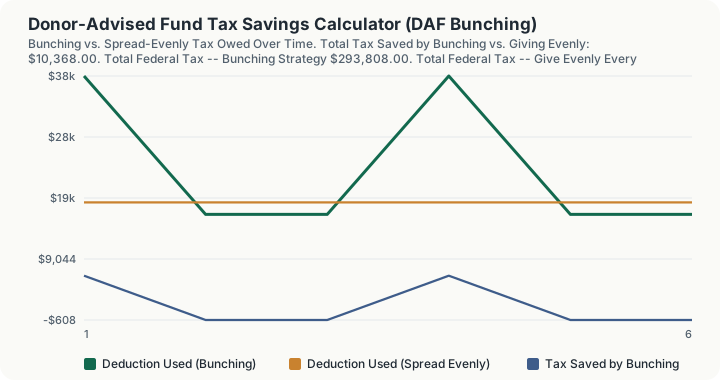
Quick Answer: Contributing several years of intended charitable giving to a donor-advised fund in a single year, then taking the standard deduction in the years between, can produce a larger total tax deduction than giving the same total amount spread evenly across the same years.
Overview
The Tax Cuts and Jobs Act of 2017 nearly doubled the standard deduction and capped the state and local tax deduction at $10,000. Both changes were good for tax simplicity, but together they quietly ended itemizing for a large share of taxpayers who used to itemize every year. A household with a modest mortgage, some state and local taxes, and a habit of giving a few thousand dollars a year to charity often finds that all of those itemized deductions added together still fall short of the standard deduction. When that happens, the charitable gift produces no additional tax benefit at all. The taxpayer takes the standard deduction regardless of whether they gave $0 or $10,000 to charity that year.
Bunching is a response to that specific problem, and a donor-advised fund is the tool that makes it practical. A donor-advised fund, or DAF, is a charitable giving account sponsored by a public charity (often affiliated with a brokerage or community foundation). A donor contributes cash or appreciated securities to the DAF and receives an immediate tax deduction for the full contribution in the year it is made, exactly as if they had given directly to a charity. The money then sits in the DAF, invested and growing tax-free, until the donor recommends grants out to specific charities on whatever schedule they like, next month, next year, or over the next decade.
That separation between when the deduction happens and when the charity actually receives the money is what makes bunching work. Instead of giving $10,000 a year for three years and getting no incremental tax benefit in any of those years, a donor contributes $30,000 to a DAF in year one. Combined with their other itemized deductions, that single large contribution is enough to exceed the standard deduction and make itemizing worthwhile that year. In years two and three, the donor takes the standard deduction (since there is no new deductible gift that year), while continuing to recommend grants from the DAF to their chosen charities on a normal annual schedule. The charities receive the same steady support they always would have. The donor simply timed the deduction differently, and that timing difference produces real tax savings.
How This Is Calculated
This calculator compares two strategies over the same multi-year horizon, holding the total amount given to charity identical between them.
Bunching strategy: in the first year of each cycle, the donor contributes the full multi-year giving amount (annual giving target times the cycle length) to a DAF at once. That year's itemized deductions equal other itemized deductions (like SALT and mortgage interest) plus the full bunched contribution. In every other year of the cycle, the donor has no new charitable contribution to itemize, so they take the greater of the standard deduction or their other itemized deductions alone (which is usually the standard deduction, since that is the entire point of the strategy). The cycle then repeats for the full projection horizon.
Spread-evenly strategy: the donor gives the same annual amount every single year and itemizes only if their other itemized deductions plus that year's gift exceed the standard deduction; otherwise they take the standard deduction and the gift produces no incremental benefit.
For both strategies, the calculator computes federal income tax each year using the same progressive bracket table, subtracting whichever deduction (standard or itemized) applies that year:
`
Tax(year) = ProgressiveTax(Income, Brackets, max(Standard Deduction, Itemized Deductions That Year))
`
Summing each strategy's annual tax over the full horizon and taking the difference gives the total tax saved by bunching:
`
Total Tax Savings = Total Tax (Spread Evenly) − Total Tax (Bunching)
`
Because both strategies involve giving away the exact same total dollar amount to charity over the horizon, any positive savings figure represents a genuine reduction in tax paid to the government, not a reduction in support delivered to charity. This is why bunching is often described as a nearly free improvement for donors who are already giving consistently and already have some other itemized deductions, but not quite enough to clear the standard deduction bar every year on their own.
Worked Example
A single filer with $250,000 of income before deductions intends to give $10,000 a year, has $8,000 of other itemized deductions, and is weighing a three-year bunching cycle against giving evenly, over six years. The 2026 single standard deduction is $16,100. Because bunching is a cycle rather than a one-off, the year-by-year sequence matters more here than the headline.
Step 1 -- The bunched contribution in year 1. $10,000 x 3 years = $30,000 into the DAF at once
Step 2 -- Year 1 itemized deductions under bunching. $8,000 + $30,000 = $38,000, comfortably above the $16,100 standard deduction
Step 3 -- Year 1 taxable income and tax under bunching. $250,000 - $38,000 = $212,000 Tax: $44,296.00
Step 4 -- Year 1 under the give-evenly strategy. Itemized: $8,000 + $10,000 = $18,000, which still beats the standard deduction Taxable: $250,000 - $18,000 = $232,000 Tax: $50,696.00
Step 5 -- Year 1 advantage to bunching. $50,696.00 - $44,296.00 = $6,400.00
Step 6 -- Year 2, the first off-year. Bunching has no new gift, and $8,000 of other itemized deductions falls short of $16,100, so the standard deduction applies Taxable: $250,000 - $16,100 = $233,900 Tax: $51,304.00 Give-evenly, unchanged: $50,696.00 Advantage this year: -$608.00, against bunching
This is the part the headline hides. In every off-year, bunching is $608 worse, because the give-evenly donor is still just clearing the standard deduction and bunching is not. The strategy front-loads a large win and then pays a small toll for the rest of the cycle.
Step 7 -- Year 3, the second off-year. Identical to year 2: -$608.00
Step 8 -- Net position after one full three-year cycle. $6,400.00 - $608.00 - $608.00 = $5,184.00
Step 9 -- Year 4 restarts the cycle. Another $30,000 into the DAF, another $6,400.00 advantage, followed by two more off-years at -$608.00 each
Step 10 -- Six-year totals. Bunching: $293,808.00 of federal tax Give evenly: $304,176.00 Saved: $10,368.00, or exactly 2 x $5,184.00
The same $60,000 reaches charity either way. What changed is that $10,368 stayed with the donor rather than going to the Treasury.
Step 11 -- A faster two-year cycle instead. Bunching $20,000 every other year over the same six years saves $7,776.00, less than the three-year cycle's $10,368.00
Step 12 -- The same three-year cycle with $25,000 of annual giving. Saved: $4,804.00, far less than the $10,368.00 at the $10,000 level
Step 12 is counterintuitive and worth sitting with. Bunching gets less valuable as annual giving rises, because a donor already giving $25,000 a year clears the standard deduction on their own every single year, so there is no wasted deduction left for bunching to rescue. The strategy pays best for the donor whose annual giving lands just short of making itemization worthwhile.
What This Does Not Account For
- The AGI percentage limits on charitable deductions. Cash gifts to a DAF are generally limited to 60% of AGI, and gifts of appreciated securities to 30% of AGI, with a five-year carryforward for any excess; a very large single-year bunched contribution relative to income could bump into these limits.
- Investment growth inside the DAF between the time of contribution and the time grants are actually made to charities, which this calculator ignores for simplicity.
- State income tax treatment of charitable and standard deductions, which varies by state and is not modeled here.
- The Alternative Minimum Tax, which historically limited the benefit of itemized deductions for some taxpayers, though far fewer taxpayers are AMT-exposed since TCJA raised the AMT exemption substantially.
- Non-cash contributions of appreciated securities, which can avoid capital gains tax entirely on the contributed shares in addition to producing the deduction, an additional benefit not quantified in this calculator's tax comparison.
- Bunching cycles that do not evenly divide the projection horizon. The calculator repeats full cycles; a horizon that is not a clean multiple of the cycle length will end mid-cycle.
Common Pitfalls
- Believing the charity receives less money under bunching. The charity (or charities) receive grants from the DAF on whatever schedule the donor recommends, which can be identical to what they would have received under direct annual giving. Bunching changes when the deduction is claimed, not when or how much the charity is supported.
- Forgetting DAF contributions are irrevocable. Once money goes into a donor-advised fund, it must eventually go to qualified charities; it cannot be returned to the donor, even though the donor retains advisory (not legal) control over which charities receive grants and when.
- Ignoring the AGI percentage limits when bunching a very large multi-year contribution. Donors bunching many years of giving, or giving a large sum of appreciated stock, should check the 60%-of-AGI (cash) or 30%-of-AGI (appreciated securities) limits before assuming the full contribution is deductible in the contribution year.
- Not adjusting the bunching cycle to the donor's actual giving capacity. A cycle length chosen without regard to cash flow can leave a donor short on liquidity in the bunch year, especially for donors funding the DAF with cash rather than appreciated securities.
- Confusing a donor-advised fund with a private foundation. DAFs have simpler administration, no minimum annual distribution requirement, and more favorable AGI deduction limits than private foundations, but the donor gives up direct legal control over the assets once contributed.
Frequently Asked Questions
Does the charity get less money if I bunch my giving instead of giving every year?
What is the minimum amount needed to open a donor-advised fund?
Can I contribute appreciated stock to a DAF instead of cash?
How often can I change which bunching cycle length I use?
Is bunching still worthwhile if I do not have $10,000 or more a year to give?
Sources
- Internal Revenue Code § 170, charitable contribution deduction rules, including the timing rule that a DAF contribution is deductible when contributed to the fund. law.cornell.edu/uscode/text/26/170
- Internal Revenue Code § 63(c), standard deduction amounts. law.cornell.edu/uscode/text/26/63
- IRS Revenue Procedure 2025-32, 2026 standard deduction ($16,100 single / $32,200 married filing jointly) and ordinary income brackets. irs.gov
- Internal Revenue Service, Publication 526, "Charitable Contributions.". irs.gov/publications/p526
Also consulted: Internal Revenue Code § 170(b), percentage-of-AGI limitations on charitable contribution deductions (60% cash, 30% appreciated securities to public charities and DAFs).