Quick Answer: IRMAA is an income-based surcharge added to your Medicare Part B and Part D premiums, and it works as a hard step function, so earning even one dollar over a tier threshold triggers the entire next tier's surcharge, not a small marginal increase.
Overview
The Income-Related Monthly Adjustment Amount, universally shortened to IRMAA, is a Medicare surcharge that higher-income beneficiaries pay on top of their standard Part B (medical insurance) and Part D (prescription drug) premiums. It's determined by the Centers for Medicare & Medicaid Services (CMS) using your Modified Adjusted Gross Income from your tax return filed two years before the coverage year. Your 2026 Medicare premiums, in other words, are based on the income you reported on your 2024 tax return, which is a detail that catches a lot of newly retired people off guard, since a high-earning final working year can trigger a surcharge two years into retirement when your actual income has already dropped.
The mechanic that makes IRMAA unusual, and occasionally brutal, is that it's a cliff, not a slope. Most of the tax code phases things in gradually. IRMAA doesn't. There are six income tiers, and crossing from the bottom of one tier into the next, even by a single dollar, means paying the entire higher tier's surcharge on both Part B and Part D, for the whole year, for both spouses if filing jointly. A couple whose MAGI comes in one dollar over a threshold isn't paying a dollar's worth of extra premium; they're paying a full tier jump, which for the higher tiers runs into hundreds of dollars extra per month, per person.
This is exactly the kind of calculation the platform's cliff-lookup engine was built for: find which income bracket a number falls into, and apply that bracket's fixed surcharge rather than blending anything.
How This Is Calculated
The calculator takes your MAGI and filing status and checks it against the 2026 CMS IRMAA tier table for both Part B and Part D independently (they use the identical income thresholds, but different dollar surcharges). Each tier has an upper income boundary specific to your filing status (single versus married filing jointly use different dollar thresholds at every tier), and the calculator walks the tiers from lowest to highest until it finds the first one your income doesn't exceed. That's your tier, and the surcharge amounts attached to it apply in full.
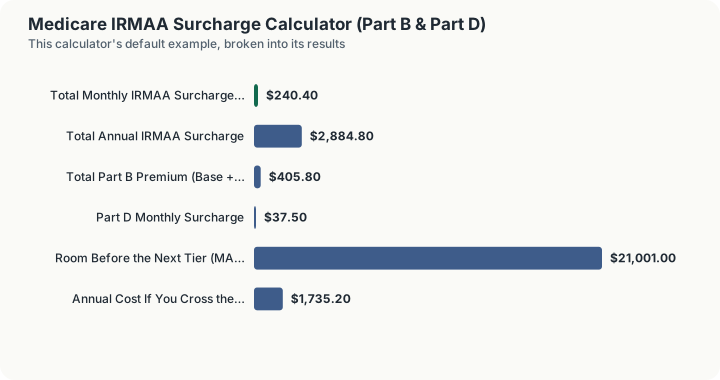
The tool reports your combined monthly surcharge (Part B plus Part D added together), the annualized version of that same figure, your total Part B premium (the CMS standard base premium plus your surcharge), and two planning-oriented figures: how much room you have in MAGI before you'd cross into the next, more expensive tier, and exactly how much your annual surcharge would jump by if you did cross it. Those last two numbers are the ones worth paying attention to if you're doing year-end tax planning, deciding whether a Roth conversion is worth the IRMAA cost, or considering a Qualified Charitable Distribution specifically to keep MAGI under a threshold.
Worked Example
A single filer reports $150,000 of MAGI on the return Medicare will look back at.
Step 1 -- Walk the tiers. Tier 1 tops out at $109,000 and Tier 2 at $137,000, both below the income. Tier 3 tops out at $171,000, which $150,000 fits inside.
Step 2 -- The tier. Tier 3, for Part B and Part D alike, since both use the same income thresholds
Step 3 -- The Part B surcharge. $202.90 a month
Step 4 -- The Part D surcharge. $37.50 a month
Step 5 -- The combined monthly surcharge. $202.90 + $37.50 = $240.40
Step 6 -- Annualised. $240.40 x 12 = $2,884.80
Step 7 -- Total Part B premium. $202.90 standard premium + $202.90 surcharge = $405.80 a month
At this tier the surcharge exactly doubles the Part B premium. Now the two planning figures.
Step 8 -- Room before the next cliff. $171,000 - $150,000 + $1 = $21,001 of additional MAGI
Step 9 -- The Part B step at that cliff. $324.60 - $202.90 = $121.70 a month, or $1,460.40 a year
Step 10 -- The Part D step. $60.40 - $37.50 = $22.90 a month, or $274.80 a year
Step 11 -- The cost of crossing. $1,460.40 + $274.80 = $1,735.20 a year
Step 12 -- What a single dollar buys. A Roth conversion of $21,001 rather than $21,000 raises the combined surcharge from $240.40 to $385.00 a month and the annual bill from $2,884.80 to $4,620.00
Step 12 is the entire character of IRMAA. It is not a rate on the income above a threshold; it is a step function on total MAGI, so the last dollar carries the whole increment.
The effect is sharpest at the bottom of the table, where the first cliff separates a zero surcharge from a real one:
Step 13 -- MAGI of exactly $109,000. Tier 1, surcharge $0.00, Part B premium $202.90, and room to the next cliff of exactly $1
Step 14 -- MAGI of $109,001. Tier 2, combined surcharge $95.70 a month, $1,148.40 a year, and the Part B premium rises to $284.10
Step 15 -- The marginal rate on that dollar. $1,148.40 of surcharge on $1 of income
Married filers face the same schedule at roughly doubled thresholds rather than doubled surcharges:
Step 16 -- A couple with $300,000 of MAGI. Tier 3, identical surcharges of $202.90 and $37.50, a combined $2,884.80 a year, but $42,001 of room before the next cliff rather than $21,001
That is why the room figure is worth checking before a December Roth conversion, a capital gain, or a Qualified Charitable Distribution decision. The surcharge is fixed by the tier; the only variable you control is which side of the line you land on.
What This Does Not Account For
- The two-year lookback. IRMAA for 2026 coverage is based on 2024 tax return MAGI, not your current income. This calculator lets you enter any MAGI figure, but you're responsible for using the correct year's figure when checking your actual premium.
- Life-changing event appeals. If you've had a significant income drop due to retirement, divorce, loss of a pension, or certain other qualifying life events, you can file Form SSA-44 to request that Social Security use a more recent, lower income figure instead of the two-year-old return. This tool doesn't model that appeals process.
- Part A surcharges. A small number of people pay a premium for Medicare Part A itself (most people get it premium-free based on work history); this calculator only covers the IRMAA surcharge on Part B and Part D.
- Held-harmless provisions. Certain Social Security beneficiaries are protected from a Part B premium increase that would reduce their net Social Security check, though this protection generally doesn't apply once a beneficiary is subject to IRMAA.
- State and plan-specific Part D premium variation. The Part D IRMAA surcharge shown here is a flat CMS-set add-on paid regardless of which specific Part D plan you enroll in; it does not include your actual plan's base premium, which varies by insurer and region.
Common Pitfalls
- Not realizing a single high-income year echoes two years later. Selling a business, a large capital gain, or a big Roth conversion in one year can trigger a real Medicare premium increase two years afterward, well after the income event itself has faded from memory.
- Missing the marriage-status threshold difference. Married-filing-jointly thresholds are roughly, but not exactly, double the single thresholds at every tier; don't assume you can simply halve a joint income figure to check it against single-filer brackets.
- Confusing IRMAA with regular income tax brackets. IRMAA tiers and federal income tax brackets use completely different income thresholds and completely different logic (cliff versus marginal), so knowing your tax bracket tells you nothing about your IRMAA tier.
- Forgetting IRMAA applies per person, not per household. In a married couple where both spouses are on Medicare, each spouse pays their own IRMAA surcharge based on the same joint MAGI, effectively doubling the household's total surcharge exposure at a given income tier.
- Overlooking Form SSA-44 after a genuine income drop. Retirees who assume their premium is locked in based on stale, pre-retirement income sometimes overpay for a year or more before learning they could have appealed.
Frequently Asked Questions
What income year determines my IRMAA?
Can I appeal my IRMAA surcharge?
Does IRMAA apply to both spouses if we file jointly?
Is IRMAA the same every year?
Why is IRMAA a cliff instead of a gradual increase like income tax brackets?
Sources
- Social Security Administration, Form SSA-44, "Medicare Income-Related Monthly Adjustment Amount: Life-Changing Event." ssa.gov
- Social Security Administration, Request to lower an Income-Related Monthly Adjustment Amount (IRMAA). ssa.gov/medicare/lower-irmaa
Also consulted: Centers for Medicare & Medicaid Services, 2026 Medicare Parts B Premiums and Deductibles fact sheet; Centers for Medicare & Medicaid Services, "2026 Medicare Parts A & B Premiums and Deductibles" official announcement.