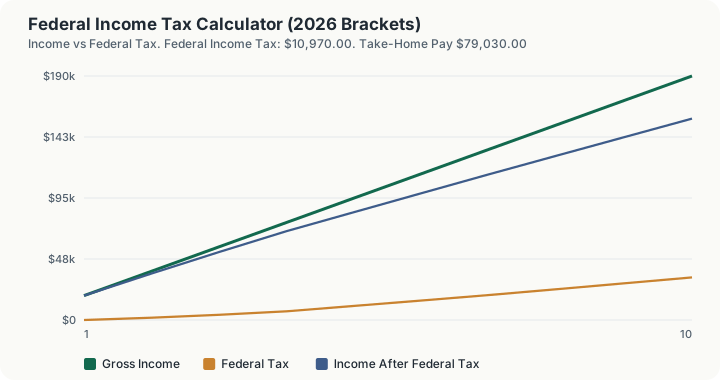
Quick Answer: A single filer earning $95,000 with a $5,000 pre-tax 401(k) deduction owes $10,970.00 in federal income tax after the standard deduction, landing in the 22% marginal bracket with an effective rate of 11.55%.
Overview
Federal income tax is not a flat percentage of your paycheck. It is a progressive, tiered system where each dollar you earn is taxed at the rate assigned to the bracket it falls into, not the rate tied to your total income. This calculator applies that tiered structure to your gross income after subtracting pre-tax deductions (401(k) contributions, HSA contributions, traditional IRA deferrals) and the applicable standard deduction, then walks the result through four marginal tiers: 10%, 12%, 22%, and 24%.
Two filing statuses are supported: single and married filing jointly. Each status has its own standard deduction and its own set of bracket thresholds, since Congress sets wider brackets for joint filers to reflect two incomes being reported on one return. The calculator also accepts a tax credits input, which is subtracted dollar-for-dollar from the computed tax liability after the bracket math is finished, since credits reduce tax owed directly rather than reducing taxable income the way deductions do.
The output separates three numbers that are frequently confused: taxable income (gross minus pre-tax deductions minus the standard deduction), total federal tax owed, and take-home pay (gross minus pre-tax deductions minus net tax). Understanding the distinction matters because taxable income is what actually gets run through the bracket schedule, not gross salary, and take-home pay in this context reflects only the federal income tax layer, not payroll taxes, state tax, or other withholdings.
How This Is Calculated
The engine first reduces gross income by pre-tax deductions and the standard deduction to arrive at taxable income, then applies the marginal bracket for whichever tier that taxable income falls into. Each bracket carries a cumulative base amount representing the tax already accrued from lower tiers, so the formula only needs to compute the marginal portion above the bracket floor and add it to that base.
Where $i$ is the highest bracket the taxpayer's income reaches, $\text{Base}_i$ is the cumulative tax from every lower bracket, $\text{Threshold}_i$ is the dollar amount where that bracket begins, and $\text{Rate}_i$ is the marginal rate applied to income above that threshold. This is the same "base plus marginal rate on the excess" format the IRS itself uses in its published Tax Computation Worksheets, rather than requiring a manual bracket-by-bracket sum.
Single Filer Schedule Applied by This Calculator
| Bracket | Taxable Income Range | Rate | Cumulative Base |
|---|---|---|---|
| 1 | $0-$12,400 | 10% | $0 |
| 2 | $12,400-$50,400 | 12% | $1,240 |
| 3 | $50,400-$105,700 | 22% | $5,800 |
| 4 | Above $105,700 | 24% | $17,966 |
Married Filing Jointly Schedule Applied by This Calculator
| Bracket | Taxable Income Range | Rate | Cumulative Base |
|---|---|---|---|
| 1 | $0-$24,800 | 10% | $0 |
| 2 | $24,800-$100,800 | 12% | $2,480 |
| 3 | $100,800-$211,400 | 22% | $11,600 |
| 4 | Above $211,400 | 24% | $35,932 |
The standard deduction applied before bracket math is $16,100 for single filers and $32,200 for married filing jointly (2026 figures, Rev. Proc. 2025-32). After the bracket calculation produces gross tax, any entered tax credits are subtracted directly, and the result is floored at zero so a large credit cannot push liability negative.
Worked Example
Using the calculator's own default scenario: a single filer with $95,000 in gross annual income, a $5,000 pre-tax 401(k) deduction, and no tax credits.
Step 1: Compute taxable income.
Step 2: Identify the applicable bracket. $73,900 exceeds the $50,400 threshold for the 22% bracket but does not reach the $105,700 threshold for the 24% bracket, so bracket 3 applies.
Step 3: Sum the tax owed tier by tier.
Step 4: Subtract tax credits. No credits were entered, so net federal tax remains $10,970.00.
Step 5: Compute effective rate and take-home pay.
The top marginal bracket reached is 22%, even though the effective rate paid across the entire $73,900 of taxable income is only 11.55%. That gap between marginal and effective rate is the single most common source of confusion among people checking their own tax math.
A second scenario, married filing jointly with $180,000 gross income, no pre-tax deductions, and $2,000 in tax credits, produces $147,800 of taxable income ($180,000 minus the $32,200 joint standard deduction), which falls in the 22% joint bracket. Tax before credits is $21,940.00 (10% × $24,800 + 12% × $76,000 + 22% × $47,000), so net federal tax after the $2,000 credit is $19,940.00.
What This Does Not Account For
- State and local income tax. This calculator computes only the federal layer. State income tax ranges from 0% in states with no income tax to over 13% in the highest-rate states, and must be calculated separately.
- Itemized deductions. If mortgage interest, charitable contributions, state and local taxes (subject to the SALT cap), or medical expenses exceed the standard deduction, itemizing on Schedule A would lower taxable income further than this calculator assumes.
- Alternative Minimum Tax (AMT). High-income filers with large amounts of certain deductions or incentive stock option exercises may owe AMT in addition to, or instead of, regular tax computed here.
- Payroll taxes. Social Security and Medicare withholding (FICA) are separate from federal income tax and are not included in this calculator's output.
- Additional Medicare Tax and Net Investment Income Tax. High earners may owe an extra 0.9% Medicare surtax on wages above statutory thresholds and a 3.8% NIIT on investment income, neither of which appears here.
- Refundable and phase-out credits. Credits like the Earned Income Tax Credit or the Child Tax Credit have their own eligibility rules, phase-out ranges, and partially refundable structures that a flat credits input cannot replicate.
Common Pitfalls
- Confusing marginal rate with effective rate. Landing in the 22% bracket does not mean 22% of your entire income goes to federal tax. Only the slice of income inside that bracket is taxed at 22%; everything below it is taxed at the lower rates that apply to those slices.
- Forgetting pre-tax deductions reduce taxable income before the standard deduction is applied. A 401(k) or HSA contribution lowers the number that brackets are calculated against, which is often more valuable than an equivalent Roth contribution for someone in a high bracket today.
- Applying the wrong standard deduction for filing status. Single and married filing jointly use different deduction amounts and different bracket widths; mixing them up produces a materially wrong result.
- Treating tax credits and tax deductions as equivalent. A $1,000 deduction saves you your marginal rate times $1,000. A $1,000 credit saves you the full $1,000, dollar for dollar.
- Ignoring that this is an annual calculation. Paycheck withholding is spread across pay periods and uses IRS withholding tables that do not perfectly match annual bracket math, so a single paycheck's withholding rate will not equal the annual effective rate computed here.
Frequently Asked Questions
Why is my effective tax rate lower than my tax bracket?
Does this calculator include Social Security and Medicare tax?
What counts as a pre-tax deduction?
Should I use the standard deduction or itemize?
Why does the calculator ask for tax credits separately from deductions?
Is this the same number that will appear on my W-2 or paycheck withholding?
Sources
- Internal Revenue Service, Revenue Procedure 2025-32, Internal Revenue Bulletin 2025-45 (annual inflation adjustments for tax year 2026 individual income tax brackets and the standard deduction). irs.gov
- Internal Revenue Service, Publication 17, Your Federal Income Tax for Individuals. irs.gov/publications/p17
- Internal Revenue Service, Publication 505, Tax Withholding and Estimated Tax. irs.gov/publications/p505
Also consulted: Internal Revenue Service, Instructions for Form 1040 and the annual Tax Computation Worksheet.