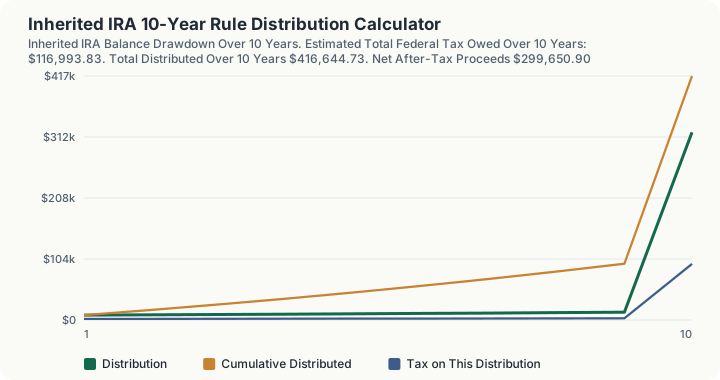
Quick Answer: Most people who inherit an IRA from someone other than a spouse must empty the account within 10 years of the original owner's death, and if that owner had already started their required withdrawals before dying, the beneficiary also has to take a minimum distribution every single year of that decade, not just at the end.
Overview
The rules for inherited IRAs changed dramatically with the SECURE Act of 2019, and then again with a set of IRS final regulations released in July 2024 that clarified exactly how the new rules work in practice. Before the SECURE Act, a non-spouse beneficiary could often stretch withdrawals across their own life expectancy, sometimes for decades, keeping the tax hit small and spread thin. That option is gone for most beneficiaries today. If you inherited an IRA from someone who died after 2019 and you're not a spouse, minor child, disabled or chronically ill individual, or someone less than 10 years younger than the original owner, you're almost certainly bound by the 10-year rule: the entire account has to be distributed, and taxed, within a decade.
What trips people up is a detail buried inside that 10-year window. If the person you inherited from had already reached their own required minimum distribution age before they died, the IRS final regulations require you to take an annual RMD in years one through nine of the 10-year period, not just drain the account whenever you want as long as it's empty by year ten. Skip a required annual distribution and you're looking at a 25% excise tax penalty on the shortfall (reduced to 10% if you correct it within the IRS's specified window), a detail plenty of beneficiaries missed for years while the IRS delayed enforcement, but which is now firmly in effect starting with the 2025 tax year.
If the original owner died before reaching their required-beginning-date, you get more flexibility. There's no mandatory annual distribution; you can withdraw nothing for nine years and take it all in year ten, or spread it however you like, as long as the account reaches zero by the deadline. That flexibility is valuable for tax planning, because a lump sum in year ten can push you into a much higher tax bracket than the same money spread evenly across the decade.
How This Is Calculated
This calculator models both scenarios side by side.
When annual RMDs are required, the calculator estimates a single-life-expectancy divisor for you at your current age, using the Social Security Administration's period life table, then divides the account balance by that divisor (reduced by one each subsequent year) to estimate each year's required distribution, growing the remaining balance at your assumed investment return along the way. In year ten, whatever balance remains is fully distributed regardless of the divisor math, because the account must reach zero by then no matter what.
When no annual RMD is required, the calculator models an even, or level, drawdown strategy: dividing the remaining balance by the number of years left in the window each year. This isn't a legal requirement, it's simply one common approach financial planners suggest for smoothing the tax impact across the decade rather than taking one enormous, bracket-jumping distribution at the very end.
For the tax estimate, each year's distribution is stacked on top of your other taxable income for that year, and the platform's shared progressive tax engine calculates the tax on that combined total, then subtracts the tax you would have owed on your other income alone. That difference is the tax specifically attributable to the inherited IRA distribution for that year, correctly reflecting how the distribution pushes you through your existing tax brackets rather than assuming a flat rate.
One limitation worth being upfront about: this tool approximates your RMD divisor using the SSA's period life table rather than the IRS's own Single Life Expectancy Table (published in Treasury Regulation 1.401(a)(9)-9), which uses somewhat different, IRS-specific divisors for RMD purposes. The two tables produce broadly similar numbers but are not identical, so treat the RMD-required scenario here as a close estimate, not an exact substitute for the IRS table your custodian will actually use.
Worked Example
Two things drive the answer under the ten-year rule: whether annual RMDs are required, and what the balance does in the meantime. Start with a deliberately transparent case, then let it grow, then flip the RMD switch.
A $100,000 account at 0% growth, no annual RMD required
Beneficiary aged 50, $90,000 of other income, filing single.
Step 1 -- Year 1 distribution under a level drawdown. $100,000.00 / 10 remaining years = $10,000.00 Balance after: $90,000.00
Step 2 -- Year 2. $90,000.00 / 9 remaining years = $10,000.00 Balance after: $80,000.00
Step 3 -- Why the payment does not move. Balance and remaining years shrink in exact proportion at 0% growth, so every year distributes $10,000.00
Step 4 -- Baseline tax on other income alone. $90,000.00 - $16,100.00 standard deduction = $73,900.00 taxable 10% of $12,400 = $1,240.00 12% of $38,000 = $4,560.00 22% of $23,500 = $5,170.00 Total: $10,970.00
Step 5 -- Tax with one year's distribution stacked on top. $100,000.00 - $16,100.00 = $83,900.00 taxable $1,240.00 + $4,560.00 + 22% of $33,500 ($7,370.00) = $13,170.00
Step 6 -- Tax attributable to the distribution. $13,170.00 - $10,970.00 = $2,200.00, and identical in every one of the ten years
Step 7 -- Ten-year totals. Distributed: $100,000.00 Federal tax: $22,000.00 Net: $78,000.00, an effective rate of 22.00% Closing balance: $0.00
The same account growing at 6%
Step 8 -- Year 1. Balance grows to $106,000.00, then distributes $106,000.00 / 10 = $10,600.00 Tax: $2,332.00. Balance after: $95,400.00
Step 9 -- Year 2. Grows to $101,124.00, distributes / 9 = $11,236.00 Tax: $2,471.92. Cumulative tax: $4,803.92. Balance after: $89,888.00
Step 10 -- Year 5. Distribution: $13,382.26. Cumulative distributed: $59,753.19. Balance: $66,911.28
Step 11 -- Year 10, the mandatory emptying. Distribution: $17,908.48. Balance: $0.00
Step 12 -- Ten-year totals at 6% growth. Distributed: $139,716.43 Federal tax: $30,737.63 Net: $108,978.80, still an effective rate of 22.00%
Growth adds $39,716.43 of distributions over the decade and the blended rate does not move, because even the largest single distribution stays inside the 22% bracket. That is the whole case for the level drawdown: it keeps every year's payment small enough not to reach for a higher bracket.
The same account when annual RMDs are required
Step 13 -- Year 1 RMD, using the single-life divisor. Distribution: $3,345.96. Tax: $736.11. Balance after: $102,654.04
Step 14 -- Year 2. Distribution: $3,546.72. Balance after: $105,266.57
The balance is rising, not falling. A single-life RMD at age 50 takes out less than 6% growth puts in, so nine years of compliance leave the account larger than it started.
Step 15 -- Year 9, the last RMD year. Distribution: $5,332.95. Cumulative distributed: $38,449.48. Balance: $120,951.33
Step 16 -- Year 10, everything left must come out at once. Distribution: $128,208.41 Tax on that single year: $30,160.69
Step 17 -- Ten-year totals under the RMD path. Distributed: $166,657.89 Federal tax: $38,619.57 Effective rate: 23.17%
Compare step 17 with step 12. The RMD path distributes more in total, because small early withdrawals leave more invested, but $128,208.41 arriving in a single tax year pushes well past the 22% bracket and lifts the blended rate to 23.17%. The annual RMDs in years one to nine are a floor, not a ceiling: nothing stops a beneficiary in this position from taking more than the minimum early to flatten the year-ten spike, and this calculator models only the minimum.
What This Does Not Account For
- State income tax. Most states tax IRA distributions as ordinary income too, on top of the federal tax modeled here, and a handful of states have no income tax at all.
- The IRS's official Single Life Expectancy Table. As noted above, this tool approximates using SSA data rather than the IRS's specific RMD table, which will produce slightly different required minimum distribution figures than what your account custodian calculates.
- Roth IRAs. Inherited Roth IRA distributions are generally tax-free (as long as the account met the 5-year holding rule), which is a fundamentally different tax situation than the traditional, pre-tax IRA this calculator models.
- Multiple inherited accounts or multiple beneficiaries. If several people inherited shares of the same IRA, or if you inherited more than one account from different people, the RMD calculations and 10-year windows are tracked separately per inherited account, which this single-account tool doesn't combine.
- Changing tax brackets over the decade. This model uses a single year's tax brackets and your current income for every year of the projection; in reality, both will likely change over a real 10-year window.
- Net Investment Income Tax and other surtaxes. High-income beneficiaries may owe an additional 3.8% Net Investment Income Tax on top of ordinary income tax, not modeled here.
Common Pitfalls
- Assuming you have full discretion over withdrawal timing. Many beneficiaries wrongly believed, based on the SECURE Act's original ambiguous wording, that they could wait until year ten no matter what. The 2024 final regulations closed that gap for beneficiaries of owners who had already started RMDs.
- Missing a required annual distribution and the resulting excise tax. The 25% penalty (10% if timely corrected) on a missed RMD is steep, and IRS enforcement leniency during the transition years is now over.
- Taking the entire balance in year ten to "get it over with." That single massive distribution can push you into a much higher marginal tax bracket than spreading withdrawals across the decade would, resulting in materially more total tax paid on the same inherited balance.
- Confusing this rule with the rules for a spouse beneficiary. A surviving spouse has fundamentally different, more flexible options, including treating the inherited IRA as their own, which are not covered by this calculator.
- Forgetting the 10-year clock starts at the original owner's death, not when you learned about the inheritance or when you retitled the account.
Frequently Asked Questions
Who is subject to the 10-year rule?
Do I have to take money out every year, or can I wait until year ten?
What happens if I miss a required annual distribution?
Does the 10-year rule apply to inherited Roth IRAs too?
Can I roll an inherited IRA into my own IRA?
Sources
- Internal Revenue Service, T.D. 10001, final regulations on required minimum distributions, published July 2024, effective for the 2025 tax year and after. irs.gov
- Internal Revenue Service, Publication 590-B, "Distributions from Individual Retirement Arrangements (IRAs)." irs.gov/publications/p590b
- Social Security Administration Office of the Chief Actuary, Period Life Table (2026 Trustees Report basis). ssa.gov
Also consulted: IRS Revenue Procedure 2025-32, 2026 federal income tax brackets and standard deduction.