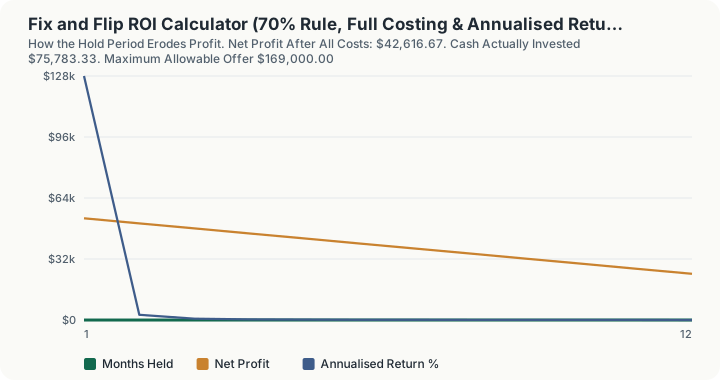
Quick Answer: At the default project (a $180,000 purchase, $55,000 of rehab, a $320,000 after repair value and a five-month hold, 88% financed at 11.5%) the net profit after every cost is $42,616.67. That is a 56.23% return on the $75,783.33 of cash actually at risk, or 191.77% annualised. The same deal nonetheless fails the 70% rule by $11,000.
What does this calculator do?
A flip is a short project, not a holding, and two consequences follow that are routinely missed.
The costs that are neither the purchase price nor the rehab budget are large. Acquisition closing, monthly carry, hard-money interest, and the agent and transfer costs on the way out add up to $42,383.33 on this project. Modelling a flip as after repair value minus purchase minus rehab is not conservative. It is a different calculation, and it overstates profit by roughly the size of the profit.
A return earned over four months is not the same return as one earned over twelve. Annualising is what makes a flip comparable to anything else, and it cuts both ways. It flatters a fast project and it punishes one that sits. This same deal held for twelve months instead of five earns $24,160.00 and annualises at 25.64%, not 191.77%.
The 70% rule (offer no more than 70% of after repair value, minus the rehab budget) is a screening test, not a valuation. It exists to reject deals in ten seconds. A deal can fail the rule and still show a profit on full costing, and this one does. That does not mean the rule is wrong. It means the rule's implied 30% buffer for costs, financing and price risk is larger than this particular project's actual buffer.
How is this calculated?
net profit = ARV − (purchase + rehab + closing + carry + interest + selling)
Financing is priced as interest-only carry, which is the standard bridge and hard-money structure over a flip term:
interest = financed × rate × months/12
The screening rule and the breakeven price are:
MAO = ARV × p − rehab; breakeven = (all-in basis)/(1 − s)
where $p$ is the screening percentage and $s$ the selling cost rate. The breakeven is solved rather than subtracted, because selling costs scale with the sale price.
Step 1: Purchase closing costs: the purchase price multiplied by the acquisition closing percentage.
Step 2: Holding costs: monthly carry multiplied by the months held, closing to closing.
Step 3: Financing cost: interest-only on the full financed balance for the hold period. No amortisation.
Step 4: Selling costs: the after repair value multiplied by the selling cost percentage.
Step 5: All-in basis: purchase plus rehab plus closing plus carry plus interest. This excludes the exit costs, and it is the figure the property carries.
Step 6: Total project cost: the all-in basis plus the selling costs.
Step 7: Net profit: after repair value less total project cost.
Step 8: Cash invested: the all-in basis less the financed amount. This is what is personally at risk and is the denominator of the return.
Step 9: Return on cash: net profit divided by cash invested.
Step 10: Annualised return: the period return compounded to a twelve-month equivalent, (1 + r)^(12/m) − 1. Undefined for a zero-month hold, and undefined where the entire stake or more is lost, because a fractional power of a non-positive base has no real value.
Step 11: Maximum allowable offer and the headroom against the actual offer.
Step 12: Breakeven sale price and the cushion between it and the target after repair value.
Worked Example
$180,000 purchase, $55,000 rehab, $320,000 after repair value, five months, $950 a month of carry, 2% purchase closing, 8% selling, $176,000 financed at 11.5%, screened at 70%.
Step 1: Purchase closing costs. $180,000 x 2% = $3,600.00
Step 2: Holding costs. $950 x 5 = $4,750.00
Step 3: Financing cost. $176,000 x 11.5% x (5 / 12) = $8,433.33
Step 4: Selling costs. $320,000 x 8% = $25,600.00
Step 5: All-in basis. $180,000 + $55,000 + $3,600.00 + $4,750.00 + $8,433.33 = $251,783.33
Step 6: Total project cost. $251,783.33 + $25,600.00 = $277,383.33
Step 7: Net profit. $320,000 - $277,383.33 = $42,616.67
Step 8: Cash actually invested. $251,783.33 - $176,000 = $75,783.33
Step 9: Return on cash for the period. $42,616.67 / $75,783.33 = 56.23%
Step 10: Annualised return. (1 + 0.5623)^(12 / 5) - 1 = 191.77%
Step 11: Profit margin on after repair value. $42,616.67 / $320,000 = 13.32%
Step 12: Profit per month held. $42,616.67 / 5 = $8,523.33
Step 13: Maximum allowable offer under the 70% rule. $320,000 x 70% = $224,000 $224,000 - $55,000 = $169,000
Step 14: Offer headroom. $169,000 - $180,000 = -$11,000, so the offer fails the rule by $11,000
Step 15: Breakeven sale price. $251,783.33 / (1 - 0.08) = $273,677.53
Step 16: Price cushion. ($320,000 - $273,677.53) / $320,000 = 14.48%
The project makes money and fails the screening rule, and both facts are useful. The after repair value can fall 14.48% before the deal loses money, which is a reasonable but not generous buffer. The 70% rule wanted a bigger one.
What does this calculator not account for?
- Tax is not modelled at all. A flip held under a year is ordinary income to a dealer, subject to self-employment tax in many structures, and none of that appears here. The profit shown is pre-tax.
- No contingency is added. The rehab budget is taken as entered. Budget your contingency inside the rehab figure, not outside it, because the calculator will not add one.
- Loan points and origination fees are not separated. Bridge and hard-money loans commonly charge two to four points at closing. Fold them into the purchase closing percentage or they will be missing.
- Interest is charged on the full financed balance from day one. Real rehab draws release in tranches, so a draw-funded loan accrues less interest than modelled. This is conservative, deliberately.
- Days on market are not modelled. The hold period is an input. The calculator will not tell you it is optimistic.
- The after repair value is an assumption, and the whole project rests on it. Nothing here validates it against comparable sales. The breakeven price and cushion exist precisely so you can see how much of a miss the project survives.
- The screening rule buffer is not decomposed. The 70% rule's 30% is a rule of thumb covering costs, financing, profit and price risk in one number. This calculator prices those items explicitly and does not reconcile the two approaches.
- No sequencing or opportunity cost. Two five-month flips a year is not the same as one twelve-month flip, and the annualised figure assumes the capital can actually be redeployed.
What mistakes do people make with this?
Quoting the annualised return as if it were realised. 191.77% assumes the same project could be repeated back to back all year. It cannot be. The annualised figure is a comparability device, not a forecast.
Modelling the deal as ARV minus purchase minus rehab. That gives $85,000 on this project. The real number is $42,616.67. The gap is the $42,383.33 of closing, carry, interest and selling costs.
Using the return on cash without noticing the leverage. The 56.23% return on cash comes from putting only $75,783.33 into a $277,383.33 project. Run the same deal all cash and profit rises to $51,050.00, because the interest disappears, but the return on cash falls to 20.98% because the denominator triples.
Treating a failed 70% test as a veto. It is a screen. Failing it means the deal has less buffer than the rule assumes, which is worth knowing and is not the same as a loss. This deal fails by $11,000 and still shows a 14.48% price cushion.
Measuring the hold from closing to listing. Carry and interest run until the sale closes, not until the sign goes up. Every extra month costs $950 of carry plus $1,686.67 of interest on this loan.
Frequently Asked Questions
How can a deal fail the 70% rule and still be profitable?
What does the annualised return actually mean?
Should I use 70% or 75%?
Why is the breakeven price higher than my all-in basis?
What happens if the project runs long?
Does all-cash improve the deal?
Sources
Also consulted: Interest-only carry on a bridge or hard-money balance: rate multiplied by balance multiplied by months over twelve, which is the structure such loans actually use over a flip term; Annualisation by compounding the period return: (1 + r)^(12/m) − 1; The breakeven sale price solved for price-scaling selling costs: S = basis /(1 − s); The 70% rule as commonly stated in the investor literature: maximum offer equals after repair value times 70%, less the rehab budget. It is a screening heuristic with no regulatory or statutory standing, and the percentage is exposed as an input here for that reason.
This calculator uses no statutory data. The relationships it applies are standard project economics:
Implementation: engine/primitives/fix-and-flip.ts.