Quick Answer: Barista FIRE means retiring early with a smaller portfolio than full FIRE requires, because part-time income covers a share of your expenses, and this calculator computes the smaller nest egg you actually need plus how long it takes to reach it.
Overview
"FIRE" stands for Financial Independence, Retire Early: accumulate a portfolio large enough that a safe withdrawal rate, most commonly the 4% rule, covers 100% of your living expenses indefinitely, without any earned income. Barista FIRE is a popular variant that relaxes that requirement. Instead of fully funding every dollar of expenses from the portfolio, you plan to keep working, typically in a lower-stress, more flexible role, such as a part-time barista job (the origin of the name, though it applies to any part-time or freelance work), that covers a meaningful chunk of your spending. Your portfolio only has to fund the remainder.
The math benefit compounds in your favor twice. First, a smaller required withdrawal means a smaller portfolio target, since the 4% rule (or whatever safe withdrawal rate you choose) scales your nest egg directly to the dollar amount you need to withdraw. Second, a smaller target is reached sooner, since you need to accumulate less before you can step back from full-time work. Many people pursuing Barista FIRE also value the qualifying part-time job for reasons beyond income, most notably employer-subsidized health insurance in the United States, which is a major expense gap for anyone retiring before Medicare eligibility at 65.
How This Is Calculated
The calculation happens in two stages.
Stage 1: Size the Barista FIRE number. Subtract your expected part-time income from your annual living expenses to find the net amount your portfolio actually needs to supply through withdrawals. Divide that net need by your safe withdrawal rate to get your target portfolio size:
`
Barista FIRE Number = (Annual Expenses − Part-Time Income) / Safe Withdrawal Rate
`
This is the same 4%-rule math behind traditional FIRE calculations, just applied to a smaller withdrawal need.
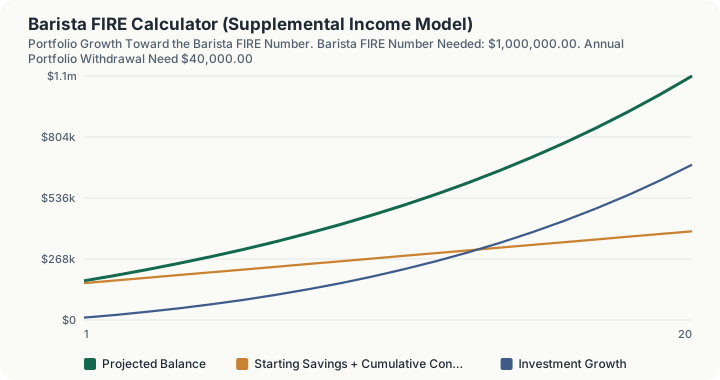
Stage 2: Solve for time to reach it. Given your current savings, how much you continue contributing annually while still working full-time, and your expected investment return, the calculator solves for the number of years until your portfolio reaches the Barista FIRE number. This uses the platform's time-value-of-money engine to solve directly for the number of periods (an investment growing toward a future value target is mathematically the same equation as a loan amortizing toward zero, solved for the opposite unknown), and it also produces a full year-by-year accumulation schedule showing the balance compounding with both investment growth and your ongoing contributions.
Worked Example
Someone with $150,000 invested spends $60,000 a year and expects a part-time job to bring in $20,000 once they downshift. They contribute $12,000 a year in the meantime and assume 7% returns and a 4% withdrawal rate.
Step 1 -- The net annual need from the portfolio. $60,000 expenses - $20,000 part-time income = $40,000
Step 2 -- The Barista FIRE number. $40,000 / 0.04 = $1,000,000
Step 3 -- Share of expenses covered by work. $20,000 / $60,000 = 33.33%
Step 4 -- Compare against full FIRE. $60,000 / 0.04 = $1,500,000, so the part-time income removes $500,000 from the target
Getting There: The First Two Years
Step 5 -- Growth on the portfolio in year one. 7% x $150,000 = $10,500
Step 6 -- Balance at the end of year one. $150,000 + $10,500 + $12,000 contributed = $172,500
Step 7 -- Growth in year two. 7% x $172,500 = $12,075
Step 8 -- Balance at the end of year two. $172,500 + $12,075 + $12,000 = $196,575
Step 9 -- Money actually put in after two years. $150,000 + ($12,000 x 2) = $174,000
Step 10 -- Cumulative investment growth after two years. $196,575 - $174,000 = $22,575
Growth has already outpaced a full year of contributions by year two, and the gap widens every year after.
Step 11 -- Years to reach the target. $150,000 growing at 7% with $12,000 added annually reaches $1,000,000 in 19.11 years
The $500,000 that step 4 removed from the target is what a $20,000-a-year job is worth in capital terms at a 4% withdrawal rate. Framed the other way, someone unwilling to work at all in early retirement needs to save an extra half a million dollars to buy the same freedom, which is usually several more years of accumulation than the barista route asks for.
What This Does Not Account For
- Healthcare costs and insurance access, which is often the single biggest variable in a real Barista FIRE plan. Many people specifically choose part-time roles for employer health coverage; this calculator treats healthcare as just another line item folded into "annual expenses."
- Social Security and pension income, which typically begins later in life and can further reduce the portfolio burden, but is not modeled as a separate income stream here.
- Sequence-of-returns risk. The safe withdrawal rate assumption, like the traditional 4% rule, is based on historical worst-case sequences over roughly 30-year retirement horizons. A Barista FIRE retirement can span 40, 50, or more years, which is longer than the original research behind the 4% rule was designed to cover.
- Variability in part-time income. This calculator assumes a fixed, reliable annual part-time income figure. Real part-time and freelance income is often inconsistent.
- Taxes on withdrawals and part-time earnings, both of which reduce actual spendable cash and are not modeled here.
- Inflation. All figures are in today's dollars; the calculator does not project future expenses or income at an inflated rate.
Common Pitfalls
- Underestimating how firmly you need to hold to the part-time income assumption. If your Barista FIRE plan depends on $20,000 of annual part-time income and that income dries up, disappears, or becomes unavailable due to health or market conditions, your portfolio alone may not be able to fully cover expenses at your planned withdrawal rate.
- Ignoring healthcare cost inflation. Healthcare costs have historically outpaced general inflation, and a Barista FIRE plan built around employer-subsidized coverage can face a shock if that coverage changes or ends before Medicare eligibility.
- Treating the safe withdrawal rate as a fixed, guaranteed number. The 4% rule is a historical rule of thumb, not a mathematical guarantee, and its safety margin was calculated for a portfolio funding retirement alone, not blended with variable part-time income.
- Forgetting that "Barista FIRE" still typically means working for years or decades. It is a meaningfully different lifestyle commitment than full FIRE, and the ongoing income need should be planned for as a real, continuing obligation, not a temporary bridge.
- Not stress-testing a lower withdrawal rate. Because a Barista FIRE portfolio may need to last longer than a traditional 30-year retirement horizon (since it typically starts earlier), some planners use a more conservative safe withdrawal rate than the standard 4%.
Frequently Asked Questions
How is Barista FIRE different from Coast FIRE?
What safe withdrawal rate should I use?
Does part-time income need to stay constant forever?
What if my part-time income covers more than my expenses?
Is Barista FIRE a realistic strategy?
Sources
- U.S. Bureau of Labor Statistics, Consumer Expenditure Survey, for typical household expense benchmarking. bls.gov/cex
- Milevsky, M. A. and Robinson, C. (2005), "A Sustainable Spending Rate without Simulation," Financial Analysts Journal 61(6). doi.org/10.2469/faj.v61.n6.2776
Also consulted: Trinity Study (Cooley, Hubbard, and Walz, 1998) and subsequent updates, foundational research behind the 4% safe withdrawal rate; Healthcare.gov, Marketplace coverage guidance for early retirees relying on part-time or gig income for insurance eligibility.