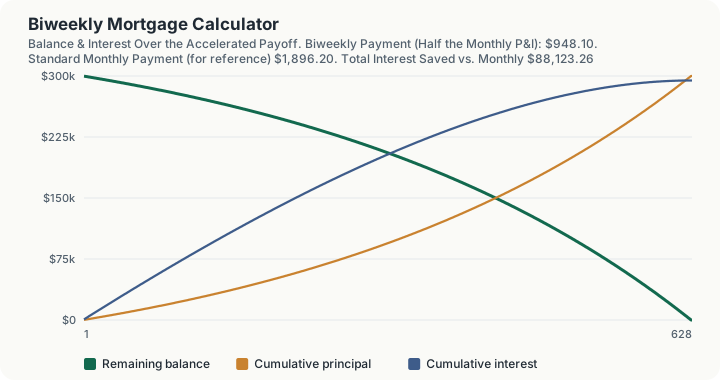
Quick Answer: Paying exactly half your normal monthly mortgage payment every two weeks results in 26 half-payments a year, the equivalent of 13 full monthly payments instead of 12, and that one extra payment a year, applied straight to principal, meaningfully shortens the loan and cuts total interest.
Overview
A biweekly mortgage payment plan is one of the simplest ways to pay off a mortgage early without refinancing or committing to a formally shorter loan term. The mechanism is almost deceptively simple: instead of paying your normal monthly payment once a month, you pay exactly half of that amount every two weeks.
Here is the arithmetic that makes it work. There are 52 weeks in a year, so paying every two weeks results in 26 payments a year, not 24. Twenty-six half-payments equal 13 full payments' worth of money, not 12. That thirteenth "extra" payment each year goes entirely toward principal, since the minimum required interest and principal for a normal 12-payment year has already been covered by the other 12 equivalent payments. The result is a loan that pays down faster than its original schedule called for, which in turn means less interest accrues over the life of the loan, which in turn means the loan finishes even earlier than a naive year-count would suggest.
Be precise about what actually creates this benefit, though. Simply switching the payment frequency from monthly to every-two-weeks, while keeping the payment size at whatever a fresh 26-payments-a-year amortization schedule would naturally require, barely changes anything, since that recalculated payment is only trivially smaller than half the monthly payment. The real acceleration comes specifically from paying half of the original monthly payment, which is larger than what a freshly recalculated 26-period payment would be, every two weeks. That extra sliver, paid consistently 26 times a year, is what shortens the loan.
How This Is Calculated
Step 1: the standard monthly payment. Compute the ordinary fixed monthly payment for the loan over its original stated term (commonly 30 years), using the standard amortization formula:
Monthly Payment = P × i / (1 − (1 + i)⁻ⁿ)
where P is the principal, i is the monthly interest rate, and n is the total number of months in the original term.
Step 2: the biweekly payment amount. The biweekly payment is simply half of that monthly payment.
Step 3: what a "fresh" 26-period amortization would require. Separately, compute what the payment would need to be if this loan were amortized from scratch using 26 periods a year instead of 12, over the same nominal number of years. This is calculated the same way, but using a periodic rate of the annual rate divided by 26 instead of divided by 12.
Step 4: the extra principal per period. Subtract the Step 3 amount from the Step 2 amount. This difference is the true source of acceleration: it is extra principal being paid down every single period, above and beyond what a plain 26-payments-a-year schedule would have required on its own.
Step 5: run the schedule to actual payoff. Using the biweekly periodic rate, the biweekly payment from Step 2, and that extra principal amount applied every period, the loan is amortized period by period until the balance reaches zero, which happens well before the original number of periods would suggest.
This calculator implements every step above using solvePMT() from the platform's time-value-of-money engine to compute both the monthly and the natural 26-period payments, and then generateAmortizationSchedule() with periodsPerYear: 26 and the extra-principal amount to run the actual accelerated payoff.
Worked Example
Consider a $300,000 loan at 6.5% annual interest, originally structured as a 30-year fixed mortgage.
Step 1: Standard monthly payment. Using P = $300,000, a monthly rate of 6.5%/12 = 0.541667%, and n = 360 months, the standard payment comes to approximately $1,896.20 per month.
Step 2: Biweekly payment. Half of $1,896.20 is $948.10, paid every two weeks.
Step 3: "Fresh" 26-period payment. Amortizing the same $300,000 at 6.5% over 30 years' worth of biweekly periods (780 periods, at a periodic rate of 6.5%/26) would only require a payment of approximately $874.76 per period, essentially the same total pace as the monthly schedule.
Step 4: Extra principal per period. $948.10 − $874.76 = $73.34 of genuinely extra principal applied every two weeks.
Step 5: Actual payoff. Running the loan forward at $948.10 every two weeks (the $874.76 base payment plus the $73.34 extra), the balance reaches zero after approximately 628 biweekly periods, or about 24.15 years, roughly 5 years and 10 months earlier than the original 30-year term. Total interest paid under this schedule comes to roughly $294,500, compared to about $382,600 under the standard monthly schedule, an interest savings of nearly $88,100 for simply changing how often the same underlying payment gets made.
What This Does Not Account For
- Paycheck timing. Biweekly pay periods (26 a year) do not align perfectly with calendar months, and some borrowers find it easier to budget for a slightly higher single monthly payment (an approach sometimes called a "biweekly equivalent" monthly plan) rather than tracking a true every-two-weeks payment schedule.
- Lender-administered biweekly programs. Some mortgage servicers offer official biweekly payment programs, sometimes with setup or processing fees, and sometimes holding payments in a non-interest-bearing account until a full monthly amount accumulates rather than applying each half-payment immediately. This calculator assumes every biweekly payment is applied to the loan the moment it is received, which produces the maximum possible benefit; a program that batches payments monthly before applying them will save somewhat less.
- Rate changes. This assumes a fixed interest rate for the life of the accelerated payoff. An adjustable-rate mortgage would need to be modeled period by period as rates reset.
- Opportunity cost of the extra payment. This calculator does not compare the interest saved against what that same extra money might have earned if invested elsewhere instead of applied to the mortgage.
- Tax deductibility of mortgage interest. Reducing total interest paid also reduces any mortgage interest tax deduction a borrower might otherwise claim; this calculator does not account for the after-tax value of that tradeoff.
Common Pitfalls
- Assuming any switch to "every two weeks" automatically accelerates the loan. As explained above, only paying more than a freshly recalculated 26-period payment creates real acceleration. Simply re-timing the same total annual payment amount to a 26-period cadence does not meaningfully speed up payoff.
- Confusing biweekly (every 2 weeks, 26 payments a year) with semi-monthly (twice a month, 24 payments a year). These sound similar but are mathematically different. Semi-monthly payments of exactly half the monthly amount do not create the extra annual payment that drives biweekly acceleration, since 24 half-payments equal exactly 12 full payments, not 13.
- Not confirming how a servicer's biweekly program actually applies payments. Some programs hold funds until a full month's payment has accumulated before applying anything to the loan, which delays the benefit compared to true per-payment application, and some charge setup or ongoing administrative fees that eat into the interest savings.
- Underestimating how sensitive the payoff timeline is to the extra payment amount. A small change in the extra-per-period amount, driven by even a modest interest rate difference, can shift the payoff timeline and total savings by a meaningful margin. Always recompute with your actual rate rather than relying on a rule of thumb from a different loan.
- Forgetting this is functionally similar to simply making one extra mortgage payment a year. A borrower who prefers not to manage a formal biweekly schedule can often achieve nearly the same result by making one additional full payment annually, applied to principal, which is administratively simpler for many people.
Frequently Asked Questions
Is a biweekly mortgage payment plan the same as refinancing to a shorter term?
Do I need my lender's permission to pay biweekly?
Why does paying half the monthly payment every two weeks work better than paying the "correct" biweekly-equivalent payment?
How much faster does a biweekly plan pay off a mortgage, in general?
Does making biweekly payments hurt my credit or count against me in any way?
Can I stop a biweekly payment plan and go back to monthly payments later?
Sources
- Consumer Financial Protection Bureau (CFPB): guidance on biweekly mortgage payment plans and third-party payment services. consumerfinance.gov
- Federal Trade Commission consumer guidance on evaluating biweekly mortgage payment programs and associated fees. consumer.ftc.gov
- Standard amortization mathematics as applied in mortgage lending, consistent with Regulation Z (Truth in Lending Act) payment disclosure requirements. ecfr.gov/current/title-12/chapter-X/part-1026