Quick Answer: Transfers to grandchildren or more remote descendants owe generation-skipping transfer tax at a flat 40% only on the amount that exceeds your $15,000,000 GST exemption; most families never come close to that threshold.
Overview
The generation-skipping transfer (GST) tax is the third leg of the federal wealth transfer tax system, alongside the gift tax and the estate tax. It exists to close a specific loophole: without it, a wealthy grandparent could leave assets directly to a grandchild, skipping the parents' generation entirely, and avoid the estate tax that would otherwise apply when the assets passed from grandparent to parent, and again from parent to child.
The IRS calls a recipient who is two or more generations below the person making the transfer, typically a grandchild, great-grandchild, or an unrelated person more than 37.5 years younger, a "skip person." Whenever a skip person receives a gift, an inheritance, or a distribution from certain trusts, the transfer is potentially subject to GST tax on top of whatever gift or estate tax already applies.
Like the gift and estate tax, the GST tax comes with real protection built in. Every transferor gets a GST exemption, currently $15,000,000, which is applied against generation-skipping transfers before any tax is calculated. There is also a GST annual exclusion, $19,000 per skip person in 2026, that works the same way as the ordinary gift tax annual exclusion, though it only applies to transfers that meet narrower "qualifying" requirements. This calculator models both shields together so you can see exactly how much of a transfer is taxable, and how much GST tax, if any, is actually due.
How This Is Calculated
- Apply the GST annual exclusion, if the transfer qualifies. Outright gifts and certain single-beneficiary trust structures qualify for a $19,000-per-skip-person exclusion before anything counts as a taxable generation-skipping transfer. Many trust arrangements with multiple or contingent beneficiaries do not qualify, even for amounts under $19,000.
- Determine the taxable transfer before exemption. Subtract the qualifying annual exclusion from the total transfer amount. If the transfer does not qualify for the annual exclusion, the full amount moves to the next step.
- Apply remaining GST exemption. Every transferor has a $15,000,000 GST exemption, the same dollar figure as the federal estate and gift tax exemption because Congress ties the two together by statute. Prior-year exemption allocations reduce what is left. The taxable transfer this year is subtracted from whatever GST exemption remains.
- Tax only the amount exceeding exemption, at a flat 40% rate. Unlike the gift and estate tax, which use a graduated rate table that tops out at 40%, the GST tax applies a single flat rate equal to the top gift/estate tax rate to any generation-skipping transfer that survives past a fully allocated exemption.
Worked Example
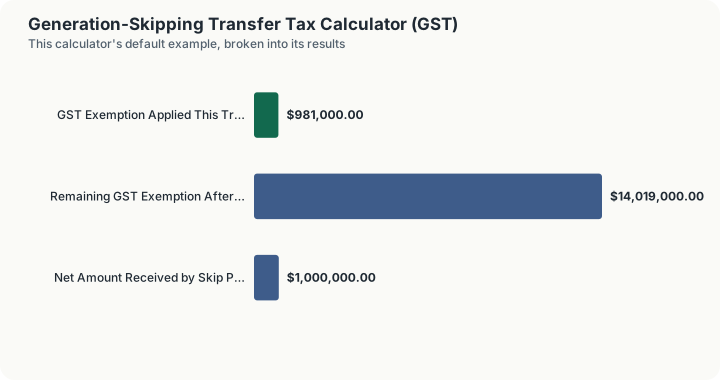
Take the baseline scenario: a $1,000,000 transfer to a single grandchild, with the transfer qualifying for the GST annual exclusion and no prior exemption used.
- GST annual exclusion: $19,000
- Taxable transfer before exemption: $1,000,000 − $19,000 = $981,000
- Remaining GST exemption before this transfer: $15,000,000
- Exemption applied: min($981,000, $15,000,000) = $981,000
- Remaining exemption after: $15,000,000 − $981,000 = $14,019,000
- Taxable GST transfer: $0
- GST tax due: $0
Now the "exemption exceeded" scenario: a $20,000,000 transfer to one grandchild, same qualifying status, no prior exemption used.
- Taxable transfer before exemption: $20,000,000 − $19,000 = $19,981,000
- Exemption applied: min($19,981,000, $15,000,000) = $15,000,000
- Taxable GST transfer: $19,981,000 − $15,000,000 = $4,981,000
- GST tax due: $4,981,000 × 40% = $1,992,400
And a non-qualifying trust transfer of $500,000, where the transferor already allocated $14,800,000 of GST exemption in prior years:
- GST annual exclusion: $0 (does not qualify)
- Taxable transfer before exemption: $500,000
- Remaining exemption before: $15,000,000 − $14,800,000 = $200,000
- Exemption applied: min($500,000, $200,000) = $200,000
- Taxable GST transfer: $500,000 − $200,000 = $300,000
- GST tax due: $300,000 × 40% = $120,000
What This Does Not Account For
- Direct skips versus taxable terminations and distributions. The GST tax code recognizes three different triggering events with different rules for who pays and when. This calculator models the direct-skip case, an outright gift or bequest straight to a skip person, and does not model the mechanics of taxable trust terminations or taxable distributions from a trust with mixed skip and non-skip beneficiaries.
- Predeceased-parent exception. If a child of the transferor has already died, that child's own children move up a generation for GST purposes and are no longer treated as skip persons. This calculator does not check family structure and assumes every recipient you describe is genuinely a skip person.
- Interaction with GST-exempt and GST-nonexempt trusts. Sophisticated estate plans often split trust funding into fully exempt and fully non-exempt shares to simplify future GST calculations. This calculator treats each transfer independently rather than tracking a trust's inclusion ratio over time.
- State-level generation-skipping taxes. A small number of states impose their own transfer taxes with different rules; this calculator only models the federal GST tax.
- Reverse QTIP elections and other advanced elections. Certain marital trust elections change who is treated as the transferor for GST purposes. This calculator assumes a single, straightforward transferor.
Common Pitfalls
- Assuming GST tax and estate tax are the same thing. GST tax is a separate, additional tax layered on top of any gift or estate tax that already applies to a transfer, not a substitute for it.
- Missing the GST annual exclusion's stricter qualification rules. Many people assume the GST annual exclusion works exactly like the regular gift tax annual exclusion. It does not. Trust transfers frequently fail to qualify even when they are under $19,000, because the trust structure does not meet §2642(c)(2)'s single-beneficiary, present-interest requirements.
- Forgetting to allocate GST exemption on Form 709 or Form 706. GST exemption is not automatic. A transferor generally must affirmatively allocate exemption to a transfer on a timely filed return, or risk having the transfer treated as fully taxable.
- Confusing "skip person" with "grandchild." A skip person is defined by generational distance, not literal family relationship. A much younger unrelated beneficiary, or a grandniece, can also qualify as a skip person.
- Ignoring the automatic allocation rules for direct skips. Certain direct-skip transfers automatically use GST exemption unless the transferor elects out, which can silently consume exemption a family intended to preserve.
Frequently Asked Questions
Who actually pays the GST tax?
Is the GST exemption really the same amount as the estate tax exemption?
Can a married couple combine their GST exemptions?
Does the GST tax apply to a transfer that already used up the regular gift tax exemption?
What is a "skip person" exactly?
Sources
- Internal Revenue Service, "IRS releases tax inflation adjustments for tax year 2026, including amendments from the One, Big, Beautiful Bill," Revenue Procedure 2025-32. irs.gov/newsroom/irs-releases-tax-inflation-adjustments-for-tax-year-2026-including-amendments-from-the-one-big-beautiful-bill
- Internal Revenue Code §2601-§2664 (Chapter 13, Generation-Skipping Transfer Tax), including §2631 (GST exemption), §2641 (applicable rate), and §2642(c) (GST annual exclusion). law.cornell.edu/uscode/text/26/2601
- Internal Revenue Service, Instructions for Form 706, Schedule R (Generation-Skipping Transfer Tax). irs.gov/forms-pubs/about-form-706
- Fidelity, "Generation Skipping Transfer Tax (GSTT) Explained." fidelity.com/viewpoints/wealth-management/insights/generation-skipping-transfer-tax