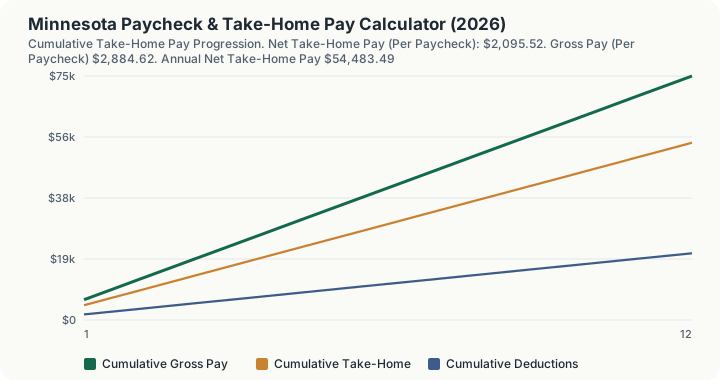
Quick Answer: A $75,000 annual salary in Minnesota, paid bi-weekly and filing single, takes home about $2,095.52 per paycheck ($54,483.49 per year) after federal tax, FICA, and Minnesota state withholding.
Four Brackets Reaching 9.85%
Minnesota's graduated income tax runs through four brackets, reaching a top marginal rate of 9.85%, among the higher ceilings in the country outside of California and Hawaii. The Minnesota Paycheck Calculator works through all four brackets alongside federal withholding and FICA to compute an exact net-pay figure.
Four brackets puts Minnesota's structure between the simplicity of a flat-tax state and the fine-grained systems used by states like Maryland or Hawaii, but the wide gap between the lowest and top rates means a raise that pushes income into a higher bracket can noticeably change a worker's state withholding.
How This Is Calculated
Minnesota's bottom bracket starts at 5.35%, higher than the flat rate in most flat-tax states, and the schedule climbs to 9.85%. Minnesota employees also now contribute to the state paid leave program through a separate payroll deduction that sits beside income tax on the stub. The income tax calculation is this subtraction:
Four passes over the annual salary produce net pay:
- FICA Payroll Tax Computation: - Social Security (OASDI): 6.20% withheld on wages up to the 2026 statutory wage base ($184,500). - Medicare (HI): 1.45% withheld on all gross earnings (no wage cap), plus 0.90% Additional Medicare Tax on earnings exceeding $200,000 (single) or $250,000 (married filing jointly).
- Federal Income Tax Withholding: Evaluated using 2026 progressive federal tax brackets (10%, 12%, 22%, 24%, 32%, 35%, 37%) after applying standard deduction thresholds ($16,100 single / $32,200 married joint).
- Minnesota State Income Tax Withholding: Run against the 2026 Minnesota schedule, four brackets from 5.35% up to 9.85%.
- Pay Period Proration: Annual net compensation is divided across the designated pay frequency (26 bi-weekly, 24 semi-monthly, 12 monthly, or 52 weekly pay periods).
Worked Example
Consider an employee in Minnesota earning $75,000 annually, paid bi-weekly (26 paychecks per year), filing single, with $3,500 in annual pre-tax 401(k) contributions.
- Gross pay per paycheck. $75,000 ÷ 26 pay periods = $2,884.62 before any withholding.
- Pre-tax deduction. The $3,500 annual 401(k) contribution reduces each paycheck by $134.62 and also shrinks the wages used to calculate federal and state income tax; FICA is still assessed on the full gross amount.
- FICA payroll taxes. Social Security withholds 6.2% of gross pay ($178.85) and Medicare withholds 1.45% ($41.83), for $220.67 per paycheck.
- Federal income tax withholding. Applying the 2026 IRS withholding tables to the reduced taxable wage withholds $265.38 per paycheck.
- Minnesota state tax withholding. Minnesota's withholding tables apply to the reduced taxable wage, withholding $168.42 per paycheck.
- Net take-home pay. $2,884.62 gross, minus $134.62 pre-tax, minus $220.67 FICA, minus $265.38 federal tax, minus $168.42 state tax leaves $2,095.52 per paycheck, equal to $54,483.49 per year, an effective total tax rate of 22.69%.
Minnesota Paid Leave Premiums (New for January 1, 2026)
If your Minnesota paycheck shrank in January 2026 without any change to your salary or your W-4, the most likely reason is the new Minnesota Paid Leave program (Minn. Stat. ch. 268B). Benefits begin in 2026, and premium withholding starts with wages paid on or after January 1, 2026.
- Premium rate: approximately 0.88% of taxable wages for the program's first year, as set by the Minnesota Department of Employment and Economic Development (DEED).
- Split: the premium is shared roughly half employee / half employer. An employer may deduct up to 50% of the premium (about 0.44% of wages) from the employee's paycheck and must pay the remainder itself. Employers with 30 or fewer employees may qualify for a reduced small-employer rate, and some employers pay the full premium voluntarily.
- Wage cap: premiums apply to wages up to the Social Security taxable wage base ($184,500 in 2026), the same cap used for the 6.2% OASDI tax.
- Practical effect: at a $75,000 salary, an employee-side share of roughly 0.44% is about $330 per year, or roughly $12.69 per bi-weekly paycheck.
This premium is not modeled by this calculator. Minnesota Paid Leave premium data is not in the engine's 2026 statutory tables, and the rate and split above are stated as the best-available published figures from DEED rather than as engine-verified values, confirm your own deduction against your pay stub and your employer's plan election. Subtract your employer's stated employee share from the take-home figure this page produces.
From Month Two To The Twelve-Month Total
Minnesota's entry bracket is 5.35%, the highest starting rate in the country, and twelve cumulative months make that opening rate impossible to ignore.
Step 7 -- Two months of cumulative pay. The schedule's first row shows $6,250.00 of cumulative gross against $4,540.29 of cumulative take-home. Row two doubles both: $12,500.00 gross, $9,080.58 take-home, with $3,419.42 accumulated on the deduction side.
Step 8 -- The full year. By month twelve the schedule reaches $75,000.00 of cumulative gross and $54,483.49 of cumulative take-home, adding $4,540.29 every month without variation.
Step 9 -- What the year actually withheld. The cumulative deduction column closes at $20,516.51. That column carries the $3,500 pre-tax 401(k) contribution alongside the tax, so tax alone is $20,516.51 - $3,500 = $17,016.51, an effective total tax rate of 22.69% on $75,000.00 of gross pay.
Step 10 -- Why the monthly increment never changes. Each month adds the same figure to every column. The engine settles FICA on the annual wage before it splits anything: Social Security applies to the first $184,500, and the additional 0.9% Medicare applies above $200,000 for a single filer. The annual result is then divided evenly by twelve. That means the familiar mid-year raise, the one that arrives when Social Security withholding stops, is not modeled here at any salary. At $75,000 it would not happen regardless.
$54,483.49 survives the year. Minnesota's floor rate means the state takes a meaningful cut of the very first dollar, which is why $17,016.51 is on the high side for this salary.
Pricing the Levers Against the Steepest State Line in This Batch
Minnesota withholds more state tax on this salary than any other state on this page's sibling calculators, and that shows up in every lever the sweep exposes.
The marginal cost of the next unit. Raising gross salary from $75,000 to $76,000 takes annual take-home from $54,483.49 to $55,118.99, so each additional $1,000 of Minnesota salary is worth $635.50 in the hand, the lowest retention in this batch. The $364.50 withheld is roughly 22 cents of federal income tax, 7.65 cents of FICA and about 6.8 cents of Minnesota tax per marginal dollar. At $100,000 the engine returns $70,370.99 of annual take-home at an effective total tax rate of 26.13%, against 22.69% at $75,000.
Pricing the pre-tax deferral. Raising the annual pre-tax contribution from $3,500 to $8,500 moves annual take-home from $54,483.49 to $50,923.49. Diverting $5,000 into the plan costs $3,560.00 of spendable pay, with $1,440.00 funded by withholding that no longer happens, an effective subsidy of 28.80%. That is the highest figure in this batch, and it follows directly from Minnesota having the highest marginal state rate on this wage: the more state tax there is, the more a deferral avoids.
Filing status reaches the Minnesota line, and the joint bands here are unusually wide. Switching to married filing jointly moves annual take-home from $54,483.49 to $57,386.65, a gain of $2,903.16, and the net paycheck from $2,095.52 to $2,207.18. Minnesota withholding falls from $168.42 to $159.84 per check, a saving of $8.58; federal withholding drops from $265.38 to $162.31 over the same switch and accounts for most of the annual gain. Minnesota's joint 6.80% band runs to $193,480 rather than $109,430, but a $71,500 taxable base clears the lower 5.35% edge under both schedules, at $33,310 single and $48,700 joint, so the joint saving at this income comes from the wider first band alone and widens considerably further up the scale.
Pay frequency changes the cheque, not the year. Moving from bi-weekly to monthly takes the headline from $2,095.52 to $4,540.29 while annual take-home stays at exactly $54,483.49.
What the Minnesota line does not subtract. The engine runs the reduced taxable wage through the state bracket schedule with no Minnesota standard deduction and no personal exemption, so $168.42 per paycheck is higher than a real Form W-4MN calculation would produce. The Paid Leave premiums described above are also outside this computation entirely: they are a separate payroll deduction and no output on this page includes them.
What This Does Not Account For
- Minnesota Paid Leave premiums (effective January 1, 2026). The employee share, roughly 0.44% of wages, about half of the approximate 0.88% total premium, is not deducted by this calculator. Your actual take-home pay will be lower than the figure shown by that amount.
- The Minnesota standard deduction. This calculator applies Minnesota's graduated brackets to your wages after pre-tax deductions but without subtracting Minnesota's own standard deduction, so the state withholding shown is overstated relative to a full-year Minnesota return. Actual Minnesota withholding computed from Form W-4MN and the Department of Revenue's withholding tables, and your eventual Minnesota return, will generally be lower.
- Minnesota-specific credits and subtractions (Working Family Credit, K-12 education credit, Social Security benefit subtraction).
- Local municipal, city, or county wage taxes where applicable.
- Post-tax wage garnishments (child support, tax levies, student loans).
- Voluntary post-tax deductions (Roth 401k, charitable giving, supplemental insurance).
Common Pitfalls
- Confusing Bi-Weekly with Semi-Monthly Pay: Bi-weekly pay results in 26 paychecks per year (two 3-paycheck months), whereas semi-monthly pay results in 24 equal paychecks.
- Failing to Update Form W-4: Inaccurate withholding allowances on Form W-4 can lead to substantial underpayment penalties or large unexpected tax bills.
- Forgetting Pre-Tax Deduction Benefits: Contributions to 401(k) and HSA accounts directly reduce taxable income, lowering both federal and state tax burdens.
- Overlooking Additional Medicare Tax: Failing to anticipate the 0.9% surtax on high-earning households with multiple income sources.
Frequently Asked Questions
Does Minnesota have a state income tax on paychecks?
How is overtime pay taxed in Minnesota?
What is the Social Security wage cap for 2026?
Why did my Minnesota paycheck get smaller in 2026?
Can I adjust my state tax withholding?
Sources
- Internal Revenue Service (IRS): Publication 15 (Circular E) and Publication 15-T (2026). irs.gov/publications/p15
- Social Security Administration (SSA): 2026 Social Security Wage Base Limit. ssa.gov
- Minnesota Department of Revenue: Employer Withholding Tax Tables (2026) and Form W-4MN, Minnesota Employee Withholding Allowance/Exemption Certificate. revenue.state.mn.us
Also consulted: Minnesota Department of Employment and Economic Development (DEED): Minnesota Paid Leave premium rate and employer/employee split for 2026 (Minn. Stat. ch. 268B). Not modeled in this calculator; rate stated as published public guidance.